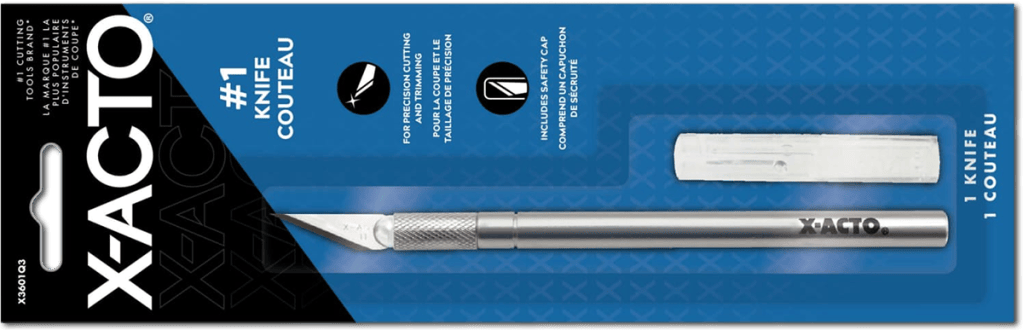
My undergraduate degree was in studio art, with a concentration in printmaking, and my favorite professor was the late great Garret Boone, or “Reverend Boone” as his students knew him (he was not ordained). I only had him officially for one class, Sculpture 101, but I worked with him on and off on various projects and grants for several years, and the better part of his teaching came from informal instruction which came in the form of anecdotes, pointers, and rules of thumb. I learned graphic design from Garret, which in those days was still done in paste-up, with acetate layers for each color ink and dry-transfer registration marks. In the pre-digital world of the late 80s, the most used tool for a designer was a #1 X-Acto knife, which could be hazardous if you weren’t careful. One day Garret chided me for leaving mine out loose and then he showed me an old draftsman’s trick: if you cut a Pink Pearl eraser in half, you can stick it over the blade of your knife and it will prevent bloody accidents.
Over the years, from grad school to freelancing to web design to museum work, I always kept my X-Acto knife and its eraser cap in my desk. Over time, I used it less and less, and it sat unused by my plastic Ames lettering guide, another relic from bygone analog days. Until a couple of weeks ago, that is, when I looked for the knife to cut some packing tape and I couldn’t find it. Eventually, I decided to purchase another via an online order. When it arrived, I was nonplussed to find that the new knife shipped with a plastic safety cap.
While it’s objectively a good thing that the knife has a bespoke safety cap, I couldn’t help but feel like something was being lost here. The wisdom of our ancestors—decades of designers, editors, and architects—was in that eraser. And even if I’m the only living soul who remembers this stuff, it’s still a loss.
I suppose in one sense this kind of thing is the inevitable result of getting older, but I can’t help but feel that I am particularly prone to the vagaries of obsolescence. In high school my dad owned an enormous (but allegedly portable) KayPro computer that ran CP/M; within a few years MS-DOS was the only game in town. When I was an undergraduate I thought to double major in computer science and I took a lot of programming classes. We were taught to program in Pascal using a VAX/VMS system, which would in only a few years’ time be completely eclipsed by C++ and Unix. In the early 90s I interned at the Museum of Fine Arts, Boston, which was one of the last organizations using the Wang operating system. So by my mid-twenties my head was full of a bunch of computing skills that would never, ever, be usable by anyone again.
In the late 90’s, web design became a career one could have; I had spent a few years trying to freelance as an illustrator and print designer, and I jumped at the chance to do something that made use of both the art and programming halves of my brain. In those heady days of the early World Wide Web (and everyone called it that then) there were no certification programs to become a webmaster (another term lost to the ages) and you learned everything in the gutter: you looked at page sources, you traded pointers on Usenet, you got your markup lambasted by the developers downstairs (thanks, John Siracusa1). HTML was not made for elaborate layouts and so everyone cheated by breaking it, using tables to position images and text, exploiting things like cell borders to create bevels, and generally making Tim Berners-Lee cry. In those days, every browser had its own quirks, Internet Explorer displayed box models all wrong, and PCs and Macs had different color palettes, all of which required some wild-west style wrangling of code. The techniques we used are etched in my mind—but are now rendered completely useless by content management systems like the WordPress that runs this blog.
But time marches on, right? New ways supplant the old, and for the most part it’s a positive thing. It may seem a bit solipsistic for me to bemoan the irrelevance of my skills in a world where most people look over their shoulders to see the ever-approaching wave of AI coming to rob them of their livelihoods. But as the years go on, I find that what I miss is not necessarily the old ways of doing things, but the hacks, the tricks, the rules of thumb that encapsulated a generation’s worth of know-how. These trade secrets secured your place in a community and a tradition. Plus, they were pretty neat.
Now if you’ll excuse me, I have a safety cap to lose.
John worked at the same dot-com as I before he became a net celebrity. Small world. ↩︎
My high school girlfriend was named Angie, and she had a great singing voice. I mean, I assume she still does; the last I heard she was a high school choral teacher. Anyway, I remember that I used to bug her (what a great boyfriend I was) by serenading the Rolling Stones’ “Angie” to her. I didn’t actually perform the whole song; I would just do my best Mick Jagger impression while singing the bit with the title name: “AHN jay… Ah-AHHHHHN jay…“
Angie was not a fan of this. Firstly, because she didn’t particularly like the Stones; secondly, because she did not know the song; and thirdly, when she looked up the lyrics she found them to be sad. She threatened to sing me a song with my name in it, but quickly ran into the problem that in spite of it being the most bog-standard male name in English, there are no memorable songs about “John,” which has always struck me as unfair. Think of all single-name songs out there, and you can probably come up with a dozen for women’s names: “Laura,” “Beth,” “Alison,” “Brandy,” “Peg,” “Jolene,” “Lola,” “Mandy,” “Windy,” and even “Tangerine,” although I was never clear if that were actually the song subject’s name or some sort of citrus-based metaphor.
I was recalling this memory the other day and wondering why some things get all the songs and some things don’t. And this brings me to the actual topic of this essay: What is it about September? Why does this month get all the songs? I mean it, how many songs can you list that are about other months? Without Googling, I can only think of two: “June is Bustin’ Out All Over” and “November Rain.”1
I guess the primary appeal to songwriters is that “September” rhymes with “remember” and so it’s easy to hack out some schmaltzy lyrics. But beyond this, September is a liminal month, hovering between summer and fall, a month of change, both the start of the harvest and the sad anticipation of the frost to come. Metonymically, it represents looking back from the vantage of middle age, for the end of youthful possibilities, and the sober realization of one’s mortality. Which is why it’s my favorite month! Let’s look at some September songs.
“September in the Rain” (1937) Music by Harry Warren, Lyrics by Al Dubin
Our first example chronologically, “September in the Rain,” was written for the 1937 cinematic musical Melody for Two. In the movie it’s sung by tenor James Melton, who was a box office draw in the 20s and 30s, but mostly forgotten today, as is the film, which I have never seen myself so I can’t summarize it here. (From the clip available on YouTube, the song doesn’t seem to be thematically related to the movie anyway.)
If they are aware of it at all, most people my age know the song through its many, many uses by Carl Stalling in his soundtracks for Looney Tunes cartoons. While these musical quotations generally took the form of brief instrumental snippets in the background, sadly there were also in many segments portraying caricatured versions of Al Jolson crooning the song in blackface2. While most of these shorts are (thankfully) out of circulation, there were examples—such as a rooster in the cartoon “Swooner Crooner” (1944)—of animal characters imitating Jolson’s performing style, and these were confusing to all of us who were born after the Kennedy administration.
“September in the Rain’s” lyrics are pretty fluffy. September is depicted as a month of love, a perfect moment in time, even when raining. In its second verse we learn that it’s actually spring, at least in time of the song, but for the singer, it’s always fall. In its original form, “September in the Rain” is pleasant enough, but the song’s real longevity comes from its having become a jazz standard. In 1961 Dinah Washington recorded what is probably the best-remembered version:
“September Song” (1938) Music by Kurt Weill, lyrics by Maxwell Anderson
Kurt Weill had a strange career trajectory. In his native Germany he was known primarily for his collaborations with playwright Berthold Brecht, and their best known musical was The Threepenny Opera (Die Dreigroschenoper) (1928), a bleakly humorous socialist critique of capitalism. Once he fled Nazi Germany in 1933, he composed music for the American theater, writing for librettos that were decidedly apolitical and audiences that were pretty bougie. However, his music was just as inventive, experimental, and weirdly beautiful as ever, and “September Song” is probably his best song, and one of the greatest of the 20th century.
Weill milks every ounce of pathos out of Maxwell Anderson’s sentimental lyrics3 with a melody that is both off-kilter and heartbreaking. It’s remarkable that a composition that’s full of crazy melodic intervals and non-diatonic harmonies has become such a standard, with covers by everyone from Frank Sinatra to Ian McCulloch of Echo & the Bunnymen.
“See You in September” (1959) Music and lyrics by Sid Wayne and Sherman Edwards
Unlike most of the other songs in this list, “See You in September” isn’t about experiencing its titular month, but about anticipating it. Specifically, it’s about being parted from your loved one over summer vacation, which is a particularly teenaged concern, especially when compared to “September Song.” Although it was first recorded by obscure Pittsburgh-based group the Tempos, it is the 1966 version by the Happenings that is remembered today.
While this is music for teenagers, kids were the ones buying all the records at the time. Released only a year later, 1960’s “Sealed with a Kiss” is pretty much equivalent lyrically, to the extent that before I researched this article I remembered them being the same song.
“Try to Remember” (1960) Music by Harvey Schmidt, lyrics by Tom Jones
As I have mentioned before, my parents’ record collection had a lot of musical soundtracks, and so I grew up singing the songs of Camelot, Man of La Mancha, and Little Mary Sunshine. But my favorite were the songs from The Fantasticks, the longest-running off-Broadway musical ever. The conceit of The Fantasticks was to take the minimalist set from Our Town and combine it with the plot of the Pyramus and Thisbe bit from A Midsummer Night’s Dream, and then write some songs with dodgy lyrics that will age poorly. But the title song is still okay, and has become a standard for vocalists, and if it’s not exactly in the Great American Songbook it’s definitely adjacent.
I mentioned earlier that one of the attractive points about “September” is the way it rhymes with “remember,” and boy howdy do Tom Jones’s lyrics lean heavily on this fact. “Try to Remember” is the song that both opens and closes the musical and as such it’s a doorway into its simple, fabular world with its theme of naïve love and initiation into adulthood.
“The September of My Years” (1965) Music by Jimmy Van Heusen, lyrics by Sammy Cahn
Like songs about September? How about an entire album of songs themed on the month? Frank Sinatra’s 1965 album The September of My Years is an extended rumination on getting old and taking stock of one’s life, and in addition to the title song contains Sinatra’s maudlin anthem “It Was a Very Good Year,” along with a cover of the wistful “Once Upon a Time” and even his aforementioned cover of “September Song.” Even the lesser-known tracks are about the passage of time, lost youth, and regret: in “Don’t Wait too Long” Sinatra admonishes “You are the summer and I am the autumn […] Your song’s beginning while mine’s nearly sung.” Clearly Old Blue Eyes was going through something, although he was only 50 at the time. I mean, I’m 58 but do you see me crying about it?
“September of My Years” is a lugubrious and amorphous track, even by Sinatra’s standards. Almost half of its running time is taken up by its introductory section, which in the parlance of jazz singing is confusingly called the “verse,” and the lack of repetition of the chorus makes this all feel like an art song. It’s really a song that requires a rainy afternoon and a double of bourbon to fully experience.
“September” (1978) Music by Al McKay, lyrics by Allee Willis and Maurice White
Jumping from that downer, here’s the exact opposite—one of the most joyful, funkiest, and soulful songs to come out of the funk/soul years of the 1970’s. Earth, Wind & Fire are particularly know for their sweeping use of horns and backing vocals, and “September” has those in abundance. Written at the height of the disco craze, the arrangement combines a four-on-the-floor beat and session-musician strings with funk guitar riffs and juicy brass runs.
Thematically, the song’s connection to the actual month of September is less universal. Marilyn White has said that the 21st of September was the due date for her and co-lyricist Maurice White’s child. But in the odd way of such things, specific and personal subjects can become universal, as with the final song on this list.
“Wake Me Up When September Ends” (2004) Music by Green Day, lyrics by Billie Joe Armstrong
American Idiot (2004) was Green Day’s most ambitious project to date in terms of its mature and cohesive themes and its formal variety, which is either a good thing or a bad thing, depending on whether or not you prefer your pop punk to be loud and dumb. I myself love song suites, and the album has two, which makes it alright by me. Many songs on the album deal with disillusionment, alienation, and loss. Lyrically, “Wake Me Up When September Ends” is about singer Billie Joe Armstrong’s loss of his father in September of 1982 when Armstrong was 10; and as is often the way with the poetics of trauma, the words used are abstract and opaque.
The song was released as a single nearly eight months after the album—younger readers of this essay might not recall a time when record companies slowly dosed single releases over many months to string along sales. But its reemergence in the summer of 2005 was tragically fortuitous when the song became linked in the public imagination with the aftermath of Hurricane Katrina, which hit the Gulf Coast in August of that year. (The way this happened was chronicled by NYT writer Sarah Boxer.)
So anyway, that’s my list. There probably are more September songs out there of which I’m unaware, but this is enough for one blog post. To summarize, “September” rhymes with “remember.” Also, I’m sure you will all agree that it’s time for songwriters to give other months a shot. And if you know of any “John” songs, let me know. Perhaps my wife can tease me with them now.
Strangely enough, I cannot find any references to Jolson actually singing this song in a movie or recording. Was he known for singing this, or was it an invention of the cartoons? ↩︎
The song’s original lyrics were much more specific to the plot of the musical and more wryly comedic. Once lifted from the musical to be a stand-alone song, passages were rewritten to be more universal. ↩︎
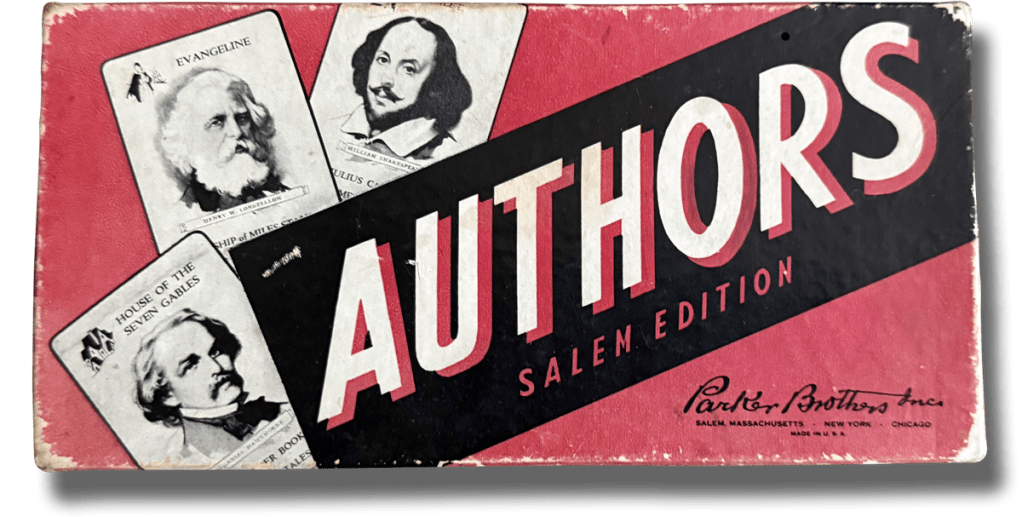
Some years ago—never mind how long precisely—I was on a vacation with my family, and—having little or no money in my purse—our recreation consisted of day trips to corners of New England that were unfamiliar to us, but close enough to not require a hotel. On the drive back from one of these we stopped in at a roadside second-hand store, and it was here that I purchased, for the princely sum of seven dollars, a 1943 edition of the card game Authors.
My copy of the “Salem Edition” of Authors
Authors had been a favorite game of my youth for a few years around 1975. If you are unfamiliar with the game, it’s basically Go Fish with a literary coat of paint. As in Go Fish, players attempt to make melds of four by asking opponents if they hold missing cards of the set they are collecting—but instead of collecting cards of the same rank, one collects cards bearing the titles of works by an author—e.g. for the Shakespeare set, you would need cards for Hamlet, Romeo and Juliet, Julius Caesar, and The Tempest. Thus, by familiarizing players with the works of Twain, Stevenson, Hawthorne, and Alcott, the game had a veneer of culture and respectability, which was probably a plus in the eyes of my mother, whose own parents forbade playing cards in the home, as these tools of the devil led inevitably to gambling.
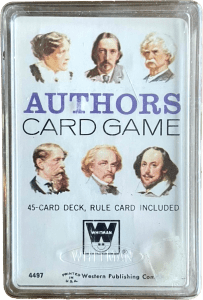
Not my copy, but the 1960’s–70’s edition of Authors from my childhood
I was charmed to see that the 1943 cards had the same design as those from the 1970’s. Most legacy games go through major re-designs every decade or so; look at all the various editions of Clue, for example. However, the illustrations from my Parker Brothers set (1943) were not only included in the Whitman edition (first published in 19511 and in various editions through the 70’s), but also by a later edition published by U.S. Games Systems (1986) with the last version using these designs (at lest, the last I could find) printed in 1996.
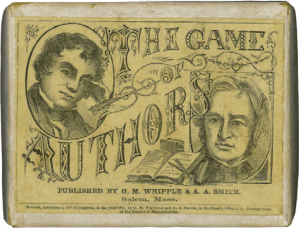
First edition (probably), Whipple & Smith, 1861
This isn’t to say that these were the original set of illustrations, or even the original selection of authors. The first version of Authors was published in 1861 by the Salem, MA company of Whipple & Smith, and its cover featured American short story writer Washington Irving and (checks notes), um, British poet Thomas Macaulay?
If you search for the creator of Authors you may find a credit for Annie W. Abbott and a date of 1843, fully 18 years before the game was first published. This confusing chronology is because Ms. Abbott created a card game called Dr Busby which had almost exactly the same play as Authors, except instead of collecting sets of four books, players collected cards representing members of four fictional families. Stewart Culin, writing in The Journal of American Folklore in the July–September, 1893 issue, claimed that Dr. Busby was retooled into Authors by an unnamed Salem man2; I have also read the claim that Abbott herself was responsible for the new game. But whomever was responsible, both Authors and Dr Busby are based on Go Fish, whose origins are murky, but which may have come from ultimately from the Italian game Andare e piscere in the 15th Century.
It’s everyone’s favorite game, Dr. Busby
Wherever and whenever Authors came from, other publishers soon began to publish their version of the game, with differing selections of authors in a variety of formats. In my earlier essay about Parker Brothers’ game design in the 1970s, I referenced Philip Urbanes’s 2004 book The game makers: the story of Parker Brothers from Tiddledy Winks to Trivial Pursuit, which I thought might fill in some details for this essay. Unfortunately, Urbane discusses Parker Brothers’ initial publication of Authors only in passing, noting that around 1870 to 1890, the company began publishing existing games that they did not originate; Authors was one of these (copyright wasn’t the same back in those days).
Parker Brothers was headquartered in Salem, MA, the same as Whipple & Smith and (as mentioned) where Authors was originally conceived; some combination of these facts no doubt led to naming the 1943 version of the game the “Salem Edition.” Parker Brothers distinguished its versions from the competition with high-quality illustration and state-of-the-art reproduction, and sold several versions at the same time, with names like “the Nickel Edition,” and “the Petite Edition De Luxe.” Even the game’s title varied on the cover of different editions, from The Game of Authors, to Great Authors, to Household Authors, which is my favorite because it implies that every good home should have a stock of writers3.
Early Parker Brothers’ editions, c. 1870, c. 1893, 1897, 1910
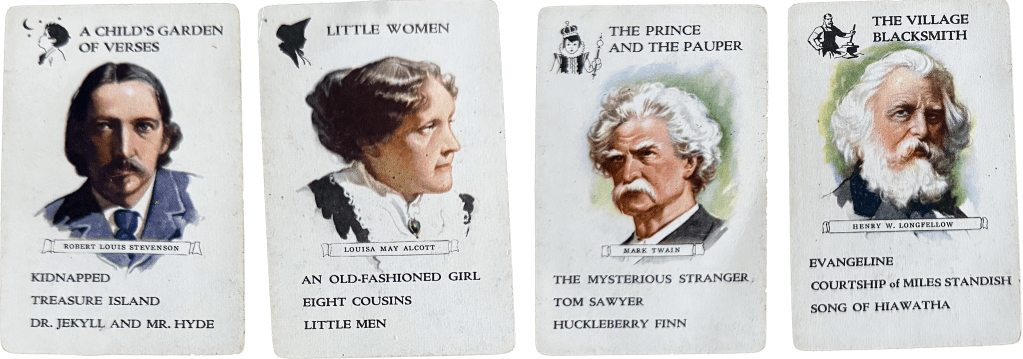
The Salem Edition (my edition) seems to have been the first to use the familiar illustrations, which are unfortunately unattributed. Unless somewhere there are archives still extant that contain correspondence or billing from the 1940’s, the artist has been lost to time. However, they appear to be the work of one hand, or perhaps a few artists working under close direction. Even though they are remarkably of a piece with one another, there are some odd variations to note. While all seem to have been painted in watercolor over an underdrawing, some are noticeably darker, such as the Robert Louis Stevenson portrait, which has heavy shadows painted with opaque colors, possibly using gouache.
Some of the portraits
The level of detail varies, probably owing to the source material being copied; this material would have included photos and engravings of the authors, as well as earlier versions of the game. About half have a highly painterly background of washes in blue, green, and yellow; the others are presented on flat white. And one portrait, that of John Greenleaf Whittier, has an entirely different ground treatment which almost resembles airbrush.
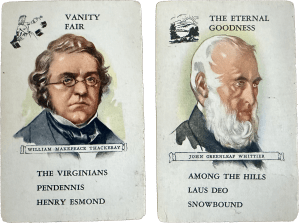
Thackery and Whittier portraits
Wait, John Greenleaf who now? This edition contains two authors that were cut from the deck when the designs transferred to Whitman publishing: William Makepeace Thackery and John Greenleaf Whittier. The English Victorian Thackery is still read today, primarily for his novels Vanity Fair and Barry Lyndon. The American Quaker abolitionist Whittier, however, is not a name you will know unless you study 19th Century American literature, and then only as an example of a poet who was popular in his lifetime, only to fall into obscurity when his earnest, moralizing style failed to resonate with 20th century tastes. It’s not surprising that editions of Authors reflect the forever evolving literary canon. The Rare Book School at the University of Virginia had an exhibition of Authors cards in 2025 that focused specifically on the writers who have come and gone through many, many versions over the last 150+ years.
The novelists, playwrights, and poets selected for the 1943 portraits are mostly Victorian, with the most recent work referenced being Mark Twain’s The Mysterious Stranger (1916)4. Looking over the assortment of writers, it’s impossible not to note that they are all American or British, white, and—save for the exception of Louisa May Alcott—male. Aside from this chauvinism, it’s also interesting that for a game published in 1943 there were no Modernist authors—this was the era of Hemingway, Faulkner, Edna St. Vincent Millay, Fitzgerald, Eliot, etc. Probably the choice was in part set by earlier versions of the game. And perhaps there was an editorial decision to avoid living writers. Whatever the criteria, the game’s roster of authors is stodgy, academic, and leans heavily on sentimental and Romantic writers.
All of this was lost on me as a child when I played the game. I assumed that the authors selected were, in fact, the greatest and most important names in literary history, and for many years I kept the titles on the cards tucked away in my memory. This was my first brush with the idea of a canon, and I found it appealing because it implied that great books were finite and that it would be possible to read them all, and then I guess I thought you would be done. These days I’m less inclined to think this way, although I do have a podcast about the subject.
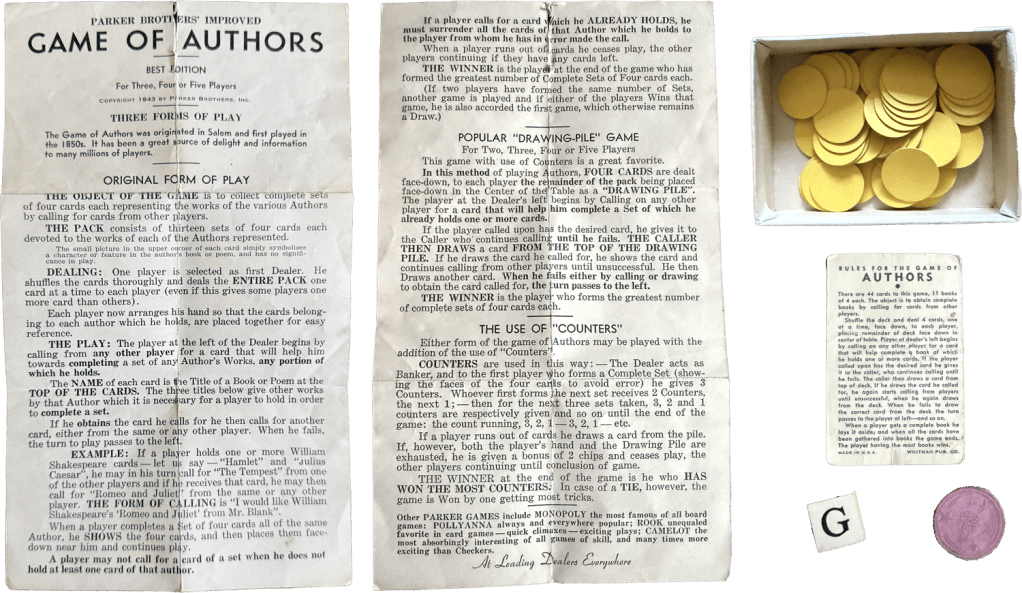
My copy of the 1943 edition has a few interesting features. It has it original rule sheet, beautifully block printed in a variety of typefaces, including a midcentury geometric sans-serif font that closely resembles Futura. This sheet calls the game “PARKER BROTHERS’ IMPROVED GAME OF AUTHORS” and declares that it is the “BEST EDITION.” My favorite passage of these rules comes at the end, where it lists “other PARKER GAMES” which include Monopoly, Rook, and Camelot, which is noted as: “the most absorbingly interesting of all games of skill, and many times more exciting than Checkers.” I have no idea what the game of Camelot is, but I chose to believe the claims made on its behalf, and I won’t Google to learn otherwise.
The game box also contains a shallow tray of yellow cardboard discs that the rules calls “counters” (with quotation marks). These are to be awarded for each meld a player makes, but with the twist that first three are given, then two, then one, and then back to three, etc. This mechanic seems so tacked-on that my assumption is the discs were cast offs from holes punched in another game that some office manager decided to repurpose. Also in amongst the cards there is a rule card from a later Whitman edition of the game, which is (oddly) far more worn than any of the portraits.
Right, Center: the original rules sheet, front and back; Left top: the “counters”; Left bottom: what are these doing here?
Finally, my copy of Authors also contains both a faded lavender wooden checker and a Scrabble tile of the letter G. These were left mysteriously by its previous owner, and one can only imagine how each contributed to any house rules.
How and why the designs transferred to Whitman is a mystery to me. I know Whitman primarily as a children’s book publisher, particularly for its licensed works featuring Disney characters. ↩︎
If you are even more fixated on this subject than I am, there is an exhaustive 476-page catalog of every known edition of Authors and ancillary games: The Game of Authors Compendium Stuart R. Kaplan and William G. Miller (2021). ↩︎
This is a peculiar choice. In his final years, Twain wrote several divergent drafts of The Mysterious Stranger, perhaps his most bleak and existential writing ever. The eventual posthumous publication in 1916 was cobbled together with parts rewritten by Twain biographer Albert Bigelow Paine. Contemporary scholars do not ascribe this edition (the one referenced in Authors) to Mr. Clemens. ↩︎