Games without frontiers

My parents were (and remain) staunchly liberal, but for people who lived their twenties through the eras of beatniks and hippies they were (and remain) pretty square. In the 70s my dad had sideburns and a mustache and smoked a pipe; my mom had a bob cut and wore knee-length skirts. Their record collection consisted of mostly classical and musical theater albums with probably the most scandalous disc being a copy of Herbie Mann’s Push Push1. It’s a wonder, then, that my childhood was filled to the brim with subversive boardgames. By this I mean games designed to promote skepticism, free thinking, and in some cases, out and out Marxism. This essay focuses on the eggheaded, leftist games of my youth.

WFF ‘n Proof (1962)

WFF 'n Proof

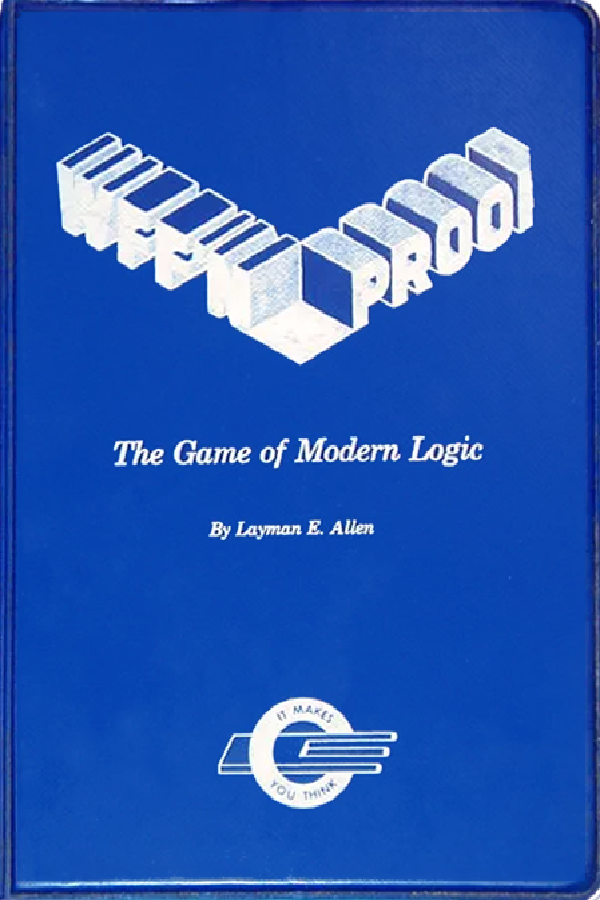
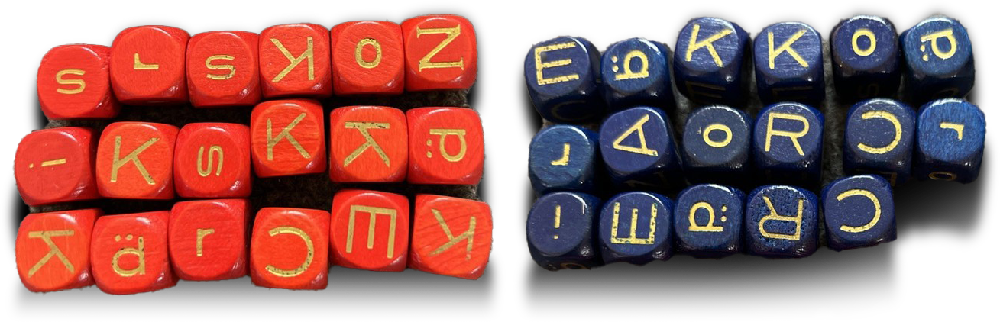
I believe my Dad acquired his copy of WFF ‘n Proof in college. In any case, this strange dice game was kicking around the house as far back as I can remember, and as long as I can remember I was trying, and failing, to learn how to play. WFF ‘n Proof is a game where players roll a handful of odd wooden dice whose sides were (mostly) Roman letters. Then they attempt, using propositional calculus, to arrange the dice into a string of atoms and connectors to produce valid statements, or what the game maker Layman E. Allen referred to as “well-formed-formulas (WFFs).” Just for fun, instead of the standard system of symbolic logic, this game uses “Polish notation,” a system of expression developed by logician Jan Łukasiewicz in which the operator is placed before its operands. Did I mention I tried to learn this game when I was seven?

This game did not strike me as particularly odd as a child. My parents were the type to let their kids play with adult things (if they weren’t dangerous or inappropriate) and let us work out what we could. Besides, my dad was a professor of theology and philosophy and occasionally taught symbolic logic, and he had an old copy of Stephen Barker’s The Elements of Logic (1965) that he gave me and my brother to read. So, proof that autism is hereditary!

dice
The WFF ‘n Proof dice, as inscrutable now as ever

I may never have learned to play WFF ‘n Proof, but I was in love with its odd presentation. The game came (in its original edition) in a plastic wallet with foam rubber housing for the dice, a thick rulebook that was more like a short novel, and a tiny hourglass for timing moves. Whatever happened to these tiny hourglasses? They used to have one in every game. As an adult, I once bought a copy of this game off eBay, only to find that foam rubber does not age well over the decades (to see what I mean, Google “original Yoda puppet”).

As niche as the game is, it is still in print today.

The Propaganda Game (1970)

Propoganda

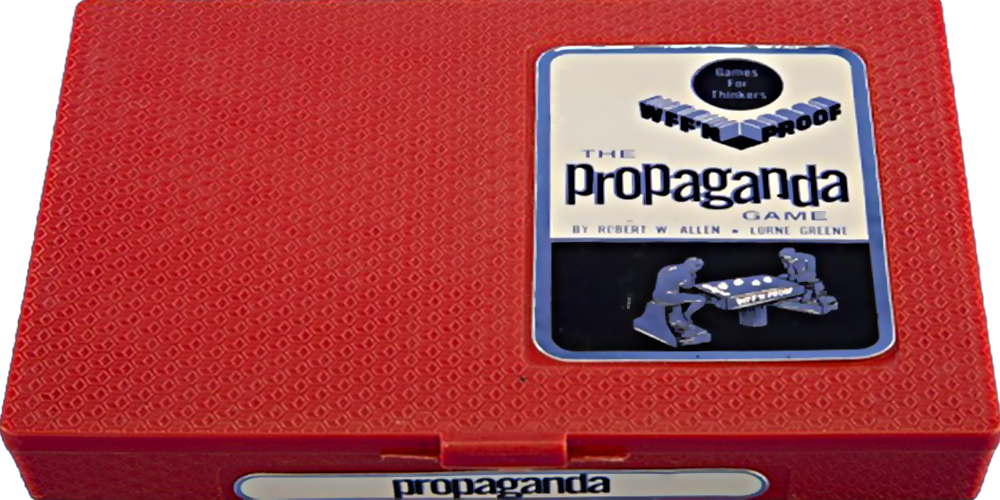
The WFF ‘n Proof company (which billed itself as “games for thinkers”) also produced other games. One, which my family also owned, was The Propaganda Game, and it was here that my education as a skeptic began. This game was also developed by Layman E. Allen, but also credited Lorne Greene, Commander Adama himself2. In a statement on the box, Mr. Greene outlines the game’s purpose:

In a democratic society such as ours, it is the role of every citizen to make decisions after evaluating many ideas. It is especially important then that a citizen be able to analyze and distinguish between the emotional aura surrounding the idea and the actual content of the idea. It is to this goal of clear thinking that THE PROPAGANDA GAME addresses itself.

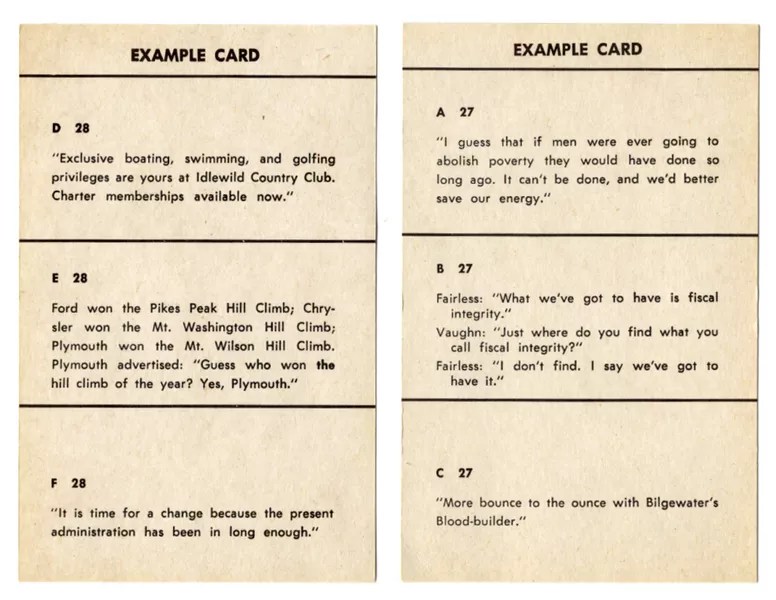
In contrast to WFF ‘n Proof, The Propaganda Game‘s rules are very simple. A set of cards are printed with a series of short arguments or appeals to the reader, and the players have to identify what kind of propaganda is being employed. If they get it right, they slide their tiddley-wink marker up the score sheet; if they get it wrong, they go back a rank.

The game is subdivided into various propaganda categories, such as “Techniques of Self-Deception,” “Techniques of Language,” “Techniques of Exploitation,” etc. Within each category, there are eight to ten techniques to identify, such as “Prejudice,” “Academic Detachment,” “Drawing the Line,” “Not Drawing the Line,” “Wishful Thinking,” “Tabloid Thinking,” and my favorite, “Causal Oversimplification,” which I believe is 85% of discourse online (the other 15% is straight-and-out lying). These categories and their techniques were first proposed in the book Thinking Straighter by George Henry Moulds (1966).

Cards
Some of the statements to evaluate. Can you spot the propaganda techniques used?

As you might imagine, a lot of this is subjective, and even as a child I found myself yelling back at Allan and Greene: “That’s not Drawing the Line! That’s just being clear!” Apparently I am not alone in my complaints, as tournament rules for this game use an amended guide, available online.

Clear thinking chart

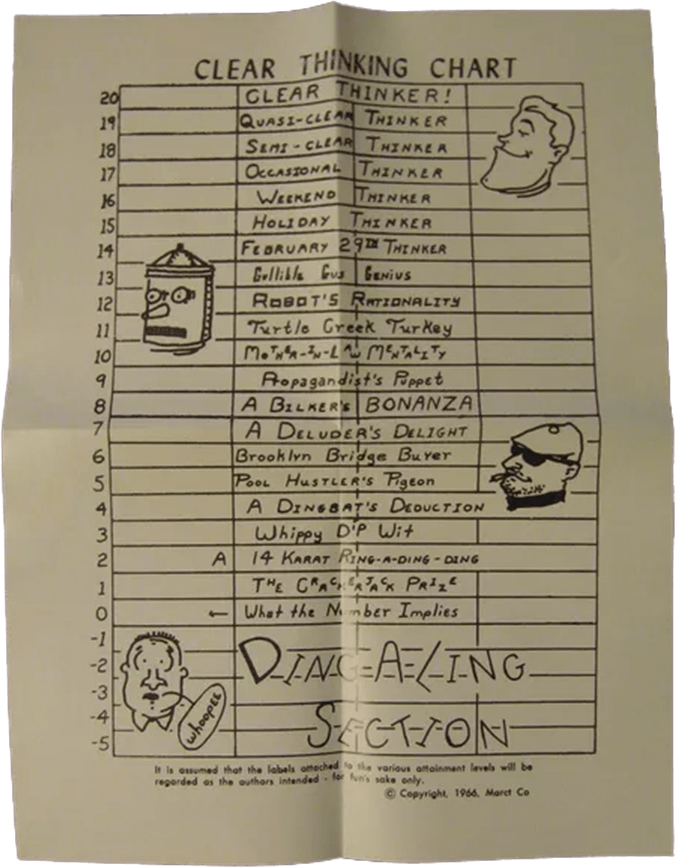
The most amusing aspect of the game is the “Clear thinking chart” used to keep score. Each rank has an unflattering name that corresponds to how easily propagandized the player is, such as “Brooklyn Bridge Buyer” or “Bilker’s Bonanza.” If you are unlucky enough to slide into negative numbers you end up in the “Ding-a-ling section.” It was a different time. There was also an interesting mechanic for games of three or more players where each voted on the correct technique, so the game not only introduced participants to propaganda but also to the Asch Conformity Test.

Lie, Cheat & Steal (1971)

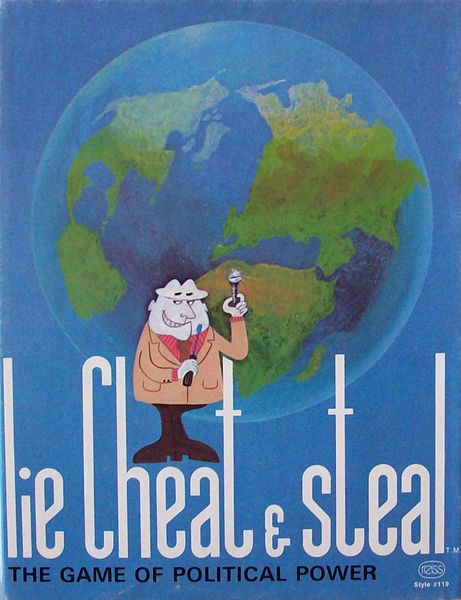
I remember when my parents purchased this game (at my brother’s and my behest). It was at Straus’s, which was the frou-frou department store that once was the pride of Youngstown, Ohio. In those days before being destroyed by malls and big boxes, department stores often carried unusual games, toys, and other novelties, and that included the output of tiny producers. Lie, Cheat & Steal was published by now long-defunct Reiss Games, whose output mostly consisted of abstract strategy and party games, although they also apparently made a board game based on the 70’s scandalous paperback The Happy Hooker. Lie, Cheat & Steal (herein, LC&S) was a highly jaundiced game about political campaigning, as described on the box bottom:

LIE, CHEAT & STEAL is the game of unscrupulous politics. You and one to five of your shifty friends can get in on the dirty-dealing, back-stabbing and thinly disguised thievery that make up the real political world.

You buy and sell votes, steal from the Public Treasury, and libel the other players to get ahead. The Senate may investigate you. You may even go bankrupt. But don’t give up! LIE, CHEAT & STEAL gives you plenty of opportunity to come back and win.

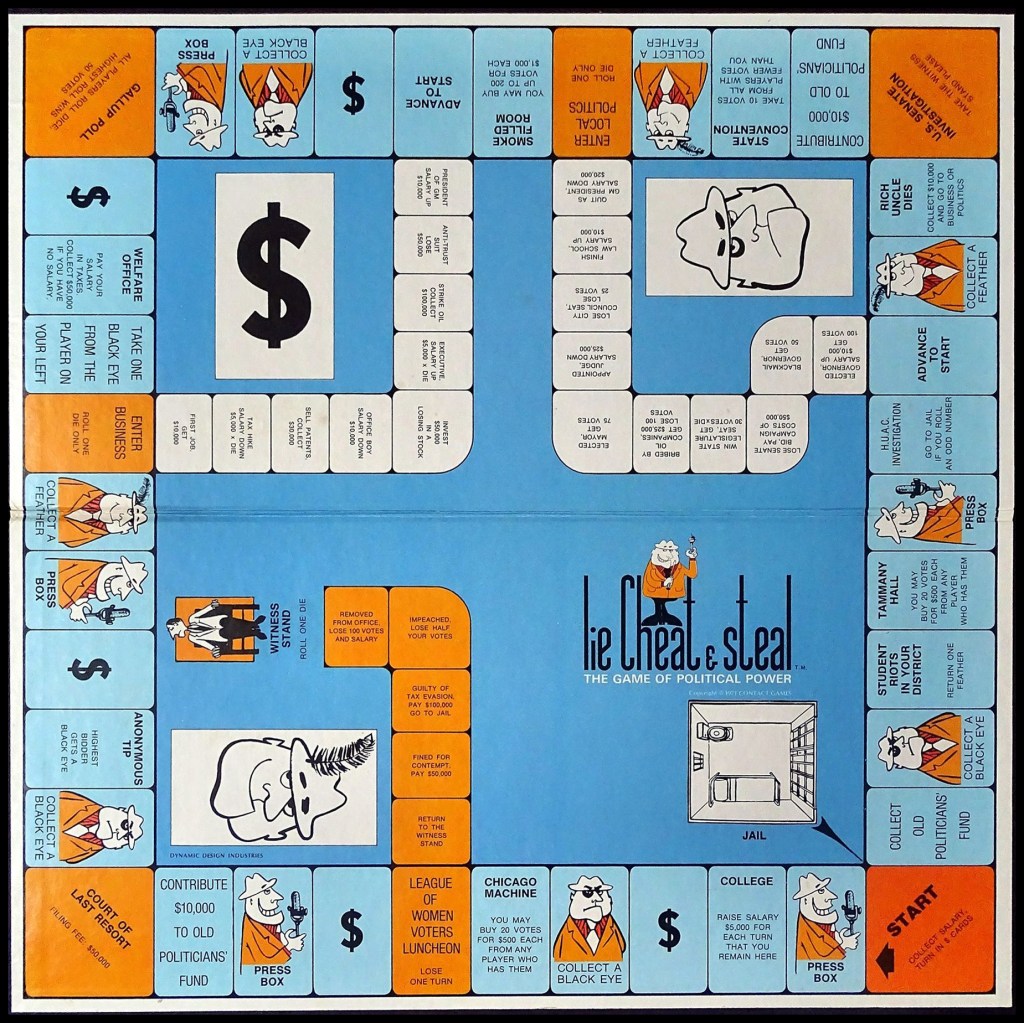
LC&S actually pre-dates Watergate, but it does reflect the era’s cynical views about corruption and money influence. Modeled somewhat obviously after Monopoly, the players roll dice to move clockwise around the board, acquiring money in unscrupulous ways to eventually buy votes. Along the way you land on spaces with names like “Tammany Hall,” “Chicago Machine” and “League of Women Voters Luncheon.” In the course of the game you might become the subject of a Senate investigation and have to take the witness stand. You collect “feathers in your cap” or “black eyes.” Neither my brother or I understood the meaning of any of this other than the “Jail” space, but we did ask our mom a lot of questions, and she did her best to explain the machinations of American Politics.

The LC&S board. I thought the guy in these pictures looked like a character in an Inspector Clouseau cartoon.

LC&S was probably the most playable amongst the games I describe in this essay, but that’s not to say it was all that fun. Like Monopoly, it ran long, and by the end I was happy when anyone would win, so it would be over. As far as politics went, I was already pretty cynical and needed no board game to disillusion men.

Class Struggle (1978)

Class Struggle

I have no idea where my dad got this game, but I suspect he sought it out because of its press coverage. The bottom of the box (I think it was the second printing of the game) enumerates its infamy:

FIRST book about capitalism to come packaged in a game box… FIRST game to be written up in a NEW YORK TIMES editorial … FIRST game ever to be played on the radio (for two hours on WBAI) … FIRST game ever to be sold by Scribner’s, 8th Street Bookshop and Salter’s Bookstore, three of New York’s most famous bookstores FIRST full-scale board game to present the side of the workers. FIRST board game ever to be sold in both Toy and Stationery Departments in Bloomingdale’s .. FIRST game ever to be sold out in one week in
Bookmasters, N.Y.C. …

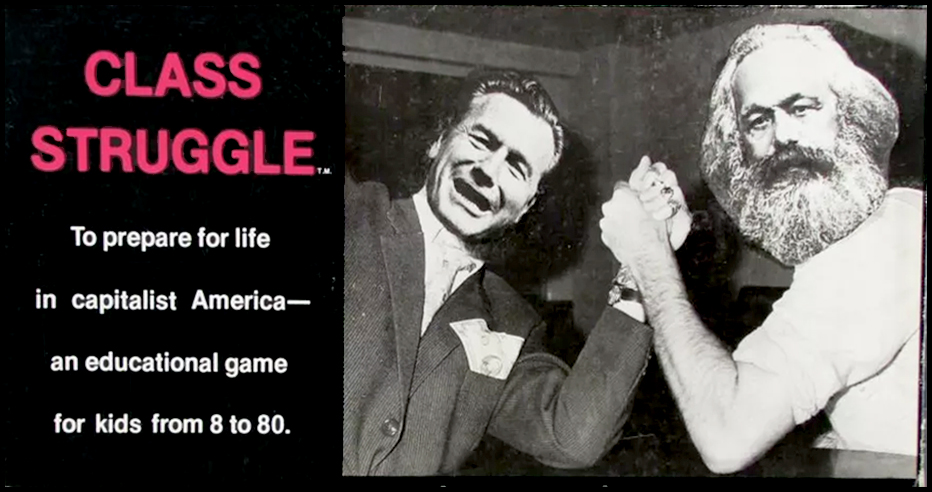
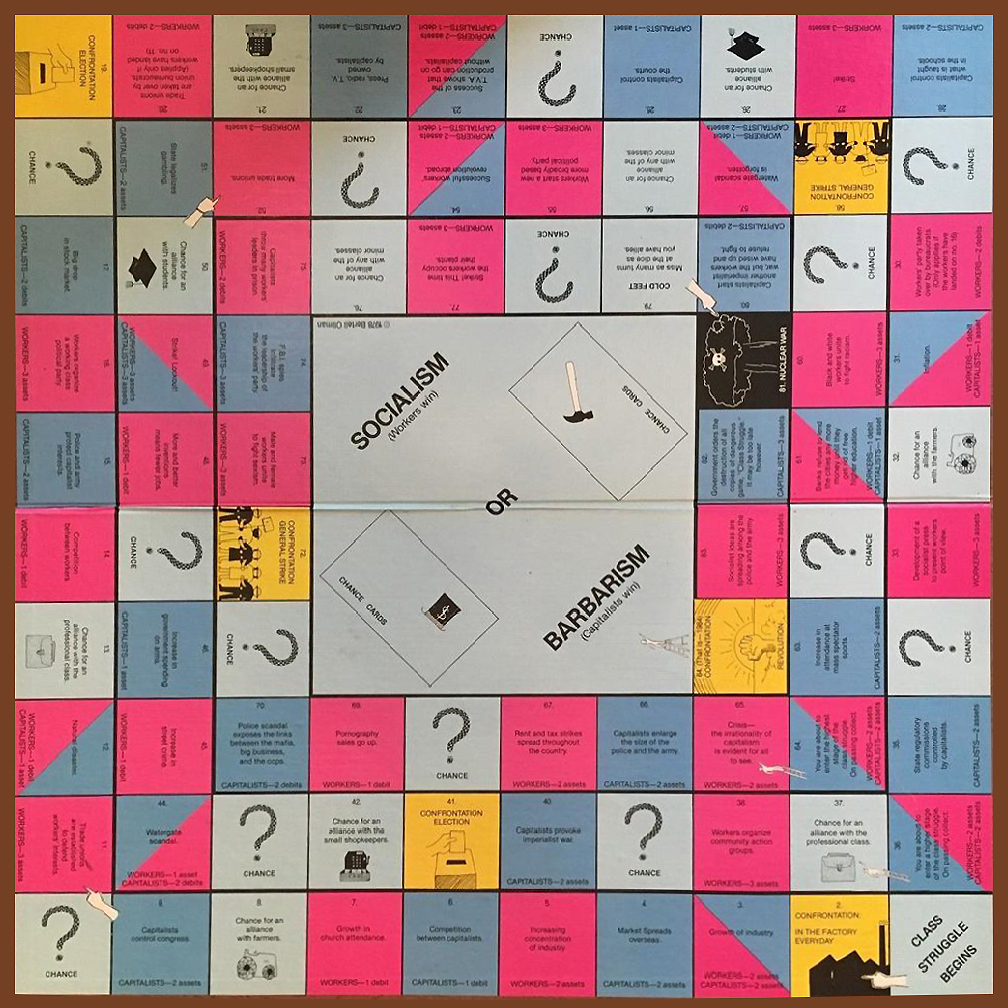
Class Struggle was developed by political professor Bertell Ollman of NYU and it’s really less of a game than a recapitulation of Karl Marx’s Das Kapital, with a rule book that is nearly as long as its source material. The pre-Photoshop collage on the cover shows Nelson Rockefeller arm wrestling Marx. Nelson has a few hundred dollar bills in his suit’s breast pocket, in case the point isn’t clear enough. In this game, one player is “the workers” and the other is “the capitalists” and they are caught in an arena of dialectical materialism, as represented by a cluttered and hastily-designed board. If there are more than two players, other factions are used, like academics or professionals, and these can make alliances with either the workers or the capitalists. The game, at least in its early editions, came with components that were at once elaborate and cheap, the strangest of which were the dice, which seemed to be cast in some sort of yellow epoxy that chipped easily.

The Class Struggle board. Will the world end in Socialism, Barbarism, or Nuclear War?

The game was not so much fun as it was funny. I imagine if you were a student of political philosophy your would get many sensible chuckles. But for me it was another clockwise slog around the board, and the games’s many potshots at Capitalism seemed like casual oversimplification. Callback!

When my parents moved from my childhood home to a new place a couple of decades ago, they cleaned out a lot of the games that had survived our many basement floodings, and one of them was Class Struggle, which they offered to whichever son would take it. I said thanks but no thanks. I think Rob may have taken it, which in hindsight might have been a lucrative move. Because however unfun, the game has developed something of a cult status over the years, with online retrospectives, contemporary re-imaginings, and even original sets sold at auction. An ironic fate, considering the game’s whole raison d’être.


  1. The 70s were filled to the brim with photos of hairy shirtless guys. ↩︎
  2. Yes, I know that he’s primarily known for Gunsmoke. This sentence is here just to annoy Boomers. ↩︎

Darkest Dungeons

In an earlier post I discussed the board games of my 70’s childhood. That one was popular, so here’s an essay about the games that came after.

One evening in 1977, my dad mentioned that some of the kids at the college where he taught were playing a strange new game that was played with pencil and paper and a variety of eccentric dice. Also sometimes lead figurines, but how they fit into the game did was unclear. He was talking, of course, about Dungeons & Dragons, which at the time was only three years old and very much a niche activity for the kind of young man who owned several Frank Frazetta posters. My older brother Rob, who had been obsessed with fantasy since my father read us the Lord of the Rings, wanted to try this thing out, so the next Saturday my dad drove us out to the Hobby Models store in Peoria, Illinois.

Original D & D
The original edition of Dungeons & Dragons (1974) and its predecessor/supplement, Chainmail (1968). Rob bought all of these and if he hadn’t worn them to shreds they would now be worth approximately 100 bajillion dollars.

Although I didn’t know it at the time, the Midwest was a hotbed of indie game production, and the birthplace of role playing games. Dungeons & Dragons was the product of game publisher Tactical Studies Rules, and TSR was situated in Lake Geneva, Wisconsin; the science fiction RPG Traveler, which was an early competitor to D & D, was published by Game Designers’ Workshop, located in Normal, Illinois. Even before he co-created Dungeons & Dragons, designer Gary Gygax had established the annual game convention that would become Gen Con (named after Lake Geneva, its original host city).

Computer Space
Computer Space: groovier than it had a right to be.

The first time I entered the Hobby Models store was as much a mind-expanding experience as if I had wandered into a head shop on Ocean Front Walk1. We may have come in search of Dungeons & Dragons, but the inventory ranged from model rockets to balsa wood and tissue kits to an enormous yellow Computer Space cabinet, the first coin-op video game (1971). Roughly a third of the floor space was dedicated to Napoleonic miniature war games. A small group of scraggly men in torn jeans and stained tee-shirts were hunched over a miniature battle ground made of green felt stuck on a sheet of plywood, supported by a pair of saw horses. On this battleground were hundreds of painted metal figures of infantry, calvary, and artillery. Players made their moves by measuring inches with a ruler; once a unit had fired in a turn, tufts of cotton smoke were placed as markers until the next turn, usually an hour or two later at the rate they played.

Miniatures
Waterloo: I was defeated, you won the war.

The front of the store was where the indy games were, and here Rob was able to procure a copy of Dungeons & Dragons. For anyone who has not seen the original booklets this game came in: the rules were next to indecipherable. There were only three ill-defined character classes and the text kept referring to an earlier game by Gygax, Chainmail, which was a set of rules for miniature play. The set actually told players they would need a copy of Chainmail, which seemed to me (and still seems to me today) like a cheap move by TSR.

Huh?
Some of the baffling rules from the original games.
Why not check the whole thing out on the Internet Archive?

In a way, the original game of D&D was a set of story-based interludes to spice up your figurine play, and it was only after a series of four supplementary books that the game evolved into its recognizable stand-alone form that charmed nerds across the nation and terrified their parents, who by the early 1980s believed the pastime to be demonic.

Dark Dungeons
Concerned mothers are warned of the inevitable progression from playing D & D to worshiping Satan in the Jack Chick tract Dark Dungeons (1984).

Rob was 13 when he began to play role-playing games with friends and I was 10. I wish I could say that I took to the game as well, but 1) I found the constant dice rolls took me out of the fantasy, and 2) Rob didn’t want his dumb brother hanging around and harshing his game night vibes. But while I wasn’t much of a player, I did find the rule books fascinating, and even more so the many odd games that emerged in Dungeons and Dragons‘ wake. There was Tunnels & Trolls, whose name was a bit too on-the-nose as a clone. There was Chivalry & Sorcery, whose rules were maybe 20 times more complex and were printed in blotchy 9-point text that looked as if it had been photocopied a dozen times. There was Bunnies & Burrows, in which players played as rabbits à la Watership Down.

But if RPGs were not for me, Hobby Models also was a doorway to the a fascinating world of small-press board games, and particularly microgames, that I did come to love. But since this essay is already longer than I planned, I will get to those next post. To be continued.


  1. I have searched in vain for interior photographs of this store from the late 70s or early 80s but I guess not everything has made it into the digital era. I did, however, find this charming advertisement from (I’m guessing) the 1960s: ↩︎
Hobby Models
Remember to keep your gifts constructive!

Never the same game twice

My last essay was a critique of nostalgia, and so to mix things up this post will be a discussion of something from my youth for which I have a great deal of affection, and that is Parker Brothers graphic design from the 1970s. This is admittedly a niche interest, even for me, but I hope you’ll be indulgent. Perhaps you, too, will come to love these beautiful and strange designs.

From around 1970 to 1980, the Salem, Massachusetts-based Parker Brothers (now a brand of Hasbro) published games whose innovative and fanciful designs drew inspiration from Pop Art, Op Art, and Madison Avenue advertising. They had boxes, boards, and components that reflected the most current techniques of printing and plastics molding. They were witty, silly, and weird. The other main players in American games at the time were Milton-Bradley, whose art tended towards cartoony, corny, and flat designs, and Ideal, whose games (like Mousetrap) were mostly showcases for their novel plastic components.

Parker Brothers design stood out for its style and sophistication, and even as a young nerd I could see that it was special. In fact, I believe they were my introduction, at the age of seven, to the whole concept of graphic design. This isn’t to say that the games were good in the sense of being fun or engaging to play; a lot of them were re-skinned versions of the basic race-around-the-board type that had been popular since the Uncle Wiggly Game. But they looked amazing and they were different.

There’s not a lot of sources of information about the company, but there is one very interesting book, The Game Makers : the Story of Parker Brothers from Tiddledy Winks to Trivial Pursuit, which was written by Philip Orbanes in 2004 and published by Harvard Business School Press. From this book I learned that starting with its founding in 1883, Parker Brothers was a family owned operation, and its ethos was decidedly conservative. It produced child-friendly tabletop games that it purchased from independent creators, with little to no research and development and with a small factory that printed simple boards and boxes and made components from simple materials.

Along the way they picked up some major properties, like Monopoly and Cluedo, which was rebranded in America as Clue, but they didn’t develop these in-house and they didn’t really have a marketing strategy of any kind. But all that changed in 1968 when the company was sold to General Mills—yes, that General Mills, of Cheerios fame. After the departure of one president who wanted to cash out and retire, and the death of another who died of lung cancer, executive vice president Ranny Barton took the helm, and he immediately replaced the head of manufacturing and the head of sales. Orbanes writes:

In one fell swoop, Ranny Barton had changed Parker Brothers from a family-run, conservative operation to one now seeking high-flying M.B.A;s and marketing wizards in a quest to again double sales. Ranny […] would oversee a group of executives who were experts (165-166).

For the first time, the company had project leaders and marketing staff (largely on loan from General Mills). They brought in professionals in design, production, and printing. They bought a new state-of-the art press capable of much finer detail and vibrant colors, and they switched to making their components out of injection molded plastic. They were out to compete, and that meant to advertise on the new medium of television, and to be distinctive.

Okay, that’s more than enough backstory. Let’s look at some of the games from this time.

Waterworks (1972)

Waterworks

I remember coming across a used copy of this game at a school tag sale when I was in first grade. It looked like nothing else I’d ever seen. The cover art was sparse and focused on its photography. The text was set in Blippo, which seemed shockingly futuristic (it was actually designed in 1969). Most of all, the diegetic title on the manhole cover felt absolutely tangible. I splurged on the 30-cent purchase (my allowance at the time was a quarter).

Waterworks
Waterworks

Inside, the cards were wonderful, featuring detailed, photorealistic depictions of pipe fittings, handles, and spouts. They came in a draw/discard bathtub. And there were tiny brass monkey wrenches (perhaps using the existing Clue wrench molds). Everything was designed to be tactile and engaging.

Waterworks was designed by Mattiene Moustakas, although whether she designed the gameplay and components, or illustrated the cards, or both, is unclear. She certainly has a crazy resume. As for the play, a modern gamer will recognize it as a tile placing game such as Carcassonne; one chained one’s cards together to make a line from handle to spout, while playing pipe junctions and leaks on the opponent’s spread. It was…ok. It was certainly different from the card games I’d played, which were basically War and Solitaire1.

The Inventors (1974)

The Inventors

I’ve mentioned before that the 1970s had a strange retro fad for “old-timey” things, by which I mean Americana from about 1890 to 1905. I am at a loss to explain this. It was a time of serious social problems, from race relations to stagflation. Perhaps there was a longing for a mythical past. The counterculture had drawn heavily on Art Nouveau in poster design, and maybe this trend was breaking into the wider culture. In any case, The Inventors was themed around patenting odd Victorian-looking inventions. The cover art was a highly staged studio shot with models in costumes with props. It featured many of the gadgets referenced in the game, as well as an inventor holding the game itself on his lap, and that kind of self-referentiality was catnip for me. (By the way, the text on the bottom right is in a typeface called Desdemona, which originated in Vienna and has always sounds drama club to me.)

The Inventors

The board features a pastiche of Victorian typography and day-glo colors. It features two different tracks to circle the board, but the filigrees and other ornamentation make it seem much more complex. There are handsome cards that feature descriptions of the various inventions to be patented. But the real star of the show is the centerpiece, “the incredible patent picker, move maker machine.”

The Inventors

This chunky bad boy held the metal clip-on numbers that were the game’s patents, and the “push-pull” dispenser never really worked because the invention cards would bend and fray when you stuck them in. But that didn’t matter, because the real attraction was the dice chute. You placed the dice into the hopper and hit a plunger and they would roll into the tub below, all while ringing a bell.

The Inventors was designed by Jeffrey Breslow, who was a student of Marvin Glass, a powerhouse designer that has created many of the most recognizable toys of the 20th century. Breslow, working with Glass, also designed Ants in the Pants. As for The Inventors’ gameplay: meh. It vaguely resembles Monopoly in that players attempt to succeed financially by developing their properties. But for the most part it’s circling the board in parallel to one’s opponents, with perishingly few actions that directly affect the other players.

The Magnificent Race (1975)

The Magnificent Race

Another old-timey game, The Magnificent Race obviously takes inspiration from Jules Verne’s Around the World in 80 Days. The players must circumnavigate the globe using cars, ships, planes, and balloons. The gimmick of the game is a non-player-character (before there even were NPCs) called Dastardly Dan, represented by a purple marble, who can interfere in, and even win, the titular race.

The game’s board shares its typography, color palette, and even curvilinear forms with the Inventors’ board, and I’m pretty sure the same designer did both. One innovation to this board is the paths are not directional, and players may move there arrows in any direction. This may not seem like a particularly distinctive feature today, but it was unusual in 1975.

The Magnificent Race

The components here pull out all the stops. There are big chunky arrows used as player markers, layout cards on which to place “advantages,” a pegboard to track overall progress around the world, and a spinner with colored marbles (including Dastardly Dan) that determines the winner of each of the series of small races that make up the game. Each player drops in a number of marbles based upon their advantages, the device is spun, and the first to drop into a divot near the center wins.

The Magnificent Race

When everything is set up it’s pretty impressive. Fun fact: the groovy fake money for the game is printed on green and purple paper that isn’t shelf-stable. I know this because the bills in the copy I purchased for my kids many decades later crumble apart at the slightest touch.

The game was designed by Bill Cooke, who co-designed Boggle (also originally published by Parker Brothers). On his Facebook page Cooke has photos including the original schematic drawings for the spinner. But for me the real attraction is the scratchy, cartoony pen drawings, which recall some of the more elaborate designs of Milton Glaser. I would dearly love to know who the illustrator was for these.

The Magnificent Race

As for the gameplay…this one’s a real let-down. All of the bells and whistles can’t hide that at its core it’s a random chase around the board. However, the spinner is a lot of fun, especially when the Dastardly Dan marble wins.

Bonkers (1978)

Bonkers

Or to refer to it by its full name as printed on the box, This Game is Bonkers. This was not a game my family owned but I played it at friends’ houses and it had an earworm-y television commercial that probably most Americans in their 50s can still sing today.

Bonkers

In the Bonkers graphic design Parker Brothers reached an apotheosis. For years they had been cribbing from the cheekier parts of Madison Avenue; here they went full-on Peter Max with shooting stars, lightning bolts, volumetric arrows, and exclamation points everywhere. The board starts pretty empty, but players fill in the spaces with U-shaped cards that change the flow of movement, directing tokens forwards and backwards and eventually into spaces that score or remove points.

Bonkers

The design couldn’t be more frenetic or bold. Unfortunately, the graphics promise a zanier time than the gameplay delivers. The mechanic of players altering the rules of the game as they go is a good one (see modern games like Fluxx), but that’s not really what’s happening here; instead, the normal clockwise race around the board is being lengthened by digressions. It’s still a fixed track. But man, does it look great.

Bonkers was designed by local boy Paul J. Gruen, who lived in West Newbury, just a half-hour drive from Parker Brothers. He also designed Pay Day (1972) for Parker Brothers, another game whose original graphics had pop art origins—in this case with illustrations resembling those of Heinz Edelmann, character designer for the Beatles’ Yellow Submarine (1968).

Pay Day

That’s enough

I could go on for hours, and it probably feels like I have already. There’s so many wonderful designs from this period: Vertigo (1970), Masterpiece (1970), 10-Four Good Buddy (1976), The Mad Magazine Game (1979). Even the original Boggle (1973) cover art is a crazy snapshot of a time of weird innovation: it didn’t actually feature the game2.

Boggle

As the 70s ended, Parker Brothers swung heavily into electronics with toys like Merlin (1978) and their own line of cartridges for the Atari 2600. And in 1985, General Mills merged the company with Kenner, then sold it to Tonka in 1987, before everything eventually got bought up by Hasbro in 1991. But for a brief time in the 70s, Parker Brothers was the one game company that was distinctive, brassy, different. The games themselves were hit-or-miss, but the design always landed.


  1. As an aside, I learned the version of Solitaire I knew from my mom, which was a hard-as-nails version that I have never seen anyone else play, so I don’t even know what it would be called. Years later I would learn that most kids played Klondike, which I would scoff at as a baby game. ↩︎
  2. Also it was set in Optima! ↩︎