


My parents were (and remain) staunchly liberal, but for people who lived their twenties through the eras of beatniks and hippies they were (and remain) pretty square. In the 70s my dad had sideburns and a mustache and smoked a pipe; my mom had a bob cut and wore knee-length skirts. Their record collection consisted of mostly classical and musical theater albums with probably the most scandalous disc being a copy of Herbie Mann’s Push Push1. It’s a wonder, then, that my childhood was filled to the brim with subversive boardgames. By this I mean games designed to promote skepticism, free thinking, and in some cases, out and out Marxism. This essay focuses on the eggheaded, leftist games of my youth.
WFF ‘n Proof (1962)
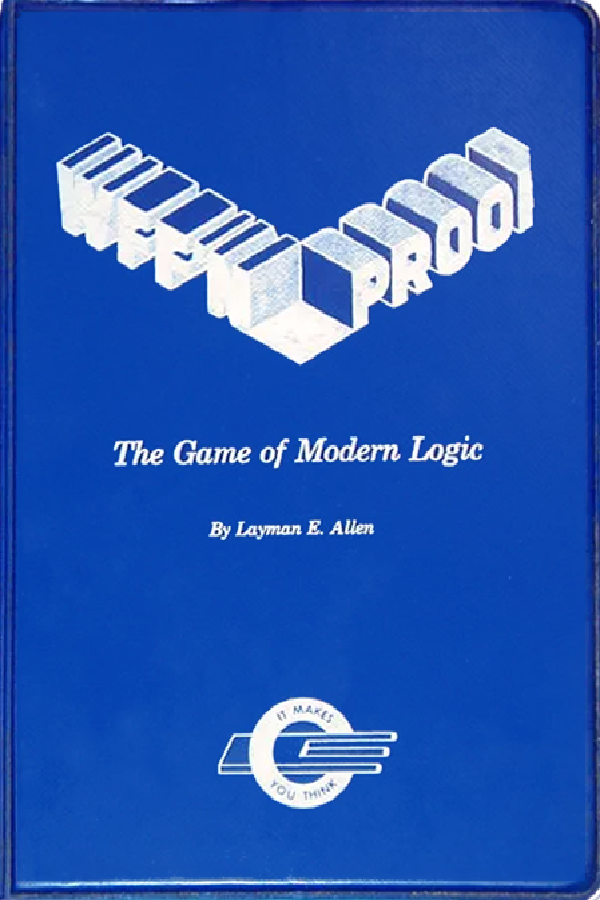
I believe my Dad acquired his copy of WFF ‘n Proof in college. In any case, this strange dice game was kicking around the house as far back as I can remember, and as long as I can remember I was trying, and failing, to learn how to play. WFF ‘n Proof is a game where players roll a handful of odd wooden dice whose sides were (mostly) Roman letters. Then they attempt, using propositional calculus, to arrange the dice into a string of atoms and connectors to produce valid statements, or what the game maker Layman E. Allen referred to as “well-formed-formulas (WFFs).” Just for fun, instead of the standard system of symbolic logic, this game uses “Polish notation,” a system of expression developed by logician Jan Łukasiewicz in which the operator is placed before its operands. Did I mention I tried to learn this game when I was seven?
This game did not strike me as particularly odd as a child. My parents were the type to let their kids play with adult things (if they weren’t dangerous or inappropriate) and let us work out what we could. Besides, my dad was a professor of theology and philosophy and occasionally taught symbolic logic, and he had an old copy of Stephen Barker’s The Elements of Logic (1965) that he gave me and my brother to read. So, proof that autism is hereditary!
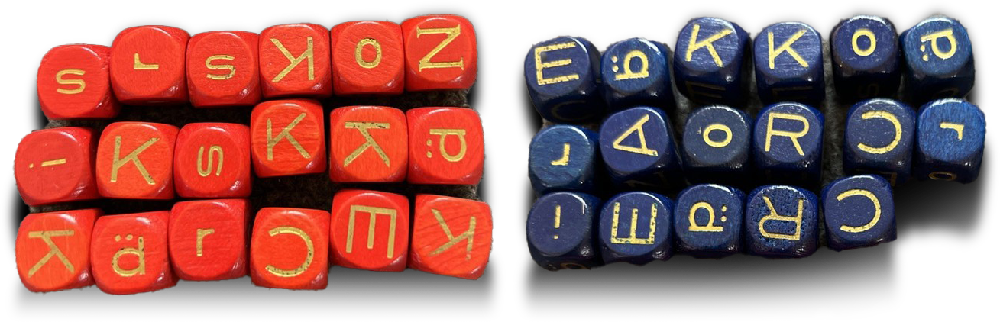
I may never have learned to play WFF ‘n Proof, but I was in love with its odd presentation. The game came (in its original edition) in a plastic wallet with foam rubber housing for the dice, a thick rulebook that was more like a short novel, and a tiny hourglass for timing moves. Whatever happened to these tiny hourglasses? They used to have one in every game. As an adult, I once bought a copy of this game off eBay, only to find that foam rubber does not age well over the decades (to see what I mean, Google “original Yoda puppet”).
As niche as the game is, it is still in print today.
The Propaganda Game (1970)

The WFF ‘n Proof company (which billed itself as “games for thinkers”) also produced other games. One, which my family also owned, was The Propaganda Game, and it was here that my education as a skeptic began. This game was also developed by Layman E. Allen, but also credited Lorne Greene, Commander Adama himself2. In a statement on the box, Mr. Greene outlines the game’s purpose:
In a democratic society such as ours, it is the role of every citizen to make decisions after evaluating many ideas. It is especially important then that a citizen be able to analyze and distinguish between the emotional aura surrounding the idea and the actual content of the idea. It is to this goal of clear thinking that THE PROPAGANDA GAME addresses itself.
In contrast to WFF ‘n Proof, The Propaganda Game‘s rules are very simple. A set of cards are printed with a series of short arguments or appeals to the reader, and the players have to identify what kind of propaganda is being employed. If they get it right, they slide their tiddley-wink marker up the score sheet; if they get it wrong, they go back a rank.
The game is subdivided into various propaganda categories, such as “Techniques of Self-Deception,” “Techniques of Language,” “Techniques of Exploitation,” etc. Within each category, there are eight to ten techniques to identify, such as “Prejudice,” “Academic Detachment,” “Drawing the Line,” “Not Drawing the Line,” “Wishful Thinking,” “Tabloid Thinking,” and my favorite, “Causal Oversimplification,” which I believe is 85% of discourse online (the other 15% is straight-and-out lying). These categories and their techniques were first proposed in the book Thinking Straighter by George Henry Moulds (1966).
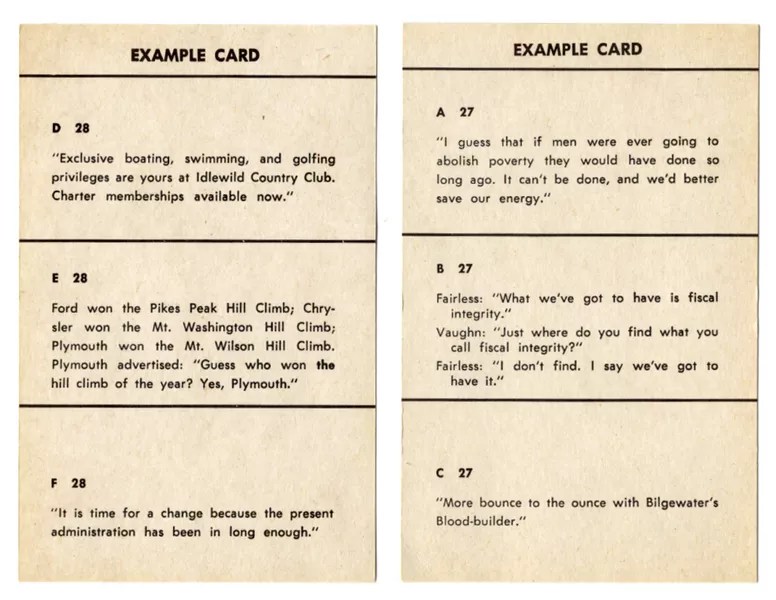
As you might imagine, a lot of this is subjective, and even as a child I found myself yelling back at Allan and Greene: “That’s not Drawing the Line! That’s just being clear!” Apparently I am not alone in my complaints, as tournament rules for this game use an amended guide, available online.
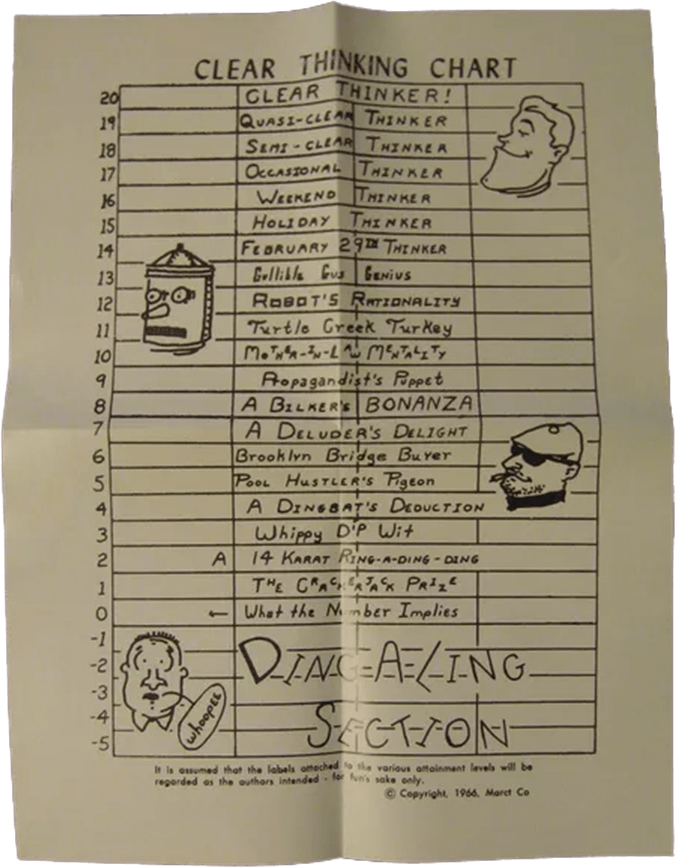
The most amusing aspect of the game is the “Clear thinking chart” used to keep score. Each rank has an unflattering name that corresponds to how easily propagandized the player is, such as “Brooklyn Bridge Buyer” or “Bilker’s Bonanza.” If you are unlucky enough to slide into negative numbers you end up in the “Ding-a-ling section.” It was a different time. There was also an interesting mechanic for games of three or more players where each voted on the correct technique, so the game not only introduced participants to propaganda but also to the Asch Conformity Test.
Lie, Cheat & Steal (1971)
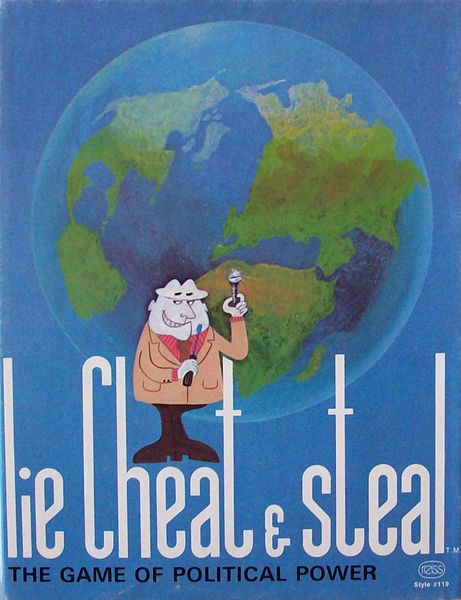
I remember when my parents purchased this game (at my brother’s and my behest). It was at Straus’s, which was the frou-frou department store that once was the pride of Youngstown, Ohio. In those days before being destroyed by malls and big boxes, department stores often carried unusual games, toys, and other novelties, and that included the output of tiny producers. Lie, Cheat & Steal was published by now long-defunct Reiss Games, whose output mostly consisted of abstract strategy and party games, although they also apparently made a board game based on the 70’s scandalous paperback The Happy Hooker. Lie, Cheat & Steal (herein, LC&S) was a highly jaundiced game about political campaigning, as described on the box bottom:
LIE, CHEAT & STEAL is the game of unscrupulous politics. You and one to five of your shifty friends can get in on the dirty-dealing, back-stabbing and thinly disguised thievery that make up the real political world.
You buy and sell votes, steal from the Public Treasury, and libel the other players to get ahead. The Senate may investigate you. You may even go bankrupt. But don’t give up! LIE, CHEAT & STEAL gives you plenty of opportunity to come back and win.
LC&S actually pre-dates Watergate, but it does reflect the era’s cynical views about corruption and money influence. Modeled somewhat obviously after Monopoly, the players roll dice to move clockwise around the board, acquiring money in unscrupulous ways to eventually buy votes. Along the way you land on spaces with names like “Tammany Hall,” “Chicago Machine” and “League of Women Voters Luncheon.” In the course of the game you might become the subject of a Senate investigation and have to take the witness stand. You collect “feathers in your cap” or “black eyes.” Neither my brother or I understood the meaning of any of this other than the “Jail” space, but we did ask our mom a lot of questions, and she did her best to explain the machinations of American Politics.
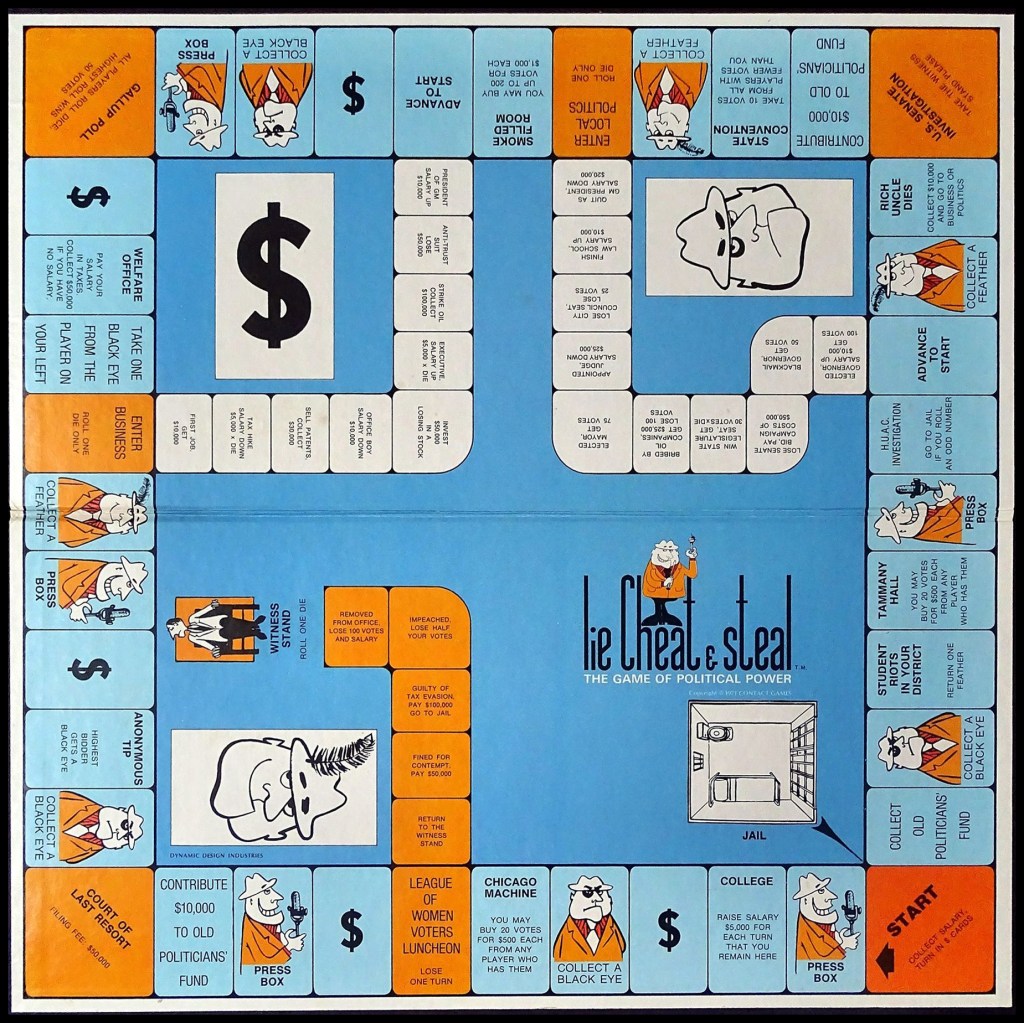
LC&S was probably the most playable amongst the games I describe in this essay, but that’s not to say it was all that fun. Like Monopoly, it ran long, and by the end I was happy when anyone would win, just as long as the game was over. As far as politics went, I was already pretty cynical and needed no board game to disillusion me.
Class Struggle (1978)
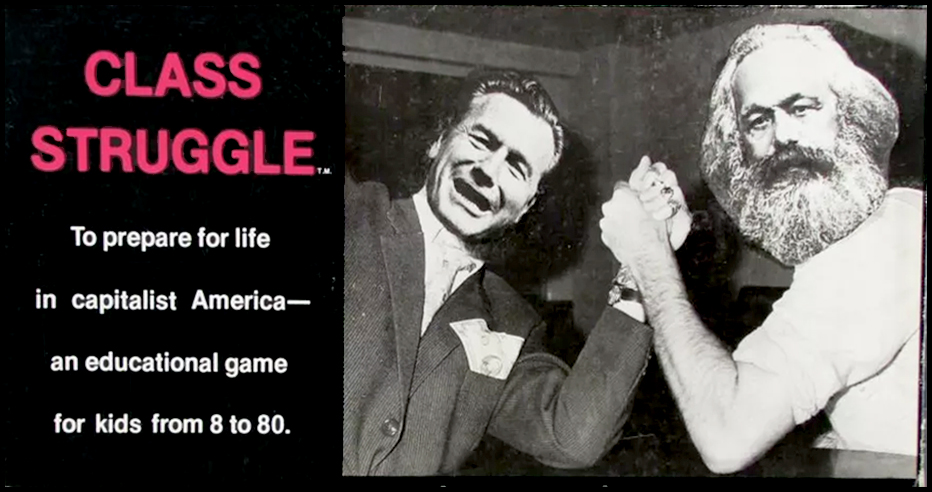
I have no idea where my dad got this game, but I suspect he sought it out because of its press coverage. The bottom of the box (I think it was the second printing of the game) enumerates its infamy:
FIRST book about capitalism to come packaged in a game box… FIRST game to be written up in a NEW YORK TIMES editorial … FIRST game ever to be played on the radio (for two hours on WBAI) … FIRST game ever to be sold by Scribner’s, 8th Street Bookshop and Salter’s Bookstore, three of New York’s most famous bookstores FIRST full-scale board game to present the side of the workers. FIRST board game ever to be sold in both Toy and Stationery Departments in Bloomingdale’s .. FIRST game ever to be sold out in one week in
Bookmasters, N.Y.C. …
Class Struggle was developed by political professor Bertell Ollman of NYU and it’s really less of a game than a recapitulation of Karl Marx’s Das Kapital, with a rule book that is nearly as long as its source material. The pre-Photoshop collage on the cover shows Nelson Rockefeller arm wrestling Marx. Nelson has a few hundred dollar bills in his suit’s breast pocket, in case the point isn’t clear enough. In this game, one player is “the workers” and the other is “the capitalists” and they are caught in an arena of dialectical materialism, as represented by a cluttered and hastily-designed board. If there are more than two players, other factions are used, like academics or professionals, and these can make alliances with either the workers or the capitalists. The game, at least in its early editions, came with components that were at once elaborate and cheap, the strangest of which were the dice, which seemed to be cast in some sort of yellow epoxy that chipped easily.
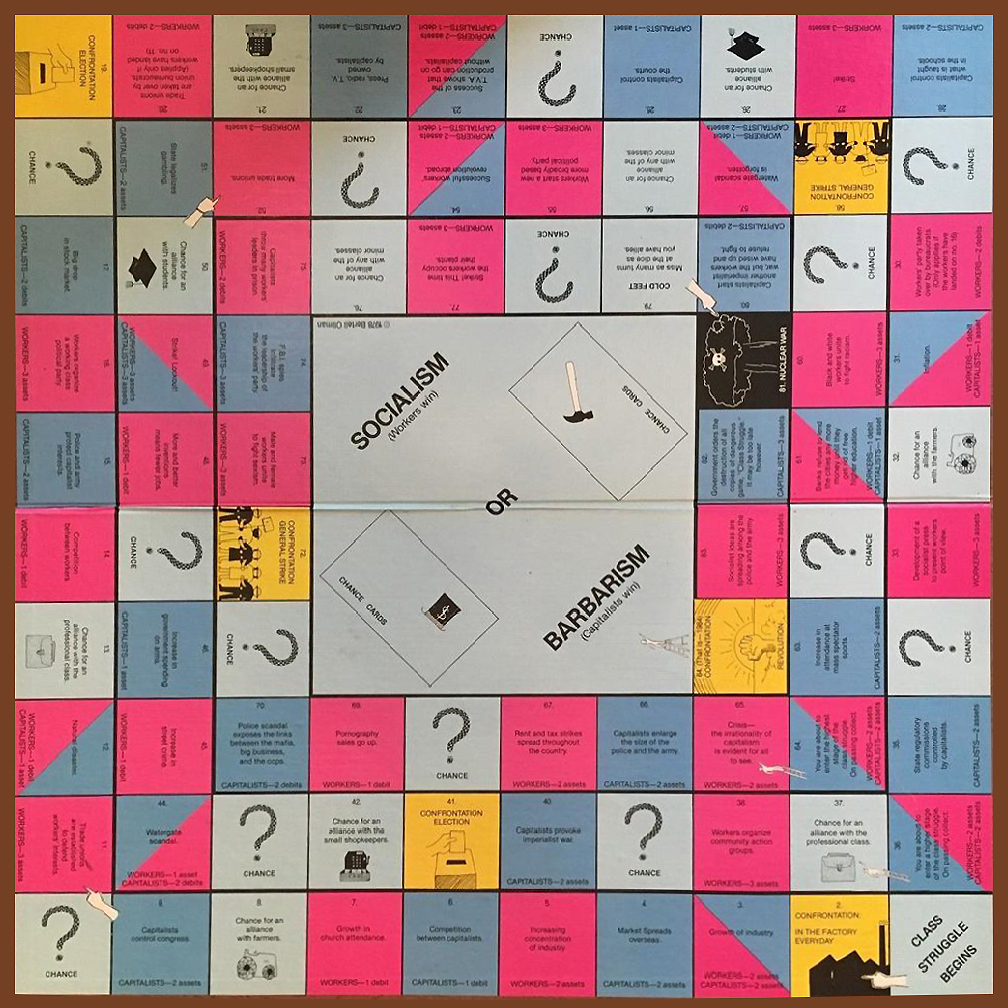
The game was not so much fun as it was funny. I imagine if you were a student of political philosophy your would get many sensible chuckles. But for me it was another clockwise slog around the board, and the games’s many potshots at Capitalism seemed like casual oversimplification. Callback!
When my parents moved from my childhood home to a new place a couple of decades ago, they cleaned out a lot of the games that had survived our many basement floodings, and one of them was Class Struggle, which they offered to whichever son would take it. I said thanks but no thanks. I think Rob may have taken it, which in hindsight might have been a lucrative move. Because however unfun, the game has developed something of a cult status over the years, with online retrospectives, contemporary re-imaginings, and even original sets sold at auction. An ironic fate, considering the game’s whole raison d’être.
- The 70s were filled to the brim with photos of hairy shirtless guys. ↩︎
- Yes, I know that he’s primarily known for Gunsmoke. This sentence is here just to annoy Boomers. ↩︎


We had that Lie, Cheat and Steal game in the 70s! I had totally forgotten about it.
LikeLike