

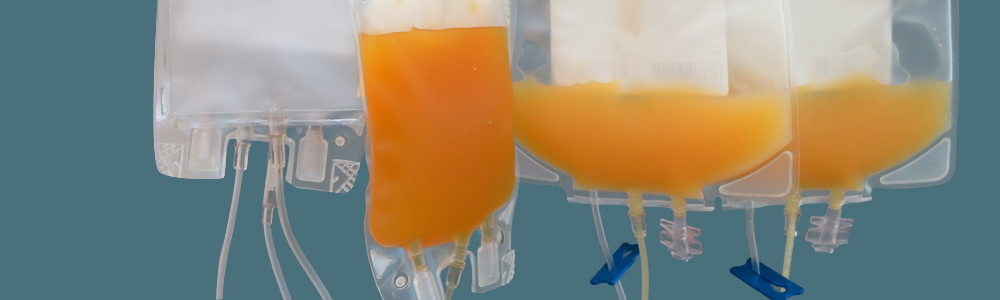
This weekend I donated platelets. I’ve been a donor for about a decade and a half; I’m not exactly sure when I started, and my Red Cross phone app only goes back 100 donations, which was some time in 2013. It is more helpful in keeping track of the number of units I’ve given so far: 361. Platelets are measured in units of at least 3 x 10¹¹ individual platelets, of which I give six each donation, along with two units of plasma. It’s hard to tell what this works out to in volume or mass, but each of the plastic bags containing a unit looks to hold about a pound of a thick yellow syrup that resembles butterscotch topping. If my guess is accurate, I’ve donated about two times my body weight at this point.
The donation process is called apheresis, and how it works is you get hooked up via IV tubes to a machine that sucks out a little bit of your blood at a time. Deep inside this contraption, a centrifuge spins the blood at a terrifically high speed, which separates the platelets, which are a different density from the other blood elements. The platelets get shunted away into the previously-mentioned plastic bags that hang in a row above the apheresis machine. You can watch them fill, which is oddly satisfying. The remainder of your blood gets returned to you—this can feel a little odd at first because it’s never quite the same temperature as the rest of your body. The procedure can either be done using two tubes attached to two arms, one for out and one for in, or by cycling the draw and return using just one arm. By the time the donation is done, all of your blood will have been removed and returned to your body, which will either fascinate you, if you’re like me, or make you feel faint, if you’re like most people.
Platelets are used in a variety of medical procedures and therapies. One of the most common uses is as part of courses of treatment for leukemia. The disease causes abnormal blood production and one part of that is a low platelet count. Units of platelet are also used in surgeries for traumatic injuries and organ transplants. In these cases, blood loss is a dangerous problem, and platelets produce clots that seal incisions and lacerations. Platelets even support wound healing and tissue growth.
One of the things I like best about the donating process is its anonymity. I get to know where donations go (in my case as far north as Maine, as far south as North Carolina), but I will never know who received them, or why. The recipients will never know me either. I like to think about the way a part of me traveled off in the world to be a part of someone else for a while, and the fact that I will never meet them is part of the charm.
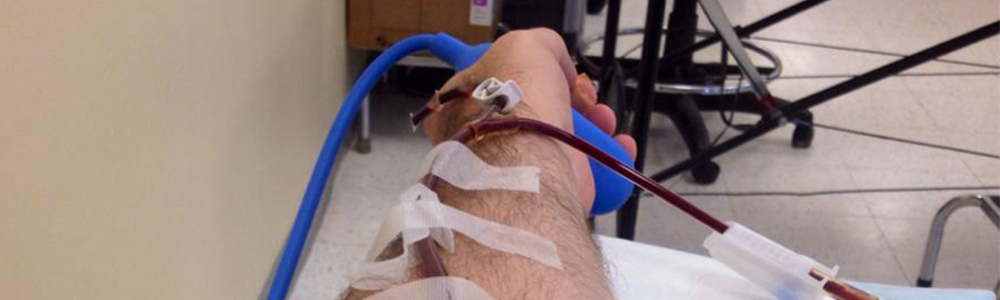
My wife has often told me that she thinks I am brave and selfless to donate because she absolutely hates needles and having blood drawn, and she couldn’t put up with it for a few minutes, let alone the two to two and a half hours a platelet donation takes. I feel like a fraud when she commends me like this, because needles have never bothered me, and I like sitting still and zoning out. I enjoy the fact that I have no responsibilities for the next couple of hours. I have even fallen asleep a few times during a donation (which isn’t a good idea if you have sharp metal objects stuck in your arm). When I give platelets the phlebotomists are doing all the work and I’m relaxing, watching foreign sitcoms on Netflix.
My wife, by contrast, has volunteered for the last couple of decades to lead a theological and philosophical reading group at a nearby prison. For this she has to develop a reading list and prepare notes. Every month spends an afternoon enriching the lives of men who are serving decades-long, or even life, sentences. The trip, including a substantial drive there and back, takes about four hours. To me, that’s work that deserves praise, and work I could never do, because I am autistic (have I mentioned this?) and I suffer from social anxiety even when dealing with people I know. So she’s the hero in the couple, or at least that’s what I think. She, of course, would say different.
I once saw a video in which a photographer said the best camera is the one you have on you. You can buy a top-of-the-line DSLR and outfit it with the most expensive lenses available. But ultimately, if your phone is what you carry around with you, that’s your best camera. Similarly, the best charitable work is the work that you are likely to continue. Volunteering isn’t about doing things that take the most effort or even deciding which cause is the most deserving of your support. It’s about finding something that lies at the intersection of what needs to be done and what you can do.
If you are like me, wanting to do good in the world but also very lazy and perhaps antisocial, you might consider platelet donation as well. You get a warm recliner with heated blankets. The staff mills around and coos over you like mother hens, asking how you’re doing and offering pillows. You can watch Veronica Mars for two to three hours and still feel virtuous. And when it’s over and the last of your blood is returned, they bandage you up and send you to a folding table they charitably call “the canteen.” Here you will eat the junkiest cookies you ever tasted and sip small boxes of fruit juice. And if you’re lucky maybe there will be a promotional tee shirt or tote bag that week.
This weekend the canteen was unusually crowded with donors. Two older guys with scruffy gray beards and worn jeans were comparing their lifetime donations. One proudly gave his number as 700. So I guess I have a ways to go yet.

