A hill of beans

If one can set aside the many, many ethical issues involving AI art, the question remains for its detractors (like me): what exactly do its proponents see in it? It’s certainly gotten “better,” in the sense that the people in the images now usually have the right number of fingers, and any text isn’t a garbled mess of ersatz letters, and there are fewer instances of what H.P. Lovecraft would call non-Euclidean architecture. But for me at least, the more accurate AI gets, the less it appeals. In the early days of DALL-E and Midjourney, when we were all stuck at home in the midst of a pandemic, typing silly prompts and getting smudgy blurs in response was a lark. Like the joke about the dog who could only type 20 words a minute, the remarkable thing was that it worked at all, not that it was any good. But today, when I prompt Chat GPT with “patriotic American family with a boy and a girl and a dog watching TV,” the elaborate tableau generated is so on the nose, and yet so soulless and dead-eyed (see below), that it renders all the state-of-the-art computation (and the presumably extravagant energy use) irrelevant. All the figures face forward and arranged using strict isocephaly; the virtual canvas is arranged with horror vacui that makes Where’s Waldo look open and airy.

chat gpt
Chat GPT image from my prompt (this is the first, and I hope the last, time I will ever use generative AI)

There have been a lot of think pieces about the politics of AI art, from claims that it’s beloved by fascists, to the counter belief that it’s a great democratizer. It does seem to have a particular home on social media, Facebook especially, where AI’s prosaic manner lends itself to oversimplification, cliché, and moralism. When you don’t have to do the work of actually visualizing what you’re saying, you don’t have to make sure your ideas make sense and that your facts are, well, facts. Part of the process of creation is realizing that your visual problems may actually be conceptual problems. Similarly, viewers looking for confirmation of their own beliefs are more easily swayed by images that have the veneer of reality. Or they might just accept them as real.

Whatever the politics, it’s this effortless, cut-and-dried nature of AI that makes it so tedious. Allow me to make another one of my patented far-fetched analogies. In the mid 90’s, during the heyday of Microsoft Office, clip art was everywhere, and the most overused clip arts of all were the Screen Beans, a series of bulbous human-shaped silhouettes doing things, or more commonly, reacting to things. These illustrations were designed by Cathy Belleville and licensed to Microsoft for distribution with Office in 1995. They depicted poses that were purposefully vague, so that they could be used in any situation; however, that vagueness also drained them of any meaningful content or personality.

But, boy howdy, they got used. In Powerpoint presentations, yes, but also in church bake sale signs and guitar lesson flyers and passive aggressive notes reminding people to pay into the coffee fund. This was before most people had Internet access so it all got printed on the sly using the office laser printer. So many trees gave their lives for the millions of reams of 20 lb. copy paper that were emblazoned with a screen bean jumping in the air or scratching its head in bewilderment. But for all the ubiquity of these inky nebbishes, they never really gave the texts they accompanied any new information.

those unavoidable Screen Beans

So why do these generic, overused illustrations remind me of AI art, which is supposed to be bespoke to the user prompt? Both are art for people who really don’t care about art. They are perfunctory nods in the direction of art employed by people who lack the skills, funds, or interest to do better. Clip art, like AI, was presented as a democratic form bringing design to the masses. Why limit art production to people who spent their lives developing a skill, who expect to be paid for what they do? This will do instead. But to paraphrase Johnson, “what is drawn without effort is in general viewed without pleasure.”

The history of art has been the history of its production and distribution. When books had to be written by the few who were literate and copied painstakingly by hand, there were few books, but they were highly valued by writer and reader alike. Similarly, music production once required musicians who had invested years into their craft, as well as had access to instruments or could make their own. Listening required finding these musicians, organizing them, and gathering an audience. Painters had to apprentice with masters in their workshops; they had to know how to mix linseed oil or tempera with rare pigments. As people learned ways to mass produce their tools, to replicate their creations, and to widely disseminate the results, the arts changed. And this was a good thing, because it meant greater access for art lovers, a lower bar to entry for potential artists, and less cost for everyone. Technology in this case really was democratizing. But up until now, however it was made, the creation of art had to be intentional, and took time and practice.

This is what’s lost when effort is eliminated. Whether you mine your own cobalt to mix your own paint or you draw in digital media on a tablet, the effort is the art: not just the act of creating, but your motives, your lived experiences, and your personal aesthetics are the ultimate media of your work. Likewise, the effort an audience brings to close attention, to interpretation, to contextualization—that’s the other half of art. And if we give the production over to machines, we may as well design an AI to enjoy it.

I never thought leopard dogs would eat my face

When my wife and I were first thinking of adopting a dog a few years ago, we spent a while considering the breed. We went back and forth on size preferences, how active a pup we could handle, etc. Eventually Marina started looking for a German Shepherd, based on her warm memories of a half-Shepherd her grandparents had when she was a girl. When she found an adoption posting for our dog Hunter (whom I’ve mentioned before), it was love at first sight.

Hunter
Hunter and his amazing ears (photo by me)

Because of the anonymity of the adoption process, we didn’t know anything of Hunter’s origins beyond his obvious resemblance to a black and tan Shepherd. It was also pretty clear that there was at least one other breed in there somewhere, if only because of his half-pointy, half-floppy ears that resemble bat wings when he perks them up. Eventually our curiosity got to us and so we paid for genetic testing. When we got the analysis, we learned we were proud owners of a 50-50 mix of German Shepherd and Catahoula Leopard Dog.

catahoula
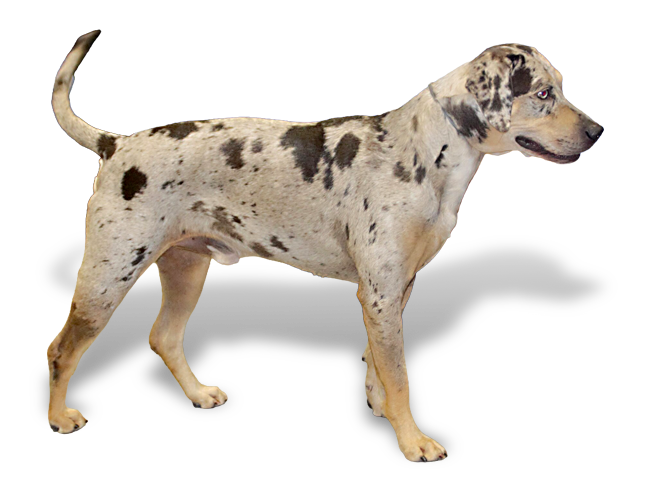
A Catahoula Leopard Dog (Wikimedia Commons)

What’s a Catahoula Leopard Dog? you might ask. I mean, that’s what Marina and I asked; we had never heard of such a thing—we had to Google. The Catahoula Leopard Dog, a.k.a the Catahoula Hog Dog, a.k.a the Louisiana Catahoula Cur, or (simply) a.k.a. the Catahoula, is the state dog of Louisiana. It’s a breed that dates to the 18th century, when French settlers in the Mississippi basin crossbred their own Beauceron dog with Native American dogs, making a delicious creole canine gumbo. The resultant breed was a dog that was smaller and faster than the Beauceron, and well-adapted to hunting in swamps (they even have webbed paws). Catahoula were (and still are) used to hunt wild boar, and while I’m no hunter myself, I have to admit that’s pretty badass. They get the “leopard” part of their name from the fact that most (but not all) have an irregular patchwork of large and small spots. Some are white, some are brown, some are black, some are a bluish gray. They tend towards medium-large (65–75 pounds) and have floppy ears and soulful eyes, although to be fair, all dogs have those.

dogs
A sampler of the many Catahoula color schemes
(collage of images from Wikimedia Commons)

Knowing Hunter’s genetics explained a lot about his idiosyncratic behaviors. When outdoors, he likes to range far from us, intent on flushing out rabbits and squirrels. When he trees the latter, he expectantly summons us, presumably to shoot the poor critter down. Indoors, however, he is docile and cuddly, and he hates when anyone leaves the room and tries to herd us together—a Hog Dog in the streets and a Shepherd in the sheets. But home life is not all snuggles and pets: at home, he goes into watchdog mode, staring intently out our front window, barking clamorous epithets at anyone passing within 30 yards of the house.

They also serve, who only stand and wait

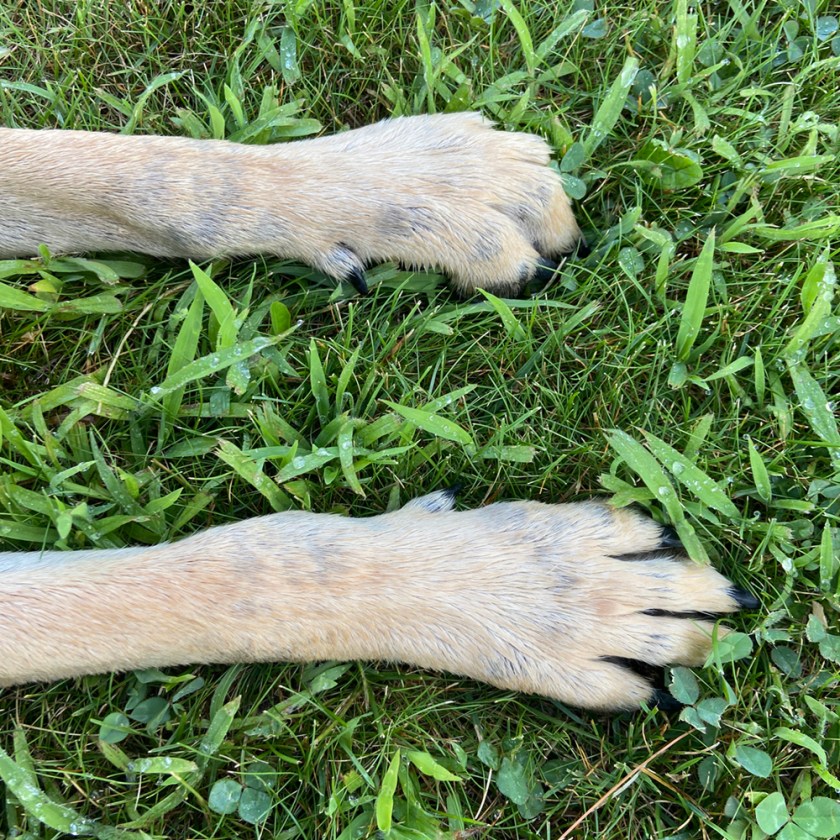
The Catahoula in Hunter goes beyond his behavior. While his coloration is Shepherd, his build is almost entirely Catahoula, from his attenuated, deer-like legs to his barrel chest. And when he gets wet, you can see through the slicked-down fur the distinctive spots on the skin below.

spots
Hunter’s hidden spots (another photo by me)

Our adoption papers say that Hunter was born in Massachusetts. We will probably never know how or why his parents were bred together; perhaps his mix is a sought-after one? I imagine many people would want a Shepha-loua; ours is certainly a very good boy (although again, all dogs are).

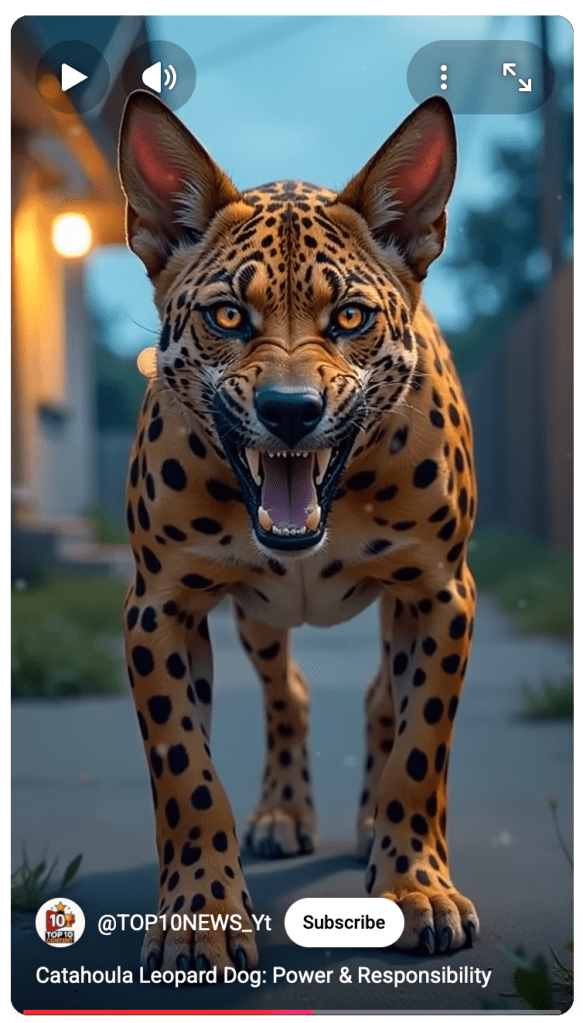
To end this essay on a jarringly different note (it’s a bad habit of mine): Since New England has no boar to offer, I have spent a not-insignificant amount of time watching YouTube videos about Catahoulas, trying to learn what activities and training might be appropriate for our dog. A lot of the videos are specifically about training your puppy to hunt. Many are silly domestic videos about the odd sounds the dogs make when irritated, or other creative ways they express dissatisfaction. And some are about how the breed requires careful training lest they become dangerous. Among these, I found some curious AI-produced shorts that present a large language fever dream of a “leopard dog” which might be at home in one of Tim Burton’s later films (you know, the bad ones). These videos, while hilarious, are a puzzle to me. What series of events led to their creation? Was there a human who holds a grudge against Catahoulas that dictated these to Nano Banana? Were they part of a larger AI project tasked with producing a video about every American Kennel Club breed? Were any humans involved at all? These hallucinatory vignettes are a cautionary tale, less for their warning regarding the breed, and more for their illustration of just how froot-loops bonkers artificial intelligence can be.

what
For when you gaze long into the leopard dog, the leopard dog gazes also into you

Although it’s been said many times, many ways, Feliz Navidad

Traveling with a large, active dog means forgoing air travel, and instead committing to road tripping, however long it might take. This year, as with the previous two Christmases, my wife, our dog, and I spent several days driving through the wilds of the Midwest to see family; this requires patience, fortitude, and a lot of music and podcasts. My wife does most (okay, all) of the driving, so her phone was linked into CarPlay, and she had selected several festive playlists for the trip.

Almost immediately upon hitting play, the music began skipping erratically. Songs cut out before their final, or even second, choruses. They faded into the next song but skipped its first minute or two. Some songs blipped in for a few bars and left. One of these was “All I Want for Christmas is You,” and I was mostly thankful for its truncation, but on the whole the situation was not conducive to singing along, and isn’t belting songs out-of-tune in the safety of one’s car the whole point?

I soon realized what had happened: AutoMix. Apple published the most recent release of iOS, 26, with this new feature in their Music app—and in fact, AutoMix is turned on upon upgrade without alerting the user. Apple touts the “enhancement” in a press release thusly:

Apple Music delivers an elevated listening experience with AutoMix, which mixes one song into the next, just like a DJ. Using AI to analyze audio features, it crafts unique transitions between songs with time stretching and beat matching to deliver continuous playback and an even more seamless listening experience.

What this means in the real world is that during play the application fades songs one into the other, attempting to sync up passages with similar tempos. This may require making the beat faster or slower and jumping over bits of the songs. Except it’s not bits, it’s often most of the track, and it’s not a “seamless listening experience,” it’s a freaking mess.

There’s a lot to hate about this feature. Apple wants users to think of it as having a virtual club DJ in one’s pocket, but it feels to me more like radio in the 60s and 70s, when announcers would cue one track into another and talk over the introductions and fadeouts in an effort to keep fickle listeners from turning the dial. Songs were treated like unvariegated slop instead of as discrete works with their own integrity. Producers during this time mixed tracks with an ear to radio play, and so almost every song ended in a tediously long fadeout; some even had fade-ins, or lengthy instrumental openings. Disk jockeys even had a term for talking over the entirety of a song’s opening, stopping just as the vocals began: “hitting the post.” Punk rock’s greatest gift to the world was to normalize songs that simply started and ended without any of that nonsense.

So there are aesthetic reasons to reject Apple’s feature. But even if you really, really want (for god knows what reason) your songs to fade in and out seamlessly, AutoMix ain’t it, kid. Its output is beyond broken: songs are truncated, lyrics are cut-off mid phrase. A feature this busted should never have been released, let alone be set as the default behavior. Somewhere along the line a coder, or a project leader, or QA tester, or even a clueless manager type should have listened to a tech demo and say, eww, no, what the hell is that, make it stop now.

But this is the problem with tech companies today: a fetish for novelty intersecting with the sunk cost fallacy. They spent x number of man-hours creating this electronic albatross and by god they’re going to ship it, even if (especially if) no one was asking for it in the first place. They have to be the first out of the gate, or someone else is going to corner the market in bad ideas. Apple’s press release brags that AutoMix uses AI in its analysis, and in many ways this feature is an encapsulation of the industry-wide fiasco that is Artificial Intelligence. AI is shoved on us whether we want it or not, whether it’s actually useful or appropriate. AI carries ethical and moral concerns. But most of all, it just doesn’t work.

Fortunately for my wife and dog and me, I was able to turn the feature off after a few minutes poking around the phone settings. Sweet relief! Then when we eventually arrived at my parents’ house, I got to experience the joy of turning off their TV’s motion smoothing. It was truly a magical Christmas. And so, as Tiny Tim observed, God Bless Us Every One!


Bonus post: More Eldritch AI Horrors

One of the stops on my round of Christmas Day socializing with family was to visit my older brother Rob and his extended family, and they are all perfectly wonderful people, but by that point my stupid autistic brain was pretty much shut down, so while everyone was playing party games the way normal people do, I was hyper-fixating on a YouTube video that was playing on the television, titled descriptively enough, “Bing Crosby, Frank Sinatra, Dean Martin, Gene Autry, Andy Williams, Nat King Cole🎄Golden Christmas.” I believe Rob was just looking for an easy playlist of seasonal crooner classics, and for the most part, the audio of this video fit the bill, providing familiar recordings that are probably not really public domain, but let’s not draw attention and pretend that they are.

But it wasn’t the songs that I was focused upon, it was the unearthly generative AI video that accompanies them. This consists of an eight and a half minute loop that depicts festive scenes of a holiday-decorated train traveling through impossibly white mountains covered in pine trees and snow. From time to time the train arrives in a Thomas Kinkade-esque village where happy people mill about shops that resemble dollhouses. Everything is rendered in the oversaturated glow of AI. And if one is prone to hyperfixation, strange things become apparent the more the loop repeats.

The number of cars in the train, for example, keeps changing. And the engine itself changes from a steam-powered to a cable car (although the cable car seems to have a vestigial smoke stack). The train’s riders stick their mittened hands out of the window and snow bursts off the knitwear in clouds, although the trees the passengers reach for are about 20 feet away. As the train streams through the town center, there are no platforms and the pedestrians wander by mere inches from their festive deaths.

yikes
this is not safe behavior

Strangest of all is a happy couple consisting of a man in his 60s and a woman in her 20s (I guess AI is prone to midlife crises). The man carries a wrapped gift precariously pinched between the his right thumb and index finger. He stops and turns to his companion, smiling. As he lifts his left hand, a second gift magically appears, pulled whimsically from a parallel dimension.

poof
…and for my next trick…

Around the 1:23 mark, the real cosmic horror begins. At this point, the soundtrack also becomes generative AI, with a Dean Martinish voice singing unholy chimerical monstrosities that resemble actual songs, as one might remember them in a waking nightmare. I don’t know why the producer of this video decided that an hour and twenty three minutes was the limit for unauthorized song use, unless perhaps that producer were actually an AI as well. In any case, the soundtrack for the last forty minutes of the video is Christmas songs from the Upside-Down, as sung by a choir of Gremlins and Heat Misers. For me, the apex/nadir of the lyrics are:

so wave goodbye to Frosty,
as he melts away today

wave goodbye
this is the actual visual that accompanies the above line

To which I say again, God Bless Us Every One!