I never thought leopard dogs would eat my face

When my wife and I were first thinking of adopting a dog a few years ago, we spent a while considering the breed. We went back and forth on size preferences, how active a pup we could handle, etc. Eventually Marina started looking for a German Shepherd, based on her warm memories of a half-Shepherd her grandparents had when she was a girl. When she found an adoption posting for our dog Hunter (whom I’ve mentioned before), it was love at first sight.
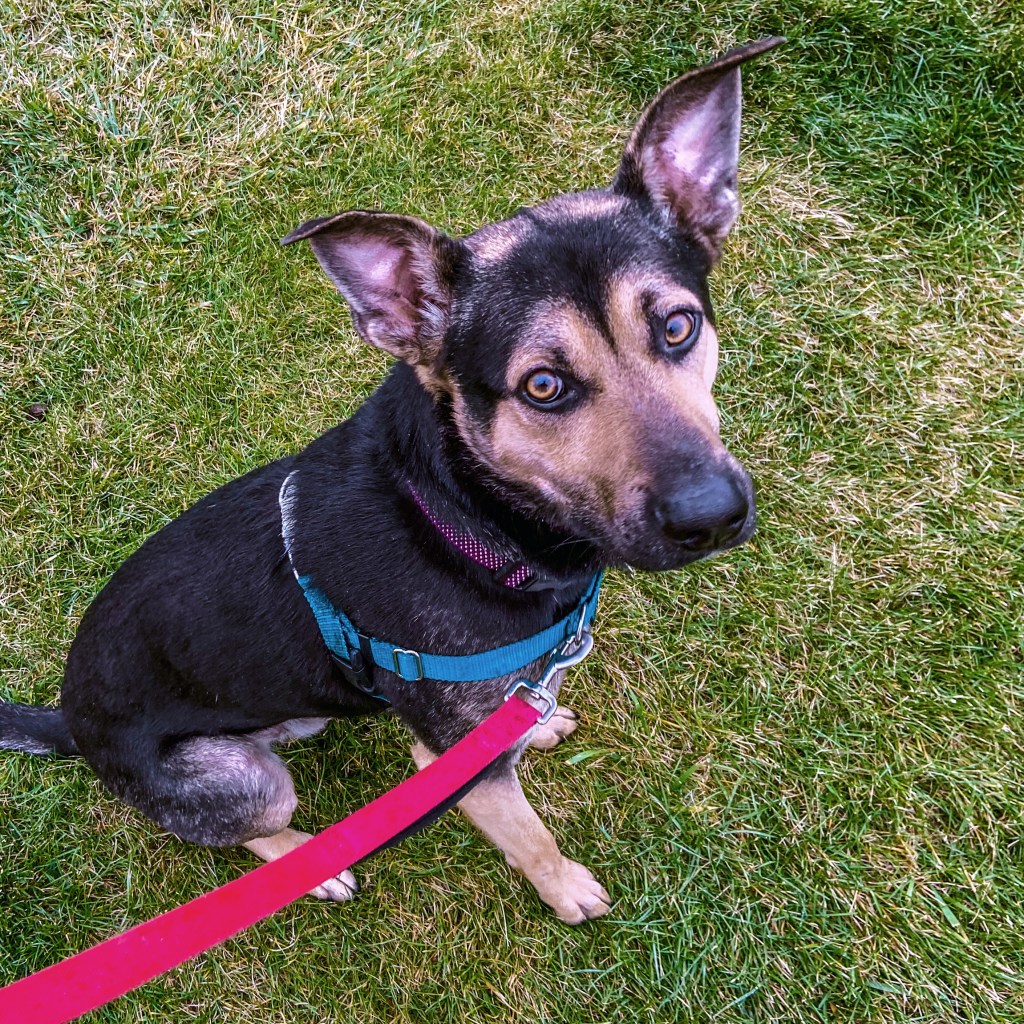
Hunter
Hunter and his amazing ears (photo by me)

Because of the anonymity of the adoption process, we didn’t know anything of Hunter’s origins beyond his obvious resemblance to a black and tan Shepherd. It was also pretty clear that there was at least one other breed in there somewhere, if only because of his half-pointy, half-floppy ears that resemble bat wings when he perks them up. Eventually our curiosity got to us and so we paid for genetic testing. When we got the analysis, we learned we were proud owners of a 50-50 mix of German Shepherd and Catahoula Leopard Dog.
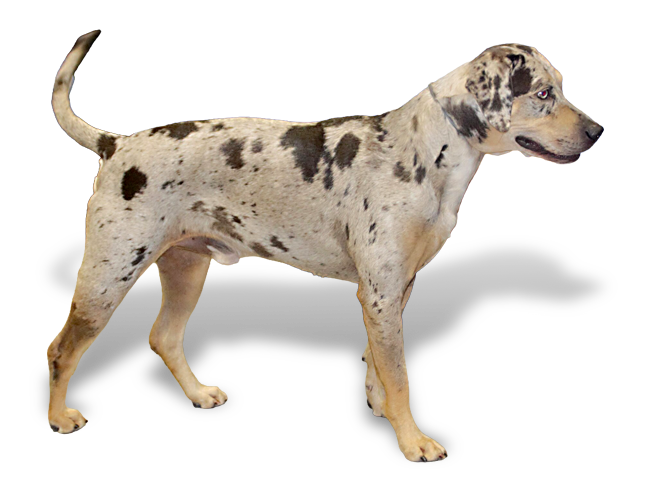
catahoula
A Catahoula Leopard Dog (Wikimedia Commons)

What’s a Catahoula Leopard Dog? you might ask. I mean, that’s what Marina and I asked; we had never heard of such a thing—we had to Google. The Catahoula Leopard Dog, a.k.a the Catahoula Hog Dog, a.k.a the Louisiana Catahoula Cur, or (simply) a.k.a. the Catahoula, is the state dog of Louisiana. It’s a breed that dates to the 18th century, when French settlers in the Mississippi basin crossbred their own Beauceron dog with Native American dogs, making a delicious creole canine gumbo. The resultant breed was a dog that was smaller and faster than the Beauceron, and well-adapted to hunting in swamps (they even have webbed paws). Catahoula were (and still are) used to hunt wild boar, and while I’m no hunter myself, I have to admit that’s pretty badass. They get the “leopard” part of their name from the fact that most (but not all) have an irregular patchwork of large and small spots. Some are white, some are brown, some are black, some are a bluish gray. They tend towards medium-large (65–75 pounds) and have floppy ears and soulful eyes, although to be fair, all dogs have those.
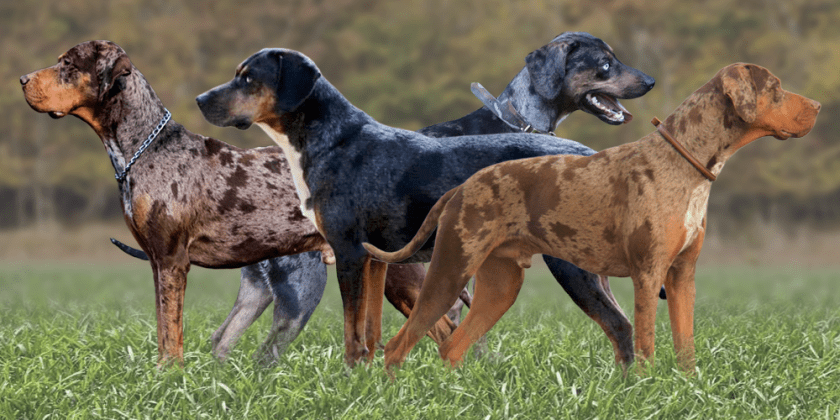
dogs
A sampler of the many Catahoula color schemes
(collage of images from Wikimedia Commons)

Knowing Hunter’s genetics explained a lot about his idiosyncratic behaviors. When outdoors, he likes to range far from us, intent on flushing out rabbits and squirrels. When he trees the latter, he expectantly summons us, presumably to shoot the poor critter down. Indoors, however, he is docile and cuddly, and he hates when anyone leaves the room and tries to herd us together—a Hog Dog in the streets and a Shepherd in the sheets. But home life is not all snuggles and pets: at home, he goes into watchdog mode, staring intently out our front window, barking clamorous epithets at anyone passing within 30 yards of the house.
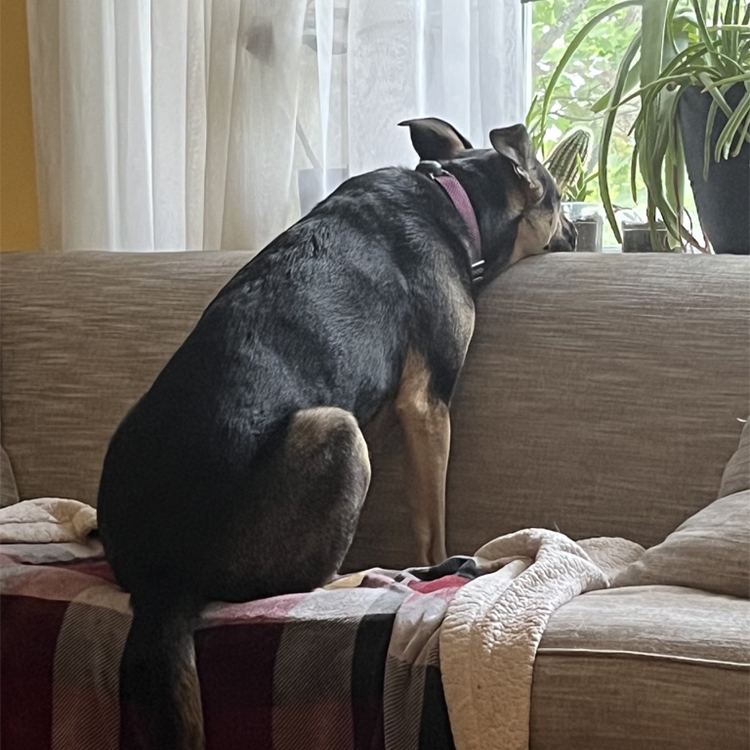
They also serve, who only stand and wait

The Catahoula in Hunter goes beyond his behavior. While his coloration is Shepherd, his build is almost entirely Catahoula, from his attenuated, deer-like legs to his barrel chest. And when he gets wet, you can see through the slicked-down fur the distinctive spots on the skin below.
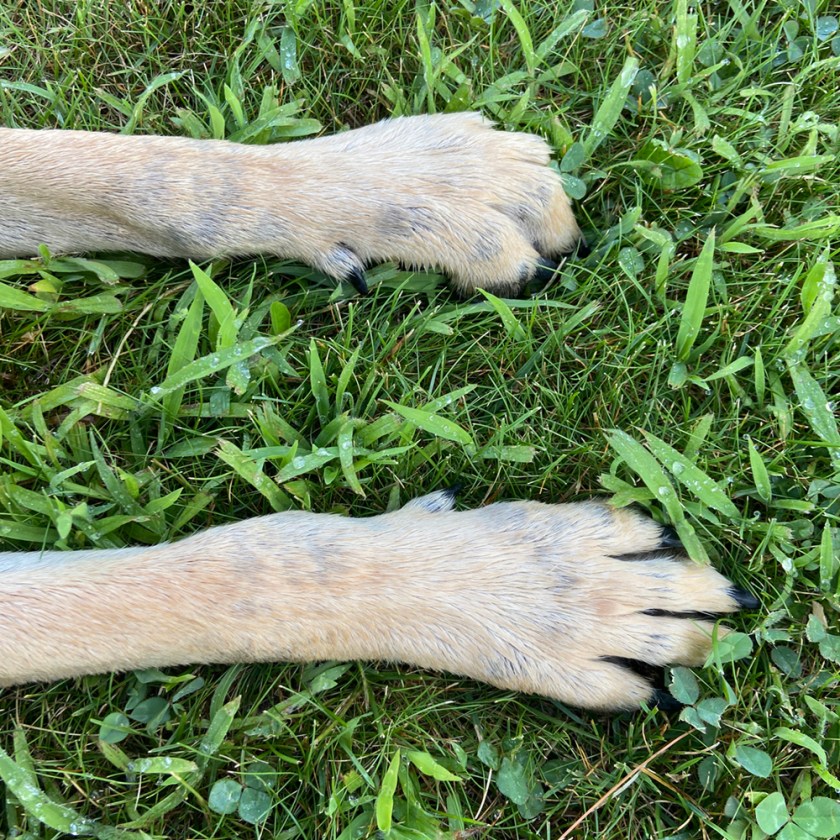
spots
Hunter’s hidden spots (another photo by me)

Our adoption papers say that Hunter was born in Massachusetts. We will probably never know how or why his parents were bred together; perhaps his mix is a sought-after one? I imagine many people would want a Shepha-loua; ours is certainly a very good boy (although again, all dogs are).

To end this essay on a jarringly different note (it’s a bad habit of mine): Since New England has no boar to offer, I have spent a not-insignificant amount of time watching YouTube videos about Catahoulas, trying to learn what activities and training might be appropriate for our dog. A lot of the videos are specifically about training your puppy to hunt. Many are silly domestic videos about the odd sounds the dogs make when irritated, or other creative ways they express dissatisfaction. And some are about how the breed requires careful training lest they become dangerous. Among these, I found some curious AI-produced shorts that present a large language fever dream of a “leopard dog” which might be at home in one of Tim Burton’s later films (you know, the bad ones). These videos, while hilarious, are a puzzle to me. What series of events led to their creation? Was there a human who holds a grudge against Catahoulas that dictated these to Nano Banana? Were they part of a larger AI project tasked with producing a video about every American Kennel Club breed? Were any humans involved at all? These hallucinatory vignettes are a cautionary tale, less for their warning regarding the breed, and more for their illustration of just how froot-loops bonkers artificial intelligence can be.
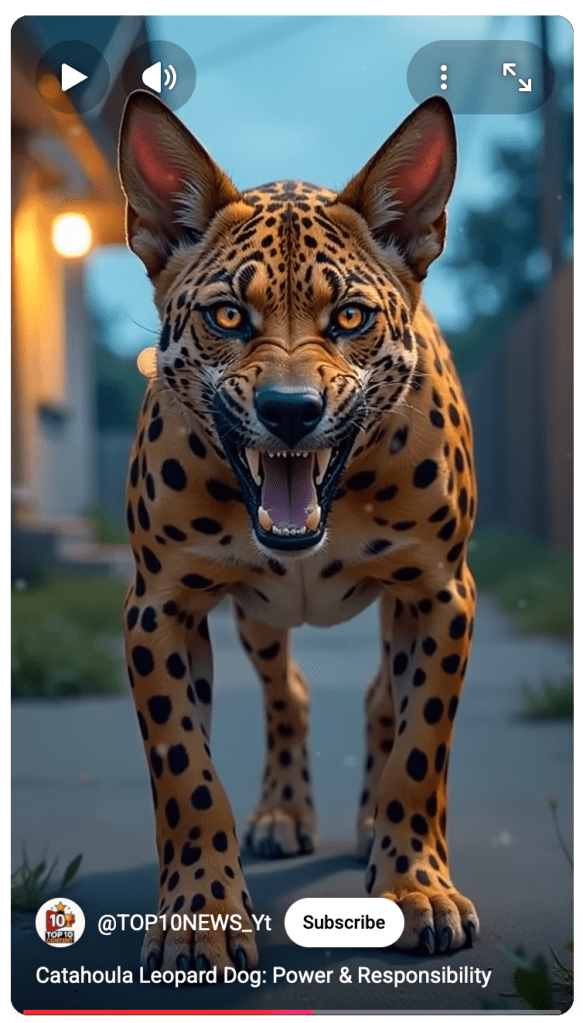
what
For when you gaze long into the leopard dog, the leopard dog gazes also into you

Out of touch

Getting a psychiatric diagnosis affects everyone differently. For many, it’s a catharsis, a key to self-discovery and self-acceptance. For others, it can be a troubling albatross, a confirmation that in some basic, inescapable way you will never quite fit in, not matter how hard you try. But one experience almost every newly diagnosed person shares is searching their memory for the clues to their condition that were missed, but now seem obvious: for all the past embarrassments, conflicts, deviations, and social failures that now have an explanation.

My first few weeks after being diagnosed with Autism Spectrum Disorder were full of denial. I told myself that I couldn’t be autistic because 1.) I was highly verbal; 2.) I didn’t have any sensitivities to the textures of fabrics or the sounds of chewing; 3.) I thought of myself as empathic to a fault, feeling shame for people who didn’t feel it for themselves; et cetera. But slowly I realized that none of this was cut-and-dry.

For example, I definitely have a lot to say (too much sometimes) when I get going on a topic that interests me, but I am super hesitant to talk with people I don’t know—and often even people I do know. I can talk too loud, I can mumble, I can stutter. I have to remind myself constantly to take turns with my interlocutors. And while for the most part I don’t have sensory issues, such as an aversion to anything but my favorite foods1, but often when I am wearing layers in winter I have a sudden claustrophobic reaction and need to tear everything off at once. And while I may feel empathetic, I have a very hard time expressing it, to the point that a lot of people assume I am blowing them off.

Then there are some dead giveaways that should have tipped me off much sooner: my many stims, the oddest and most off-putting of which is my constant desire to rub my feet together; my ability to develop any number of special interests and to flit from one to another; and my tendency towards living entirely inside my head. I learned from my mother that when I was a little boy I would sometimes drift off into an unresponsive reverie and she had to shake me by the shoulder to get me to focus.

So long story short, I eventually accepted (though didn’t embrace) my disorder. It has become painfully obvious to me that if ASD had been viewed with the more expansive eye of contemporary psychological practice, I would have been diagnosed much sooner, which might have given me tools to fake that eye contact that neurotypicals seem so keen on for some inexplicable reason2. This broader classification has led to more late-in-life diagnoses such as mine, as well as significantly more childhood ones, and is the obvious reason that reported ASD cases have greatly increased over the last decade, so RFK Jr. can go pound sand.

Eventually I worked my way through denial, bargaining, and depression (skipping over anger because I’m such a cool-headed guy3) and found my way into acceptance, however. By this I mean, paraphrasing Alan Watts, I started to become what I am. I embraced my obsessions, even the nerdy ones like math that I had tamped down so as not to bore people at parties. I found times and places to space out entirely and stim in all my weird ways. And I recognized a somewhat painful truth, which is that I don’t really like to be touched.

(This is where I assure my wife that I’m not talking about her. I have always loved her touch.)

What I am talking about it the various social ways people used handshakes, hugs, and (ugh) encouraging hands on shoulders. This had become a problem for me in the 2000’s because there was a growing norm that when you greeted people, or were greeted, you were expected to hug. Even men were often expected to hug other men, and it felt like a minefield to me. I was never sure how long or how hard I was supposed to hold on, and how to not be creepy about it, and it caused a lot of stress. My liberal self was glad that men were letting go of gay panic, but my autistic self was dying inside.

Two things happened that saved me: The #metoo movement brought scrutiny to previously tolerated behavior. And then there was the pandemic, which had even more of an effect. Over the course of a few years hugging became less and less prevalent, although there still are huggers out there, you just have to watch out for them.

Anyway, a couple of years ago, we got a dog, Hunter (see header image). Hunter is a large and muscular dog, half German Shepherd and half Catahoula (if you don’t know that breed, neither did we). He can look intimidating, and will bark fiercely at anyone with the temerity to deliver a package on our porch. But he is also a big softy and will snuggle up with any of the family (and strangers that we bring inside without his noticing). And he will vigorously lick, by which I mean he gets his whole foot-long tongue involved, and will stick it down your ears and your nostrils and anywhere else you don’t actively discourage him from.

And the weird thing is, while this seemed all too much at first, I became able to stand it. I told myself that Hunter needs to be able to express affection in his own language, and that whatever my personal reaction was (which was ick), this was something I could do for him. And herein lies the truth that I’m sure is obvious to neurotypicals, but which eludes many with autism: when you do something for someone you love, you can put up with a lot.

And so this is the blindingly simple life hack (again, ick) that I have learned from my dog. And while I don’t know if it will help me to hug any better, I’m all set the next time a four-legged friend greets me with their tongue in my face.


  1. I even have a great fondness for unpopular flavors like licorice, cilantro, mushrooms, olives, pickled herring, etc. ↩︎
  2. Honestly, guys, what the hell is this “windows of the soul” nonsense? Learn how to say what you mean and you’ll never have to guess what’s in someone’s head. ↩︎
  3. This isn’t remotely true. ↩︎