I met a traveller from an antique land

My undergraduate degree was in studio art, with a concentration in printmaking, and my favorite professor was the late great Garret Boone, or “Reverend Boone” as his students knew him (he was not ordained). I only had him officially for one class, Sculpture 101, but I worked with him on and off on various projects and grants for several years, and the better part of his teaching came from informal instruction which came in the form of anecdotes, pointers, and rules of thumb. I learned graphic design from Garret, which in those days was still done in paste-up, with acetate layers for each color ink and dry-transfer registration marks. In the pre-digital world of the late 80s, the most used tool for a designer was a #1 X-Acto knife, which could be hazardous if you weren’t careful. One day Garret chided me for leaving mine out loose and then he showed me an old draftsman’s trick: if you cut a Pink Pearl eraser in half, you can stick it over the blade of your knife and it will prevent bloody accidents.

Over the years, from grad school to freelancing to web design to museum work, I always kept my X-Acto knife and its eraser cap in my desk. Over time, I used it less and less, and it sat unused by my plastic Ames lettering guide, another relic from bygone analog days. Until a couple of weeks ago, that is, when I looked for the knife to cut some packing tape and I couldn’t find it. Eventually, I decided to purchase another via an online order. When it arrived, I was nonplussed to find that the new knife shipped with a plastic safety cap.
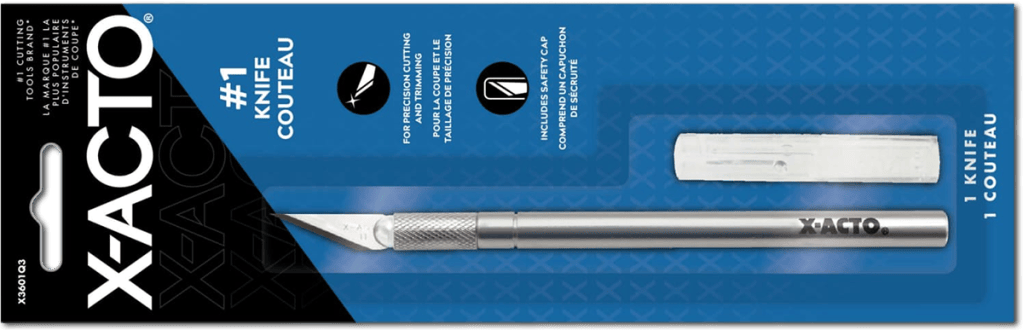
While it’s objectively a good thing that the knife has a bespoke safety cap, I couldn’t help but feel like something was being lost here. The wisdom of our ancestors—decades of designers, editors, and architects—was in that eraser. And even if I’m the only living soul who remembers this stuff, it’s still a loss.

I suppose in one sense this kind of thing is the inevitable result of getting older, but I can’t help but feel that I am particularly prone to the vagaries of obsolescence. In high school my dad owned an enormous (but allegedly portable) KayPro computer that ran CP/M; within a few years MS-DOS was the only game in town. When I was an undergraduate I thought to double major in computer science and I took a lot of programming classes. We were taught to program in Pascal using a VAX/VMS system, which would in only a few years’ time be completely eclipsed by C++ and Unix. In the early 90s I interned at the Museum of Fine Arts, Boston, which was one of the last organizations using the Wang operating system. So by my mid-twenties my head was full of a bunch of computing skills that would never, ever, be usable by anyone again.

In the late 90’s, web design became a career one could have; I had spent a few years trying to freelance as an illustrator and print designer, and I jumped at the chance to do something that made use of both the art and programming halves of my brain. In those heady days of the early World Wide Web (and everyone called it that then) there were no certification programs to become a webmaster (another term lost to the ages) and you learned everything in the gutter: you looked at page sources, you traded pointers on Usenet, you got your markup lambasted by the developers downstairs (thanks, John Siracusa1). HTML was not made for elaborate layouts and so everyone cheated by breaking it, using tables to position images and text, exploiting things like cell borders to create bevels, and generally making Tim Berners-Lee cry. In those days, every browser had its own quirks, Internet Explorer displayed box models all wrong, and PCs and Macs had different color palettes, all of which required some wild-west style wrangling of code. The techniques we used are etched in my mind—but are now rendered completely useless by content management systems like the WordPress that runs this blog.

But time marches on, right? New ways supplant the old, and for the most part it’s a positive thing. It may seem a bit solipsistic for me to bemoan the irrelevance of my skills in a world where most people look over their shoulders to see the ever-approaching wave of AI coming to rob them of their livelihoods. But as the years go on, I find that what I miss is not necessarily the old ways of doing things, but the hacks, the tricks, the rules of thumb that encapsulated a generation’s worth of know-how. These trade secrets secured your place in a community and a tradition. Plus, they were pretty neat.

Now if you’ll excuse me, I have a safety cap to lose.


  1. John worked at the same dot-com as I before he became a net celebrity. Small world. ↩︎
We hear the playback and it seems so long ago

I suppose I should mention here that this is a comic essay and I am exaggerating for, you know, effect. I grew up in a podunk town in the middle of bupkis, so that no doubt is reflected here. If you had a cool 80s childhood that was different, then good for you.

These days the popular conception is that the 1980’s were all pink and aqua, but they were actually surprisingly brown if you lived through them. The success of Stranger Things (at least before its las season), the rise in retro synth-pop as practiced by artists like Chapell Roan, the popularity of $30 vinyl versions of albums one can stream for free, a revival of shoulder pads and denim jackets, the number of YouTube reaction videos for the Goonies—all of these point to an interest in the decade of Reagan and Thatcher that goes far beyond the nostalgia of aging Gen-Xers, and speaks to the generation of kids out there longing for a time before smart phones ruined everything. This amuses me because I am old enough to remember the 1980’s revival of the 1950’s, and even the 1970’s revival of the 1900’s, which was a pretty darn weird thing if you think of it.

Of course, when you look at the 80’s through rose-tinted (and leopard-print-framed) nostalgia glasses when you weren’t even yet alive in the 20th century, you are going to get things wrong, especially if you’re being lied to by Netflix. Correcting perceived misconceptions of the time of my youth—when nobody asked—is the most old-man thing ever, but I just turned 58, so here I go.

'OK, boomer': la frase edadista que triunfa en las redes
actually I’m Gen-X, but no one under 40 knows the difference

I. The music wasn’t that cool

I am grateful, really, that Netflix has popularized Kate Bush for the TikTok set, but the truth is back in the 1980’s no one outside of the UK was listening to her (except me, I was cool)1. I remember playing my copy of Hounds of Love for my long-suffering high school girlfriend and her declaring the record “strange” and me “weird.”

These days, when a movie or tv show is set in the 1980s, the soundtracks are all songs by Echo and the Bunnymen, Elvis Costello, etc. Likewise, Spotify playlists and Sirius radio stations would have you believe the decade’s music was entirely New Wave. But in reality, fm radio playlists were 60% Michael Jackson, 30% Madonna, and the rest was made up of Hair Bands, Yacht Rock, and Pop Country (Kenny Rodgers was very hot around 1982). College radio stations might play Punk or New Wave, but only college kids listened to college radio. Rap was still being invented at the time but it was strictly segregated.

So when a television show or movie tries to play it cool with a Post Punk/New Wave soundtrack (and yes, I’m looking at you, Stranger Things) remember that we all want to think we were cooler kids than we really were2.

II. Design wasn’t totally radical

If you think of the eighties look, you probably are imagining some combination of pink, purple, aqua, and neon (“Miami Style”) or of angular floating shapes and zigzags atop backgrounds made up of repeating patterns of dot, lines, and squiggles (“Memphis Style3“). Or maybe you’re thinking of a mixture of both4. And if one is to go by the VH1 series I ♥ the 80’s, your conception would be true. But the truth is these styles were entirely the domain of MTV bumpers and overpriced boutiques that sold earrings made from shards of broken CDs5.

Miami style
Miami style
Memphis style

In reality, most design in the 80s was inherited from the 70s, which means a lot of browns and yellows, denim and tee shirts. It was the design of strip malls, K-marts, and ranch houses—but not cool mid-century ranch houses, cheap 70’s ranch houses with a lot of lucite. It was the age of particle board and the plastic shopping bag and those little springy doorstops that got all bent and never worked.

III. Punks weren’t everywhere

I was going to write a bit here about how in the 1980s it was de rigueur for crowd scenes in movies to feature a punk rocker with eyeliner and an enormous hairspray mohawk, or even violent gangs of these exotic creatures robbing convenience stores and fighting zombies, but it turns out that somebody else already wrote that better than I would.

I will add that punk culture was definitely a thing, but as a movement it was a lot less flashy, and more insular, and largely kept to itself. My wife had a punk era in her teens and she’s super cool. Real punk culture was rich in vernacular style and a DIY ethos. But mainstream America found punks to be scary and local news stories blamed them for everything that was wrong in society, and so fake, threatening punks were everywhere in movies and tv.

Also, valley-speak was entirely made up for that one Frank Zappa song.

IV. It was something of a hellscape

Look, I’m nostalgic for my childhood just like everyone else. I love my original 1980 Rubik’s Cube for which I still the original Ideal6-branded plastic case. But the 80s were not a good time to be alive if you were a woman, or black, or queer, or any combination of those. It was the decade when the Hippies made way for the Yuppies, and we elected a senile, jelly bean eating, horoscope believing B-movie actor who ruined everything. The myth of the Welfare Queen upset the squares so much that they tore apart the intricate support systems that fed starving children. Even as the Cold War was winding down, the U.S. couldn’t keep its imperialist hands out of Central America. Also, He-Man and the Masters of the Universe was an objectively awful cartoon.


This all may sound like a lot of complaints from a cranky old dude, but my motives are pure. I am a pathologically nostalgic person (just look at my tag cloud), but I am also aware of the toxic nature of nostalgia. As kids, my generation were brought up being told about the wondrous world of Boomer culture, of how everything was peace and love and drugs and sexual liberation and how each and every one of them had attended both Woodstock and Altamont. And how much the music today sucked, and how lazy and cynical the kids were. And I was determined that when I was older I would never let my own nostalgia cloud my memory, and I would not think that my childhood was more special and magical because I grew up when I did.

Now let me tell you why Talking Heads was the greatest band ever.


  1. She was huge in the UK, which is one way they’re better than us. ↩︎
  2. Except, of course, for me with my Laurie Anderson and my wife with her Smiths. ↩︎
  3. Which originated in Milan, Italy, although it was named after Memphis, Tennessee, by way of a Bob Dylan song. Look, the 80s didn’t really make sense. ↩︎
  4. It’s a free country. ↩︎
  5. CDs were actually everywhere in the 80s. ↩︎
  6. R.I.P. ↩︎

Hang in there

Note: this is another companion essay to an episode of podcast, Sophomore Lit. Maybe listen to it before reading this?

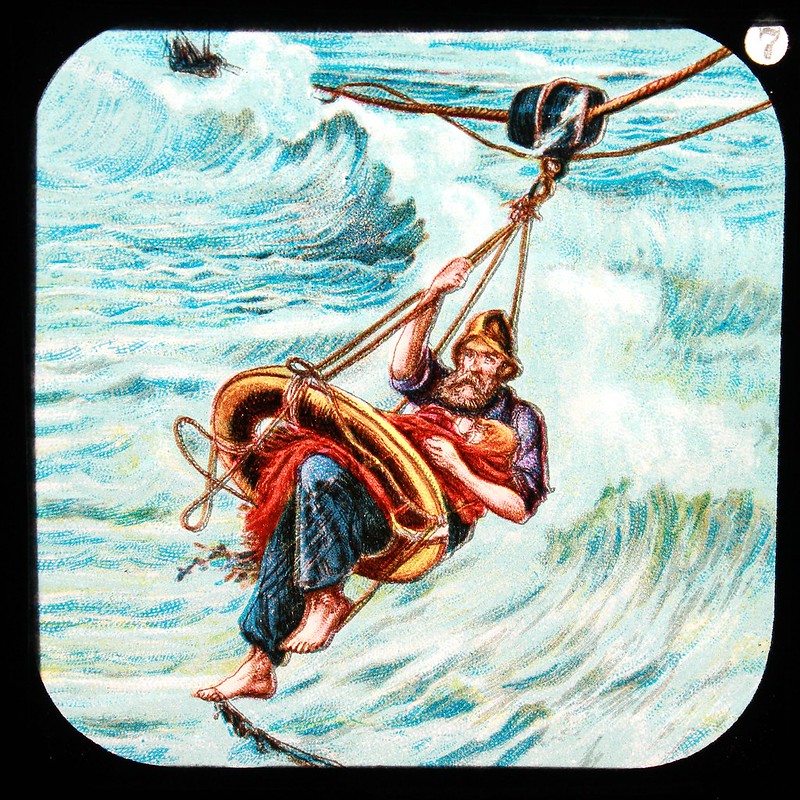
Shortly after recording the most recent Sophomore Lit episode about Robert Westall’s young adult novel The Watch House (1977), guest host Ross Cleaver pointed me towards an online discussion about a magic lantern series called Our Life Boat Men. While most of the eight-slide series features scenes of rescues involving life boats, there is one slide that depicts a rescue using a rope line and pulley, the technique that Westall describes in his book.

The Pulley
“The Pulley.” Slide no. 7 from the series Our Life-Boat Men, W. Butcher & Sons, c. 1901.
Image from Tyne & Wear Archives & Museums.

Magic lanterns were a form of image projector popular in the 19th and early 20th century. The ability of curved glass to bend light was known from antiquity, with the earliest written reference appearing in Aristophanes’ The Clouds. Reading-stones (rounded glass magnifiers) and even spectacles were used in medieval times. But modern lenses as we know them started in the 17th and 18th century with the development of the telescope and the microscope. By the 19th century optics had become precise enough to sharply focus projected light. This development, along with increasingly bright light sources, such as gas and limelight, led to the commercial production and popularity of magic lanterns.

Butcher & Sons “Primus” magic lantern, c. 1890.

These projectors used glass slides that came in a variety of sizes upon which were the images to be projected. The first slides were hand-painted, but later, photographic techniques allowed for mass replication. At first, publishing companies mechanically transferred black line images to the slides, most commonly using decals; colors (if any) still had to be added by hand. But at the end of the 19th century chromolithography and semi-transparent inks made possible printing uniform editions of magic lantern slides, albeit with often imperfect registration of colors, as is evident from “The Pulley.”

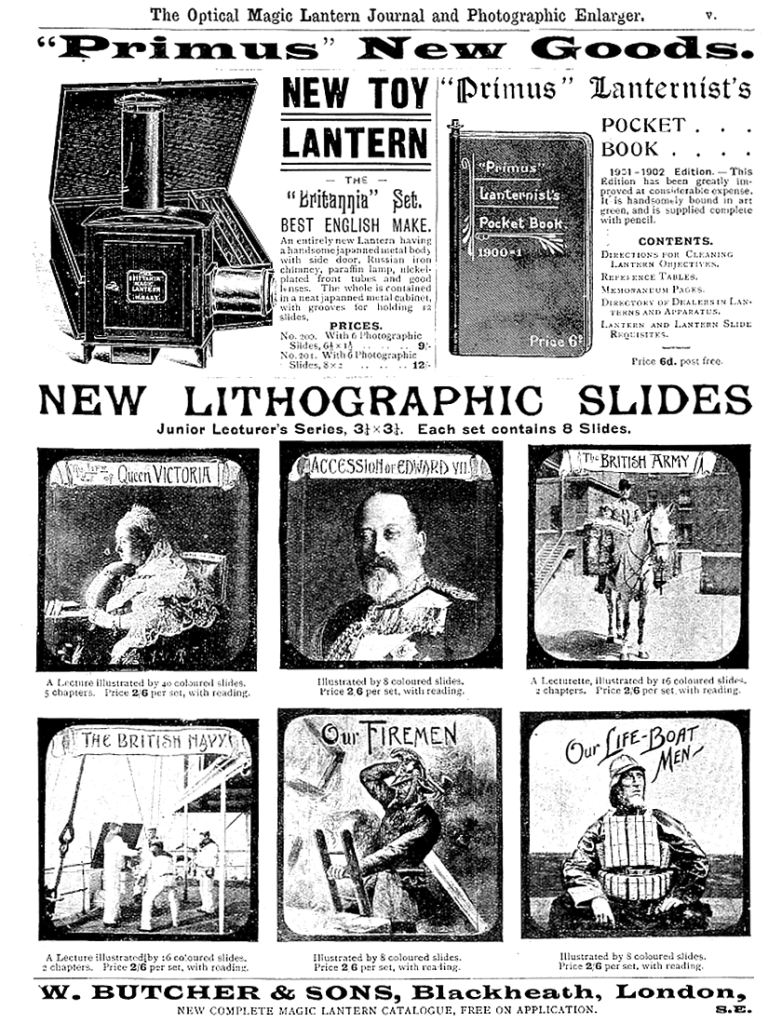
The series Our Life-Boat Men was sold as a part of London-based W. Butcher & Son’s Junior Lecturer’s Series. While the slides themselves are undated, a 1901 advertisement lists Our Life-Boat Men as one of six “new” lithographic sets produced to be used with their Primus line of lanterns. Butcher & Sons aimed at a market of well-to-do home users, and their chromolithographic slides were relatively inexpensive when compared to ones designed for theatrical use—and yes, in the 19th century people did pay admission for the privilege of viewing still projections in darkened rooms.

Butcher and Sons
Advertisement for W. Butcher & Sons in The Optical Magic Lantern Journal and Photographic Enlarger, November 1901.

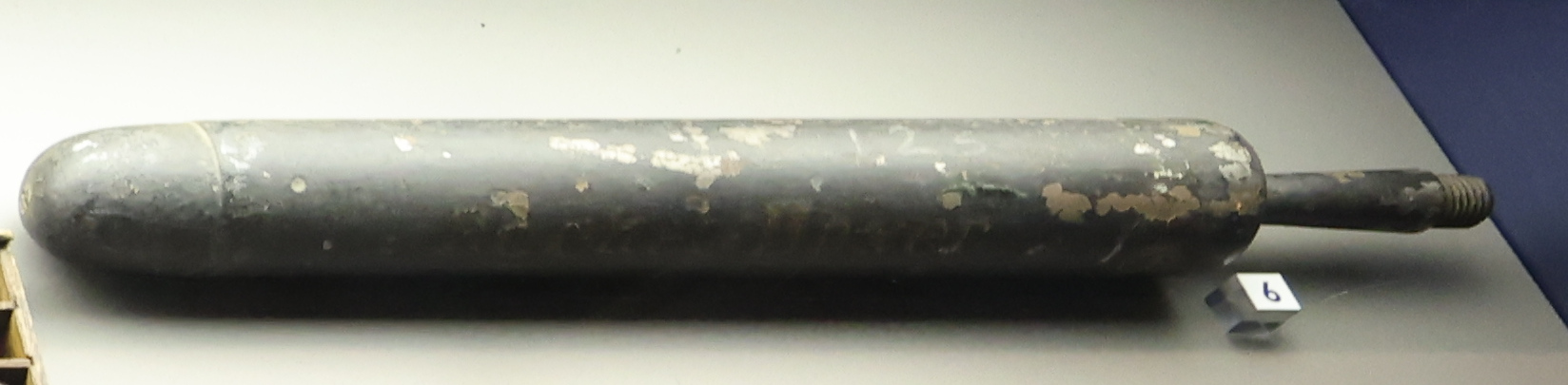
In Westall’s book, the book’s protagonist Anne is told of the techniques employed by the Victorian life-savers who used to work at the titular watch house. The port of the novel’s fictional town of Garmouth (based upon Westall’s hometown of Tynemouth) is bounded on its sides by shallows covered with mounds of rock, and in bad weather ships could beach themselves only a few hundred feet from shore. The watch house volunteers would shoot ropes to the ships using rockets and survivors could be drawn ashore using pulleys. As I mention on the podcast, when I read these passages—describing rescues carried out in the 1850’s—I was incredulous. It didn’t seem possible, especially with 19th-century rockets, to fire with such accuracy while dragging 20 pounds of rope (or more). But apparently this was a widely-used technique. The Shipwreck Centre & Maritime Museum of displays examples of the apparatuses that were employed.

The Boxer rocket, developed in 1855, was a two-stage rescue rocket.
Image by Geni, CC BY-SA 4.0, via Wikimedia Commons

In the slide “The Pulley” the intrepid hero is riding in a lifebuoy that is hitched to a hoist trolley—if something goes wrong, at least he has a flotation device. In his arms he appears to be holding a child wrapped in a tattered red blanket. The rescuer is lightly dressed for such cold weather, although he wears a sou’wester oilskin hat, which is standard rough weather maritime gear. There are narrative details that make me wonder. Why is the man barefoot? Is that standard practice, or did he loose his boots in the operation? He appears to have a strand of kelp trailing from one foot. Does this mean he’s grazing the water? Is he in danger of submerging? Come to think of it, how can the rope be staying that taut? Wouldn’t it dip with the weight of the passengers?

But mostly: Why can’t I stop obsessing over random bits of forgotten culture?