

My undergraduate degree was in studio art, with a concentration in printmaking, and my favorite professor was the late great Garret Boone, or “Reverend Boone” as his students knew him (he was not ordained). I only had him officially for one class, Sculpture 101, but I worked with him on and off on various projects and grants for several years, and the better part of his teaching came from informal instruction which came in the form of anecdotes, pointers, and rules of thumb. I learned graphic design from Garret, which in those days was still done in paste-up, with acetate layers for each color ink and dry-transfer registration marks. In the pre-digital world of the late 80s, the most used tool for a designer was a #1 X-Acto knife, which could be hazardous if you weren’t careful. One day Garret chided me for leaving mine out loose and then he showed me an old draftsman’s trick: if you cut a Pink Pearl eraser in half, you can stick it over the blade of your knife and it will prevent bloody accidents.

Over the years, from grad school to freelancing to web design to museum work, I always kept my X-Acto knife and its eraser cap in my desk. Over time, I used it less and less, and it sat unused by my plastic Ames lettering guide, another relic from bygone analog days. Until a couple of weeks ago, that is, when I looked for the knife to cut some packing tape and I couldn’t find it. Eventually, I decided to purchase another via an online order. When it arrived, I was nonplussed to find that the new knife shipped with a plastic safety cap.
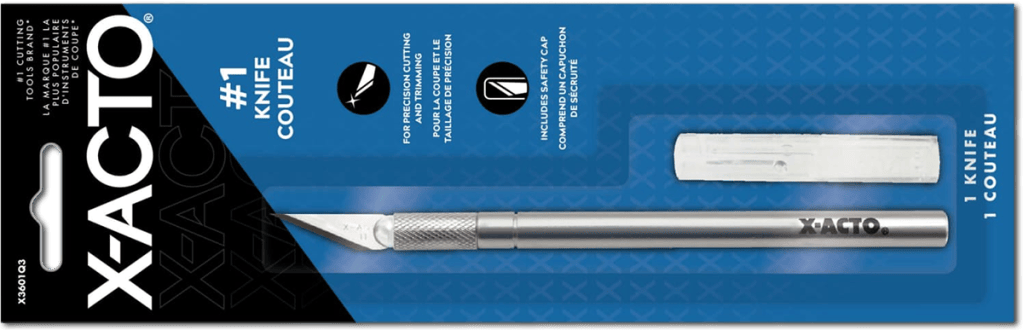
While it’s objectively a good thing that the knife has a bespoke safety cap, I couldn’t help but feel like something was being lost here. The wisdom of our ancestors—decades of designers, editors, and architects—was in that eraser. And even if I’m the only living soul who remembers this stuff, it’s still a loss.
I suppose in one sense this kind of thing is the inevitable result of getting older, but I can’t help but feel that I am particularly prone to the vagaries of obsolescence. In high school my dad owned an enormous (but allegedly portable) KayPro computer that ran CP/M; within a few years MS-DOS was the only game in town. When I was an undergraduate I thought to double major in computer science and I took a lot of programming classes. We were taught to program in Pascal using a VAX/VMS system, which would in only a few years’ time be completely eclipsed by C++ and Unix. In the early 90s I interned at the Museum of Fine Arts, Boston, which was one of the last organizations using the Wang operating system. So by my mid-twenties my head was full of a bunch of computing skills that would never, ever, be usable by anyone again.
In the late 90’s, web design became a career one could have; I had spent a few years trying to freelance as an illustrator and print designer, and I jumped at the chance to do something that made use of both the art and programming halves of my brain. In those heady days of the early World Wide Web (and everyone called it that then) there were no certification programs to become a webmaster (another term lost to the ages) and you learned everything in the gutter: you looked at page sources, you traded pointers on Usenet, you got your markup lambasted by the developers downstairs (thanks, John Siracusa1). HTML was not made for elaborate layouts and so everyone cheated by breaking it, using tables to position images and text, exploiting things like cell borders to create bevels, and generally making Tim Berners-Lee cry. In those days, every browser had its own quirks, Internet Explorer displayed box models all wrong, and PCs and Macs had different color palettes, all of which required some wild-west style wrangling of code. The techniques we used are etched in my mind—but are now rendered completely useless by content management systems like the WordPress that runs this blog.
But time marches on, right? New ways supplant the old, and for the most part it’s a positive thing. It may seem a bit solipsistic for me to bemoan the irrelevance of my skills in a world where most people look over their shoulders to see the ever-approaching wave of AI coming to rob them of their livelihoods. But as the years go on, I find that what I miss is not necessarily the old ways of doing things, but the hacks, the tricks, the rules of thumb that encapsulated a generation’s worth of know-how. These trade secrets secured your place in a community and a tradition. Plus, they were pretty neat.
Now if you’ll excuse me, I have a safety cap to lose.
- John worked at the same dot-com as I before he became a net celebrity. Small world. ↩︎
