

Some years ago—never mind how long precisely—I was on a vacation with my family, and—having little or no money in my purse—our recreation consisted of day trips to corners of New England that were unfamiliar to us, but close enough to not require a hotel. On the drive back from one of these we stopped in at a roadside second-hand store, and it was here that I purchased, for the princely sum of seven dollars, a 1943 edition of the card game Authors.
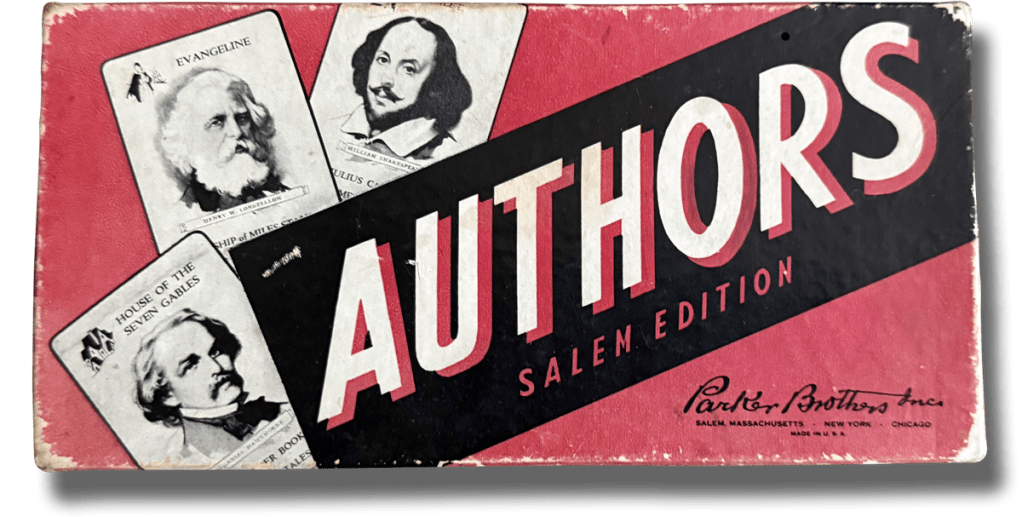
Authors had been a favorite game of my youth for a few years around 1975. If you are unfamiliar with the game, it’s basically Go Fish with a literary coat of paint. As in Go Fish, players attempt to make melds of four by asking opponents if they hold missing cards of the set they are collecting—but instead of collecting cards of the same rank, one collects cards bearing the titles of works by an author—e.g. for the Shakespeare set, you would need cards for Hamlet, Romeo and Juliet, Julius Caesar, and The Tempest. Thus, by familiarizing players with the works of Twain, Stevenson, Hawthorne, and Alcott, the game had a veneer of culture and respectability, which was probably a plus in the eyes of my mother, whose own parents forbade playing cards in the home, as these tools of the devil led inevitably to gambling.
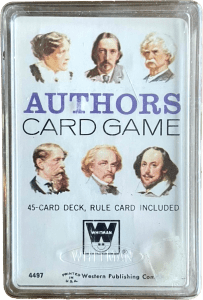
I was charmed to see that the 1943 cards had the same design as those from the 1970’s. Most legacy games go through major re-designs every decade or so; look at all the various editions of Clue, for example. However, the illustrations from my Parker Brothers set (1943) were not only included in the Whitman edition (first published in 19511 and in various editions through the 70’s), but also by a later edition published by U.S. Games Systems (1986) with the last version using these designs (at lest, the last I could find) printed in 1996.
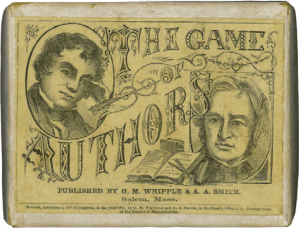
This isn’t to say that these were the original set of illustrations, or even the original selection of authors. The first version of Authors was published in 1861 by the Salem, MA company of Whipple & Smith, and its cover featured American short story writer Washington Irving and (checks notes), um, British poet Thomas Macaulay?
If you search for the creator of Authors you may find a credit for Annie W. Abbott and a date of 1843, fully 18 years before the game was first published. This confusing chronology is because Ms. Abbott created a card game called Dr Busby which had almost exactly the same play as Authors, except instead of collecting sets of four books, players collected cards representing members of four fictional families. Stewart Culin, writing in The Journal of American Folklore in the July–September, 1893 issue, claimed that Dr. Busby was retooled into Authors by an unnamed Salem man2; I have also read the claim that Abbott herself was responsible for the new game. But whomever was responsible, both Authors and Dr Busby are based on Go Fish, whose origins are murky, but which may have come from ultimately from the Italian game Andare e piscere in the 15th Century.

Wherever and whenever Authors came from, other publishers soon began to publish their version of the game, with differing selections of authors in a variety of formats. In my earlier essay about Parker Brothers’ game design in the 1970s, I referenced Philip Urbanes’s 2004 book The game makers: the story of Parker Brothers from Tiddledy Winks to Trivial Pursuit, which I thought might fill in some details for this essay. Unfortunately, Urbane discusses Parker Brothers’ initial publication of Authors only in passing, noting that around 1870 to 1890, the company began publishing existing games that they did not originate; Authors was one of these (copyright wasn’t the same back in those days).
Parker Brothers was headquartered in Salem, MA, the same as Whipple & Smith and (as mentioned) where Authors was originally conceived; some combination of these facts no doubt led to naming the 1943 version of the game the “Salem Edition.” Parker Brothers distinguished its versions from the competition with high-quality illustration and state-of-the-art reproduction, and sold several versions at the same time, with names like “the Nickel Edition,” and “the Petite Edition De Luxe.” Even the game’s title varied on the cover of different editions, from The Game of Authors, to Great Authors, to Household Authors, which is my favorite because it implies that every good home should have a stock of writers3.

The Salem Edition (my edition) seems to have been the first to use the familiar illustrations, which are unfortunately unattributed. Unless somewhere there are archives still extant that contain correspondence or billing from the 1940’s, the artist has been lost to time. However, they appear to be the work of one hand, or perhaps a few artists working under close direction. Even though they are remarkably of a piece with one another, there are some odd variations to note. While all seem to have been painted in watercolor over an underdrawing, some are noticeably darker, such as the Robert Louis Stevenson portrait, which has heavy shadows painted with opaque colors, possibly using gouache.
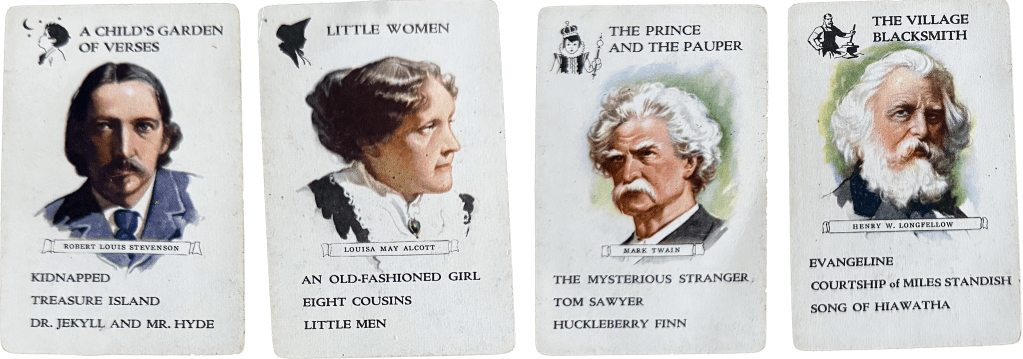
The level of detail varies, probably owing to the source material being copied; this material would have included photos and engravings of the authors, as well as earlier versions of the game. About half have a highly painterly background of washes in blue, green, and yellow; the others are presented on flat white. And one portrait, that of John Greenleaf Whittier, has an entirely different ground treatment which almost resembles airbrush.
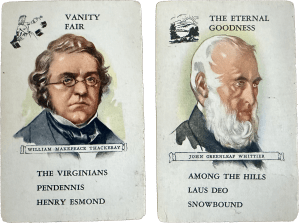
Wait, John Greenleaf who now? This edition contains two authors that were cut from the deck when the designs transferred to Whitman publishing: William Makepeace Thackery and John Greenleaf Whittier. The English Victorian Thackery is still read today, primarily for his novels Vanity Fair and Barry Lyndon. The American Quaker abolitionist Whittier, however, is not a name you will know unless you study 19th Century American literature, and then only as an example of a poet who was popular in his lifetime, only to fall into obscurity when his earnest, moralizing style failed to resonate with 20th century tastes. It’s not surprising that editions of Authors reflect the forever evolving literary canon. The Rare Book School at the University of Virginia had an exhibition of Authors cards in 2025 that focused specifically on the writers who have come and gone through many, many versions over the last 150+ years.
The novelists, playwrights, and poets selected for the 1943 portraits are mostly Victorian, with the most recent work referenced being Mark Twain’s The Mysterious Stranger (1916)4. Looking over the assortment of writers, it’s impossible not to note that they are all American or British, white, and—save for the exception of Louisa May Alcott—male. Aside from this chauvinism, it’s also interesting that for a game published in 1943 there were no Modernist authors—this was the era of Hemingway, Faulkner, Edna St. Vincent Millay, Fitzgerald, Eliot, etc. Probably the choice was in part set by earlier versions of the game. And perhaps there was an editorial decision to avoid living writers. Whatever the criteria, the game’s roster of authors is stodgy, academic, and leans heavily on sentimental and Romantic writers.
All of this was lost on me as a child when I played the game. I assumed that the authors selected were, in fact, the greatest and most important names in literary history, and for many years I kept the titles on the cards tucked away in my memory. This was my first brush with the idea of a canon, and I found it appealing because it implied that great books were finite and that it would be possible to read them all, and then I guess I thought you would be done. These days I’m less inclined to think this way, although I do have a podcast about the subject.
My copy of the 1943 edition has a few interesting features. It has it original rule sheet, beautifully block printed in a variety of typefaces, including a midcentury geometric sans-serif font that closely resembles Futura. This sheet calls the game “PARKER BROTHERS’ IMPROVED GAME OF AUTHORS” and declares that it is the “BEST EDITION.” My favorite passage of these rules comes at the end, where it lists “other PARKER GAMES” which include Monopoly, Rook, and Camelot, which is noted as: “the most absorbingly interesting of all games of skill, and many times more exciting than Checkers.” I have no idea what the game of Camelot is, but I chose to believe the claims made on its behalf, and I won’t Google to learn otherwise.
The game box also contains a shallow tray of yellow cardboard discs that the rules calls “counters” (with quotation marks). These are to be awarded for each meld a player makes, but with the twist that first three are given, then two, then one, and then back to three, etc. This mechanic seems so tacked-on that my assumption is the discs were cast offs from holes punched in another game that some office manager decided to repurpose. Also in amongst the cards there is a rule card from a later Whitman edition of the game, which is (oddly) far more worn than any of the portraits.
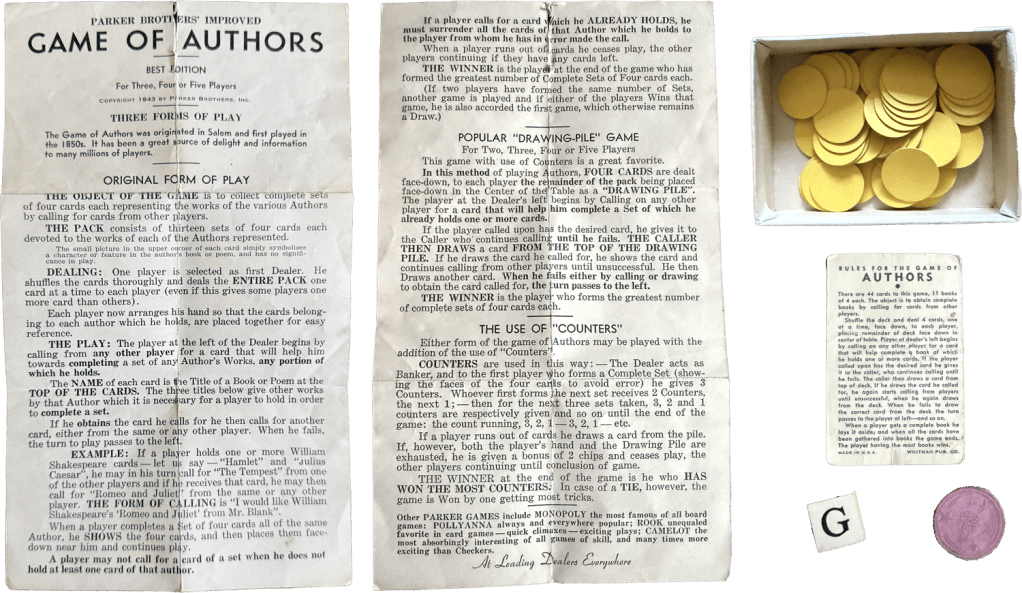
Finally, my copy of Authors also contains both a faded lavender wooden checker and a Scrabble tile of the letter G. These were left mysteriously by its previous owner, and one can only imagine how each contributed to any house rules.
- How and why the designs transferred to Whitman is a mystery to me. I know Whitman primarily as a children’s book publisher, particularly for its licensed works featuring Disney characters. ↩︎
- Quoted in Kaplan and Miller; see note below. ↩︎
- If you are even more fixated on this subject than I am, there is an exhaustive 476-page catalog of every known edition of Authors and ancillary games: The Game of Authors Compendium Stuart R. Kaplan and William G. Miller (2021). ↩︎
- This is a peculiar choice. In his final years, Twain wrote several divergent drafts of The Mysterious Stranger, perhaps his most bleak and existential writing ever. The eventual posthumous publication in 1916 was cobbled together with parts rewritten by Twain biographer Albert Bigelow Paine. Contemporary scholars do not ascribe this edition (the one referenced in Authors) to Mr. Clemens. ↩︎


