Safe & non-toxic

Back in the days when Halloween was primarily a night for kids to knock on doors to get stray change and popcorn balls; back before the holiday morphed into an excuse for young adults to dress as sexy versions of 90’s cartoons and get their slutty drink on; that is, back in the 70s, store-bought costumes were crap. They consisted of thin vacuum-formed plastic masks and silkscreened bodysuits which were made of a mystery fabric that was not quite muslin, not quite plastic, but 100% flammable. Eventually even this material was deemed too costly to produce and the suits were made entirely from vinyl, lending them all the drape of a deflated beach ball. These were the ubiquitous licensed character costumes made by Ben Cooper, inc., which, defying all reason, are highly collectable today. Nostalgia is a hell of a drug.

Ben Cooper
Ben Cooper brand costumes: bring them up the next time a Gen-Xer complains about how everything was better back when.

Of course, there were kids and parents who wished to avoid paying a whopping three bucks for commercially-produced outfits that were only marginally recognizable (owing to the fact that they had the characters’ names emblazoned on their chests). For the non-conformists, costumes of hoboes, pirates, ghosts, and mummies were good options because you could make them out of last year’s ratty clothes and sheets and felt and other bits of stuff lying around (toilet paper was often involved). But for the true weirdos, those who aspired to be something scary or gross for Halloween, there was only one game in town, and that was the Imagineering line of makeup and prosthetics. They were cheep, funky, grungy, and surprisingly effective, especially when it came to making gaping wounds and the like, and I loved them so much.

Imagineering
Imagineering products from the early-to-mid 1970s. I would dearly love to know who illustrated these. Also, note that these were vacuum sealed to their card backs—blister packs were still a few years off.

Instead of selling full costumes of specific characters, the Imagineering line consisted of theatrical building blocks you could mix and match. There were evil teeth and fake fingers. There was fake blood and tooth blackout. And there were small pallets of ingenious stage makeup, such as Scar Stuf™, a mixture of beeswax and cotton fibers that seemed like it couldn’t possibly work but which did in fact produce startlingly realistic scars, wounds, and other abrasions.
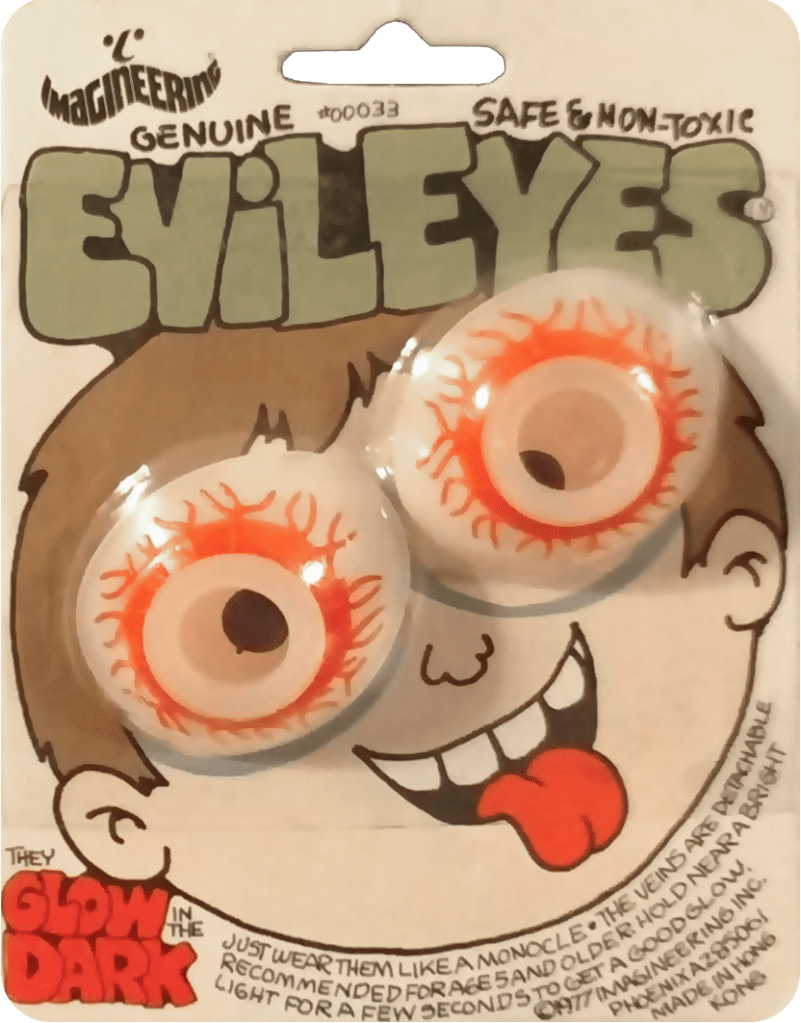
Evil Eyes

For much of my childhood I was limited to the pointy teeth and fake blood. I was not particularly flush as a kid, and while most items in the Imagineering line ran 50-75 cents, that was still a lot for me. Until one October—maybe ’78 or ’79—when I finally had some income of my own from delivering The Peoria Journal Star (afternoon edition). That year I finally splurged on a pair of Evil Eyes, the prosthetic eyes that GLOWED IN THE DARK. In light they were just a couple of ovals of plastic but in complete darkness, they were Fire from the Very Depths of Hhell. To maximize the glow effect, I would hold the plastic eyes under my reading lamp—a gooseneck 75 watt lamp clipped to the headboard of my top-level bunk bed—for about five minutes. Then I would run to the darkest place in the house (mostly under a blanket in my closet) and stare in horror at the glowing orbs until they faded into blackness. Of course, like all glow-in-the-dark toys, the magic was over far too soon, and the best effect could only be achieved by holding the eyes a long time as close as I could to the incandescent bulb, which was blisteringly hot. To save my fingertips, I took to placing the eyes on my bed and bending the lamp down as close as I could. One day I decided I would get the best glow ever by bringing the lamp down so that the hood touched my quilt and the bulb pressed against the eyes, shutting the precious lumens in entirely. Pleased with this set-up, I went off to get a snack before I would take the eyes into the dark.

Two hours later, my mother came into the living room where I was sitting reading and asked if I smelled something funny. My father also was alarmed. We walked down the hall and it became apparent that thin black smoke was coming out of my bedroom door. When we entered there was a cloudy, oily plume coming from under my lamp, which was still directly on my quilt. My father grabbed a sock to push away the lamp, which had deformed from the heat. We were greeted with a massive billow of inky miasma; and underneath, a soupy, sticky mess of plastic making tendrils from the bulb to the quilt, which now had a smoldering hole in one block. My shocked parents asked me what on Earth I had been doing and I was at a loss to explain myself. Secretly, all I could think of was if there were a way to block out the windows because holy hell, those goopy, melted eyes would’ve glowed like the sun.

The stream of warm impermanence

Strangely enough for a podcaster whose whole deal is revisiting high school assigned reading, very little of the plot of J.D. Salinger’s The Catcher in the Rye (1951) sticks in my memory. I know it involved a lot of wandering through the seedier parts of New York City, and that there was a lot of stuff about how phony adults are. There is one passage, though, that I remember clearly and think about often: a section where the novel’s runaway teen protagonist, Holden Caulfield, reflects on the enduring appeal of visits to the American Museum of Natural History. In particular, he describes the life-sized dioramas that—in his mind, at least—never change:

The best thing, though, in that museum was that everything always stayed right where it was. Nobody’d move. You could go there a hundred thousand times, and that Eskimo would still be just finished catching those two fish, the birds would still be on their way south, the deers would still be drinking out of that water hole, with their pretty antlers and they’re pretty, skinny legs, and that squaw with the naked bosom would still be weaving that same blanket. Nobody’s be different. The only thing that would be different would be you.

In this passage, Holden is seemingly describing an actual diorama that was on display in the AMNH when Salinger wrote the book: a depiction of an Inuit woman ice fishing1. The scene has been preserved in a guidebook photograph from 1911:

AMNH
Photo from General guide to the exhibition halls of the American Museum of Natural History (1911)

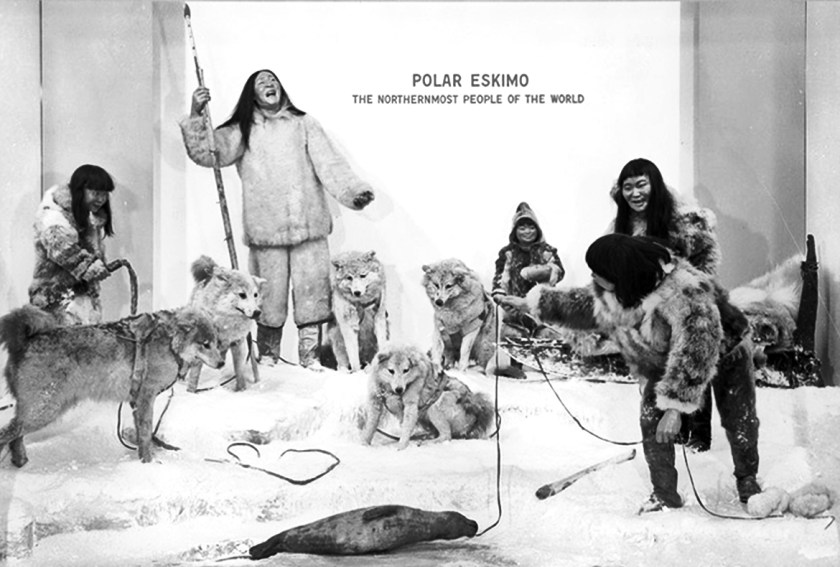
But in spite of Holden’s prediction of the display lasting “a hundred thousand” visits, just four years after the publication of The Catcher in the Rye the AMNH had replaced that diorama with another, reflecting the changing ethnography of the time:

“Polar Eskimo” installation at the American Museum of Natural History, 1955

Today, of course, neither of these dioramas are still installed, and the term “Eskimo” is considered both overly vague and possibly offensive. Arctic natives are now referred to by their nation names of Innuit or Yupik.

Exonyms aside, in this passage Holden expresses a common assumption: that museums are by definition static, fixed in time, and that the objects they display are and will always be definitive. For some, like Holden, this seeming changelessness is a source of comfort. Others may find the idea petrifying or morbid. For example, Bruce Dickinson of the heavy metal band Iron Maiden has criticized Cleveland’s Rock and Roll Hall of Fame, claiming “Rock and roll music does not belong in a mausoleum […] It’s a living, breathing thing, and if you put it in a museum, then it’s dead.”

Pro or con, immutability is implicit in both Holden’s and Dickinson’s words. But in fact, Museums are in constant flux. Sometimes changes are little. When I was in graduate school in Art History, the nautical artist currently known as Fitz Henry Lane was called Fitz “Hugh” Lane. While art museums everywhere (inluding the Fitz Henry Lane House) have corrected their attributions, I still find myself using the old name out of habit2. Some changes are enormous changes. When I visited the AMNH myself as a young child, the Roosevelt Hall—the grand entryway from Central Park West—did not feature its current display of mounted Barosaurus and Allosaurus skeletons battling. Instead it had a series of bronze statues of Nandi warriors hunting lions3, and the dinosaurs it did have on display on the fourth floor were still walking upright and dragging their tails behind them. And, of course, the most famous dinosaur on display then was the Brontosaurus. The skeleton was one of the first excavated by Earl Douglass at the fossil deposit that would be designated Dinosaur National Monument. I had a toy Brontosaurus that we bought at the museum; it was a mainstay of my childhood, although the tail eventually got chewed away by the dog. And by me.

Marx toys Brontosaurus (mold from 1955). This palaeontologically incorrect toy line is, like so much of my youth, highly collectible.

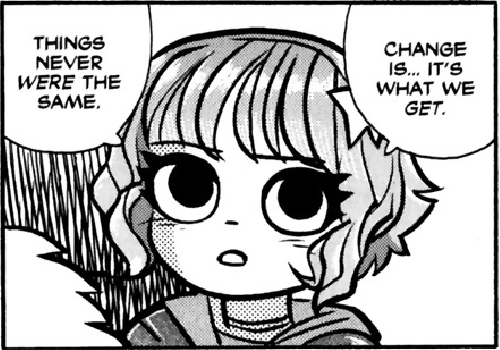
But as you probably know4, this skeleton was in fact a frankenfossil, an Apatosaurus whose missing skull was replaced with one from a Camarasaurus. When the skeleton was re-mounted in the 1990s to reflect new beliefs about the posture of dinosaurs (no more dragging tails) it was re-labeled as an Apatosaurus. Brontosauri were, in fact, no longer considered a genus. Except in 2015 they suddenly were real again. As Ramona Flowers put it, “Dude…”

change
Bryan Lee O’Malley, Scott Pilgrim’s Finest Hour (Scott Pilgrim Vol.6), 2010

(Warning: Politics) Recently I’ve been thinking about Holden’s dioramas a lot these days in relation to the complaints President Tump has made regarding the Smithsonian Institution’s collections and exhibitions. Putting aside issues of the legality or propriety of the Administration attempting to set policy for an institution that is supposed to be independent of any branch of government, this the culture-wars approach to museums seems to me to be related to the assumption that museums are, or should be, the caretakers of singular, true and timeless narratives.

Museums should, and do, take their role as authorities of truth—or at least, of cultural significance—seriously. Non-specialists visit these institutions in part because they trust curators to know their stuff. Visitors want to be guided through subjects they care about but of which they know little. But curators, conservators, registrars, and others who do know a lot have are also aware of how knowledge is never complete. They design exhibitions to reflect the current state of scholarship, and scholarship—in both the sciences and in the humanities—is constantly questioning and re-evaluating what we think, and asking what has been overlooked, and what assumptions got us here. Truth isn’t a matter of supporting a specific set of beliefs, and the stories we tell—even about ourselves—change the more we know. (end politics)

Nonetheless, I get what Holden is on about. As this blog has documented again and again, I’m full of misplaced nostalgia, and that can express itself as a general aversion to change. I think I have the most nostalgia for things that I wasn’t even around for the first time. As a child, I would visit Youngstown, Ohio’s Mill Creek Park. This park had a nature center that was housed in a 19th Century stone building, and within this was a display of old museum objects, including a shelf full of small animals and plants preserved in large jars of formaldehyde, with their contents written on peeling gum labels in a shaky copperplate script.

biological samples
I couldn’t find any photos of Mill Creek Park’s samples, so instead enjoy this collection of engravings of the zoological preservations of Frederik Ruysch.

These jars both fascinated and horrified me, and they gave me a lifelong love for Victorian and Edwardian museology—stiff taxidermy, dovetail jointed display cases, hang tags, and all the rest. They represent a time when knowledge consisted entirely of collecting, categorizing, and cataloguing. I don’t know if these jars are still on display, but the fear that they may no longer be has kept me from revisiting the park as an adult5.

photo by Kasuga Aho, licensed as CC BY-NC-SA 2.0

My favorite archaic museum exhibit, however, is Mathematica: A World of Numbers… and Beyond. Created by the wonder couple Charles and Ray Eames in 1961, one of the traveling versions of the exhibition is still somehow improbably on display at Boston’s Museum of Science in this, the year of our Lord 2025. This wonder of Mid-Century design could just as well be housed in an art museum. It drips with the charm of 1950’s typography, pastiches of Victorian broadsheet design, and cool, elegant physical objects demonstrating probability, topography, and number theory. A highlight are the “peep show” videos that accompany the exhibition. Here are a few:

Maybe it’s the sheer artfulness of this exhibition that has convinced the Museum of Science to continue to devote to a portion of limited floorspace to its presentation. It could also be that the subject of Mathematica is seen as pretty permanently fixed. But even mathematics changes, and perhaps one day this exhibition will also find its Brontosaurus.

I’m not sure what Holden would make of this essay. Like many of my posts, it sort of chugs along and then stops when I run out of things to say. I guess I hope he would understand that nothing is ever the final word—not museums, not scholarship, and certainly not blogs.


  1. Holden says that the figure is a man, but Holden is wrong about a lot of things. ↩︎
  2. I also still haven’t heard a convincing explanation as to why it was “Hugh” in the first place. ↩︎
  3. These statues, by taxidermist and big game hunter Carl Akeley (or perhaps a separate set of bronze castings), are still housed in Chicago’s Field Museum. ↩︎
  4. Being the kind of nerd that reads my blog. ↩︎
  5. Well, that and having to travel to Youngstown. ↩︎

Live fast, fight well, and have a beautiful ending

In spite of being a tiny town surrounded by endless fields of corn and soybeans, Eureka, Illinois used to have a small movie theater, the Woodford, whose Art Deco stylings dated to 1937. It had once been charming (or at least serviceable) enough, seating 400, but the time I knew it in the 70’s the theater had become a sad thing, with patches of the original carpeting replaced here and there by linoleum, haphazard electrical conduit tracing the walls like vine, and a semi-functional bathroom the size of phone booth (all my references date me) whose pull-chain toilet had seen the end of tens of thousands of movie-goers.

The Woodford Theater had settled to the bottom of the distributional food chain, showing second-run movies three times a week and softcore exploitation films late Friday nights. Within a few years, VCRs would kill the market for both of these services.

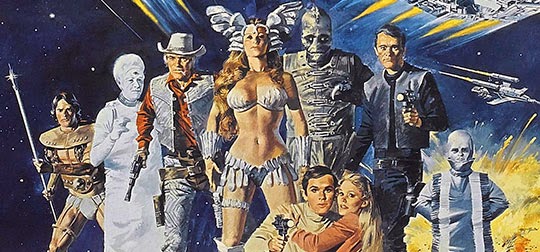
In 1980, New World Pictures released Battle Beyond the Stars. Today I know all about Roger Corman and his infamous studio and that this film was conceived as a prestige project for the company, a retelling of The Magnificent Seven but with its cowboys in space (there is an actual character in the movie called “Space Cowboy”). It even has a screenplay by indie darling John Sayles. But at the time I was 12 and all I knew was that an article in Starlog was calling this a more adult version of Star Wars and Star Wars was the Best in Life. The movie did star John-Boy from the Waltons, and I was not a fan that show, but probably he wasn’t so important, right?

My brother and I went to see it on “opening” night, which was probably a month or so after it had been in release. The crowd of maybe 60 or so was mostly bored kids who didn’t have a license or a car and couldn’t make it to Peoria and so were stuck sitting here in the theater’s torn, creaking seats. The audiences at the Woodford were always noisy, but for some reason that night the movie was late in starting, and stray pieces of popcorn were already being lobbed in lazy arcs. Twenty minutes past screentime, the house lights were still on. A chant went up: “Lights! Lights!” The lights went down, but still no picture. The audience booed. Then at last the credits began: cheers! But why was there no music? Some ugly murmuring. The first scene, involving the destruction of a peaceful spaceship by a looming alien warcraft played out in complete silence. “Sound! Sound!” went a new chant, but no sound came through the expository sequences, which consisted mostly of a scene of a futuristic city where John-Boy and his compatriots stood around in robes and stared at the invaders’ ship. As it became apparent that no dialog would be forthcoming, the audience began to yell questions: “What’s even happening?” “Why are they just standing there?” and “Where’s Jim-Bob?” Someone started to sing the Star Wars theme and many people joined in.

About ten minutes into the movie, the sound abruptly came on with a deafening crack of static, and the audience cheered. John-Boy was in a spaceship: a bulbous, sagging form that looked as if it could use a space bra, flying away from his besieged planet, adjusting some instruments and talking to his ship’s computer, which had a sassy woman’s voice and calls him “kid”—and then the image froze, followed by the classic bubbling and melting of scorched celluloid, and there was a riot of teens and pre-teens jumping out of their seats and tossing Jolly Ranchers at the projection booth. The lights came up and an usher walked in, half-heartedly held up his hands in a gesture of quieting, and then shrugged and left. The lights went down again and now there was a scene involving a lizard man talking to a captive woman strung up by her hands in some futuristic cell. “What the F—K?” yelled an older kid from the front row and the usher reappeared. “No language. Watch the goddamn movie,” he barked.

Every character had a defining tic or phrase that the audience picked up and responded to. Space Cowboy would mention at every opportunity that he came from Earth and so whenever a scene cut to him someone would shout “from Planet Earth” before Vaughn could. The sound continued to die for minutes at a time and during these moments the crowd yelled out catchphrases, sound effects, and expletives, but the usher did not return. There was no need; the atmosphere had changed from surly and combative to giddy, engaged, and even strangely affectionate. We had long ago given up on the movie as a movie and had moved on to the movie as a Happening.  To be honest, I don’t remember much about the movie’s second half. I remember people cheering whenever Sybil Danning or Robert Vaughn showed up to chew more scenery; mock-sobbing whenever one of the ragtag group of defenders met a violent end; and jumping out of their seats in delight whenever the sound cut or the film broke, which it did many times. Eventually the film ended and the audience rose to a standing ovation.

The plot of Battle Beyond the Stars, such as it is, involves John-Boy’s character traveling through space to secure the aid of mercenaries to fight back his planets’ invaders, since his home world is aggressively pacifistic, as befits an alien culture based entirely on white robes and large crystals. He meets aliens wearing space-clown makeup who have third eyes, as well as an intergalactic trucker named Space Cowboy, played by Space Robert Vaughn (space slumming it). But most memorably for the crowd reaction, he meets a Space Valkyrie portrayed by Sybil Danning, a warrior in a metal bikini and winged headpiece who lounges reclined in her fighter ship with the camera shot straight up her heaving bosom. When she delivered her lines about the glories of the warrior life in as low a register as she could manage, her chest rose and fell with such force that the audience began to breathe loudly along with her in an imitation of Darth Vader.

In this post- Mystery Science Theater world we are familiar with the joys of bad movies, of Troll 2 and The Room. Battle Beyond the Stars is not a great film, nor do I think that it’s hilariously awful—it’s just a hack job from a time when there was a theatrical market for knockoffs of other, better movies. I wouldn’t recommend watching it today on DVD or YouTube, even ironically. But that experience, in that sad little broken-down movie house was one of the most joyful I have known.

Within three years of this screening, the Woodford Theatre closed. Today the building is a thrift store.