

In the summer of 1977—shortly after Star Wars’s release—my family moved to Eureka, Illinois, where my father had accepted a faculty appointment at tiny Eureka College. I believe at the time the school had an enrollment in the mid 300s; and while it’s still chugging along these days, with about 530 undergraduates, the college remains one of those small regional schools that are sadly disappearing as large universities eat up what’s left of a contracting student demographic. Will it last another 50 years?
Anyway, that summer my family lived in an empty women’s dormitory at the college while my parents searched for a house in Eureka that they could afford. My life was entirely spent on the dinky campus: wandering unsupervised through the student union; teaching myself BASIC on the college’s HP 3000 timeshare mainframe; sneaking into the biology department to stare in horrified fascination at the human organs preserved in jars of formaldehyde; and most of all, roaming the stacks of Melick Library. The building had been built a mere ten years before, and everything about its drab late-midcentury design felt like the future to me: its rolled gray linoleum flooring; its off-white painted cinderblock walls; its aluminum floor-to-ceiling shelving; and—most of all—its floating staircase, which extended from the basement to the second floor and gave a vertical view through the entire structure.


For the next decade of my life, from my tweens to my teens, Melick Library was something of a second home—even more so when my mom became a reference librarian there (eventually she was promoted to head librarian). Melick’s stacks supplemented the censorious public education of the Eureka school system. My middle and high school textbooks featured bowdlerized abridgments of Chaucer and Shakespeare; Melick Library introduced me to the earthy writings of Kurt Vonnegut and Kathy Acker. The Woodford County children’s theater program staged made-for-kids musicals featuring singing squirrels; the Melick stacks were full of the works of Brecht, Pirandello, and Ionesco. Our middle-school health classes embarrassedly told us sex was for making babies only when you were married; Melick had the book Human Sexualities that featured racy nude photos by Duane Michals. There were even fever dream books that made no kind of sense, like the enormous spiral-bound Arcology: The City in the Image of Man, architect Paolo Soleri’s inscrutable manifesto about fantastical cities that are massive single structures.
A teen having unfettered access to a college library is everything Moms for Liberty warns against, and time and again I felt like I was partaking in something forbidden and perhaps dangerous simply by being there. But of all the forbidden fruit on the shelves, there was one book I returned to again and again like some sort of arcane grimoire filled with secret knowledge, and that was Biology Today. This enormous, mysterious, and impenetrable tome confused my adolescent mind in the best way. I didn’t know it at the time, but I had happened upon a book that was an anomalous in its genre, highly controversial, a publishing failure, and which would in time develop a small cult of fans. To this day copies can sell to collectors for hundreds of dollars.1
I have mentioned this book in passing before, but didn’t have the space in that essay to more fully discuss this strange capsule of 1972 culture. It’s a heavy tome—heavy as in “weighing 5.8 pounds,” but also heavy as in “heavy, man“—and it’s ostensibly meant as a college textbook for a standard two-semester class in introductory biology. The book doesn’t refer to itself as such, however—the preface presents the work as sort of a general-reader targeted omnibus of the current state of the life sciences. It contains none of the usual textbook apparatus such as marginal examples, review questions, or suggested assignments. And to be honest, it’s hard to imagine the book actually being used by undergraduates.
The first edition (the only one that’s interesting) was published by the long-defunct CRM Books, an abbreviation for “Communications / Research / Machines, Inc. Books” CRM’s main claim to fame was originating the magazine Psychology Today2. For a book of natural science, Biology Today is a strongly humanist work. It presents its subject with a strong emphasis on human biological systems; but it also veers off into subjects that are biology-adjacent, or sociological, or whatever the authors thought might be interesting to write about: sociobiology, psychology, sexuality, drug use, overpopulation, etc. And its eccentric musings are sumptuously framed with cutting–edge graphic design and profusely illustrated with colorful, psychedelic, and often explicit graphics.
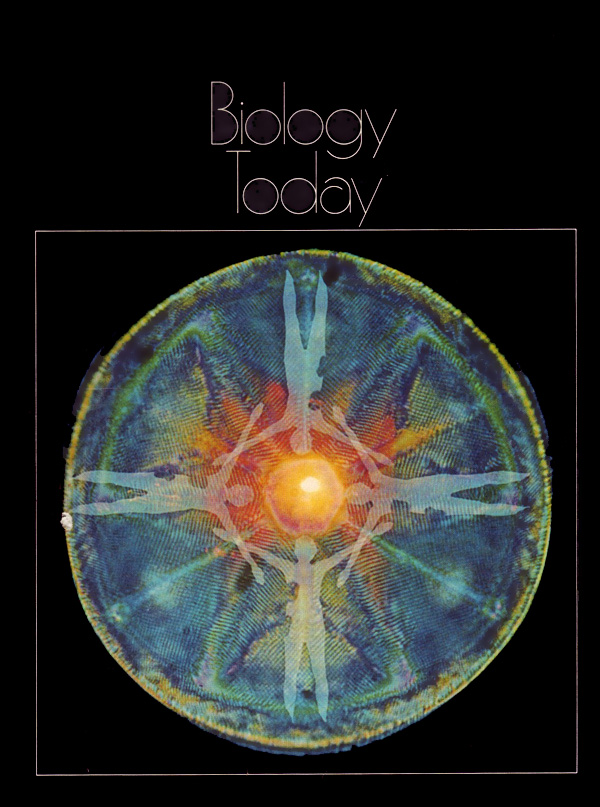
The book’s abstract cover features a psychedelic illustration of kaleidoscopic figures on a black ground. This austere knockout design, with its hairline rules and its title set in the Virginia typeface—a geometric face that had been released by Lettergraphics International only a couple of years before—was about as contemporary as you could get for 1972. Inside, the pages limit the text, set in Optima, to the inside half of the page, the outer half being margin, which might explain why the book clocks in at 1000 pages. The preface sets the tone for what will follow, stating “Like religion or politics or group therapy, science is a peculiarly human endeavor that seeks to newer and better solutions to the problems plaguing us all” and promised that this textbook would not be like others that “floated disconnectedly above the physical and chemical substrate of life.”
Biology Today contains a lot of stuff that has no business being in a science textbook. For example, the introductory essay, “What is Life?” is written by the Nobel prize winning biochemist Albert Szent-Györgyi, and in an odd start for the book, contains a passage hinting at intelligent design:
I do not think that the extremely complex speech center of the human brain, involving a network formed by thousands of nerve cells and fibers, was created by random mutations that happened to improve the chances of survival of individuals. […] I cannot accept the notion that this capacity arose through random alterations, relying on the survival of the fittest. I believe that some principle must have guided the development toward the kind of speech center that was needed.
The penultimate chapter, “Human Possibilities,” has a section speculating on the future of human evolution, cheerfully suggesting that an enlightened civilization would selectively breed for traits such as intelligence and docility—you know, eugenics, but in the name of science:
The potentiality for genetic change within the human species is staggering. An analogy commonly drawn is the history of the dog since domestication. From the starting point of the wolf (with possible admixture from several other wild canines), breeds have been developed as disparate as the St. Bernard, Chihuahua, bulldog, and dachshund. There seems little doubt that selective breeding of the human species could lead to the same diversity. Even if such a possibility was ethical, by what standards should it be guided? […] for what qualities would man be bred? There are perhaps only two qualities on which there would be near agreement: intelligence and nonaggression.
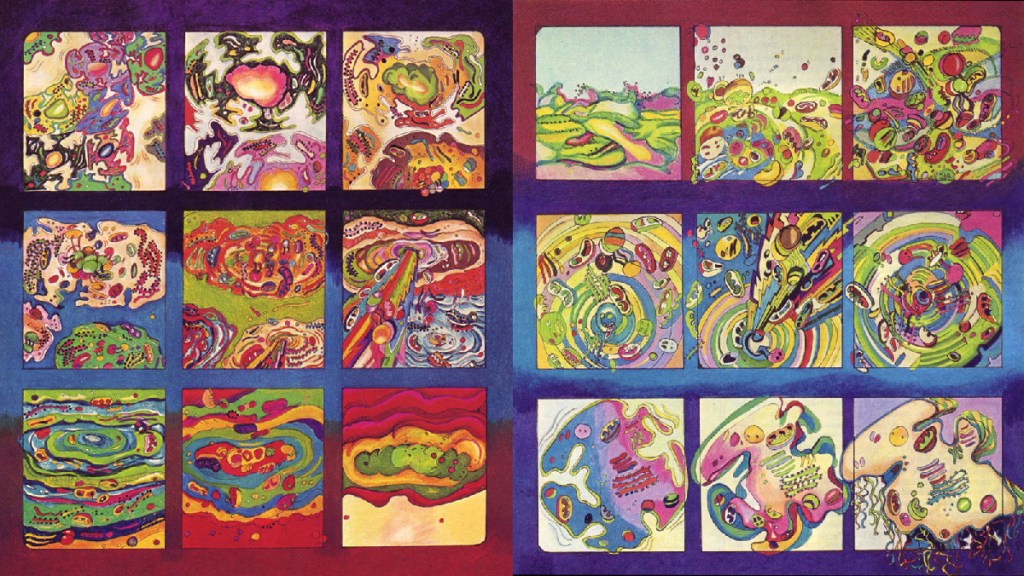
The beginning chapters deal with the normal intro-to-bio discussion of eukaryotes and prokaryotes, eventually arriving at the Krebs Cycle, and on into meiosis and mitosis, taxonomy and genetics. You know, biology stuff, the stuff of late-night examination eve cramming sessions, which your memory has slowly rejected in the years since. But here is where the book’s weirdness begins, with full-page grids illustrating the differences between cell types—maybe. To me they seem like an unholy cross between Peter Max and Willem de Kooning for a PSA warning about the effects of psilocybin.
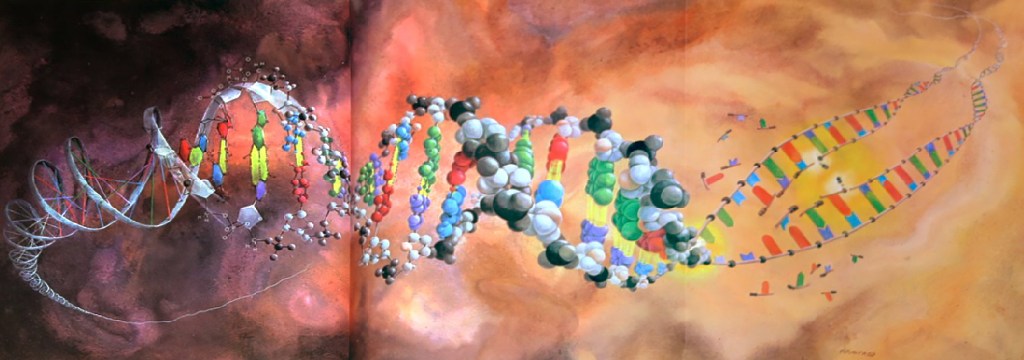
The book’s many illustrations of microscopic and sub-cellular subjects are lush with color and weirdly abstract. One of the more impressive ones is a centerfold (of which the book has two!) that opens to to a width of about four pages and shows a strand of DNA that transitions through four different models that, in turn, represent the nucleotides as rods, structural formulae, spherical atoms with glowing hydrogen bonds, and a string of color-coded flags which unzip to allow the helix to replicate.
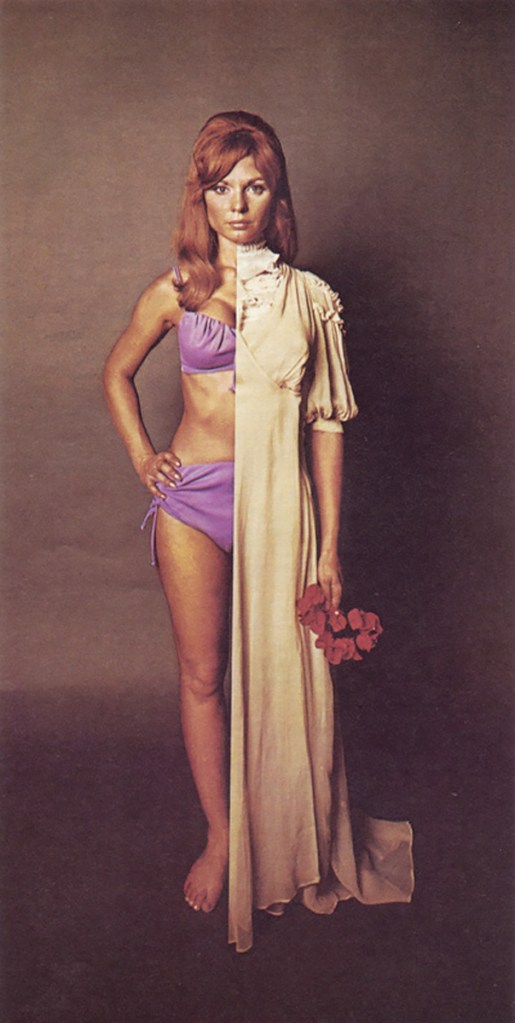
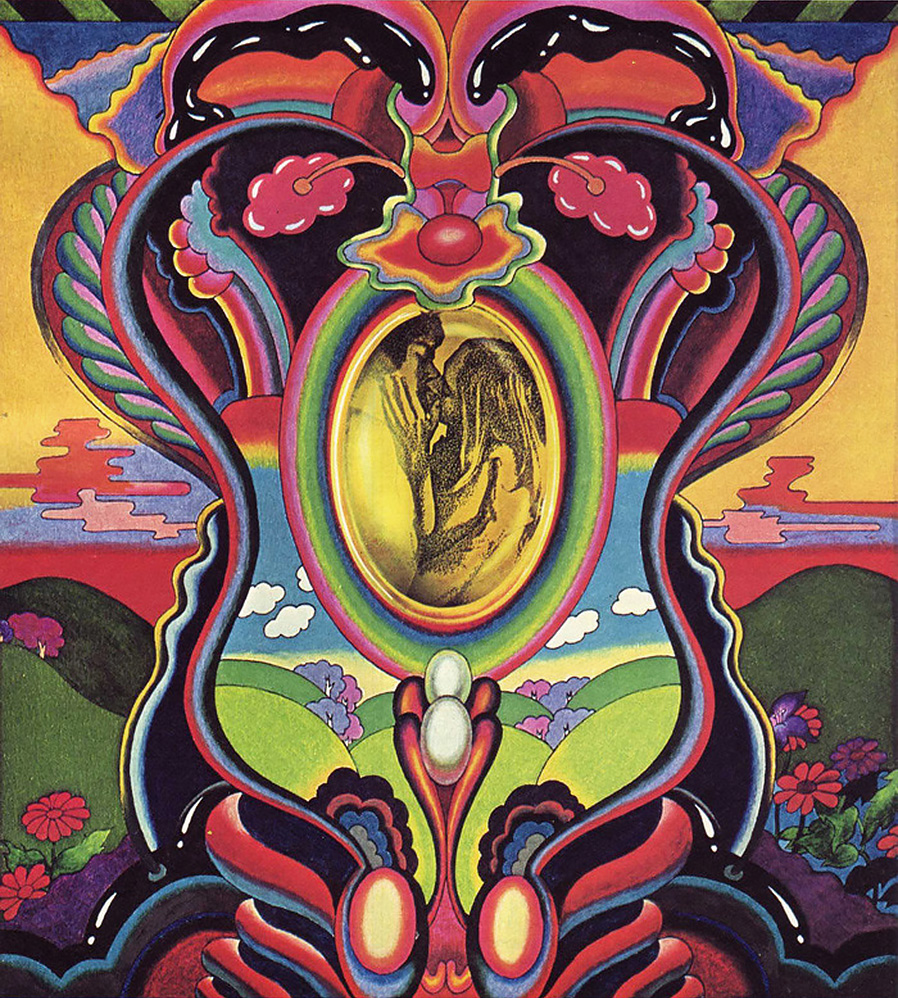
The strangest motifs throughout the book are its many “an artist’s interpretation of…” illustrations. These are full-page, color illustrations that symbolically represent a theme or subject in the current chapter. Some examples are “An artist’s interpretation of a pandemic,” “An artist’s depiction of a swarm of rapidly dividing bacteria,” and the smudgy and opaque “A photographic impression of a speed trip.” In a book that’s an extravagant 1022 pages long (including index), the art director thought it would be a good use of space to devote many to these exegetical graphics. Not that I’m complaining; these are a goldmine of trippy 1970’s art.
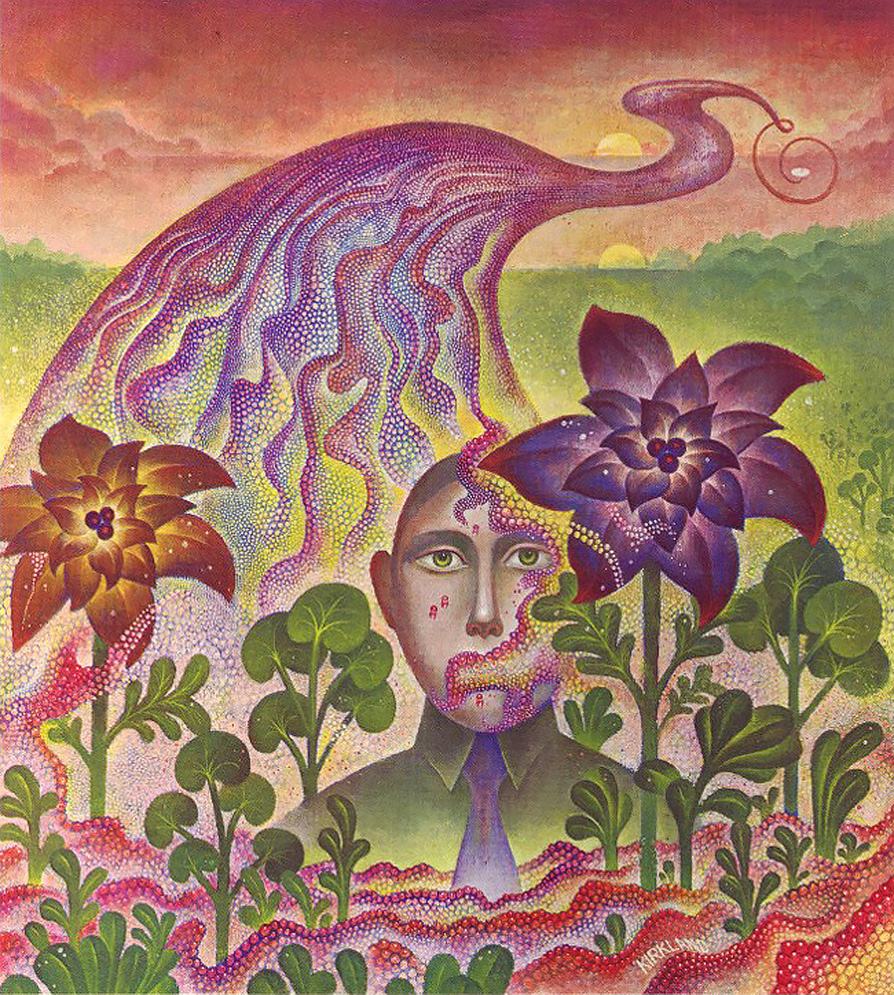
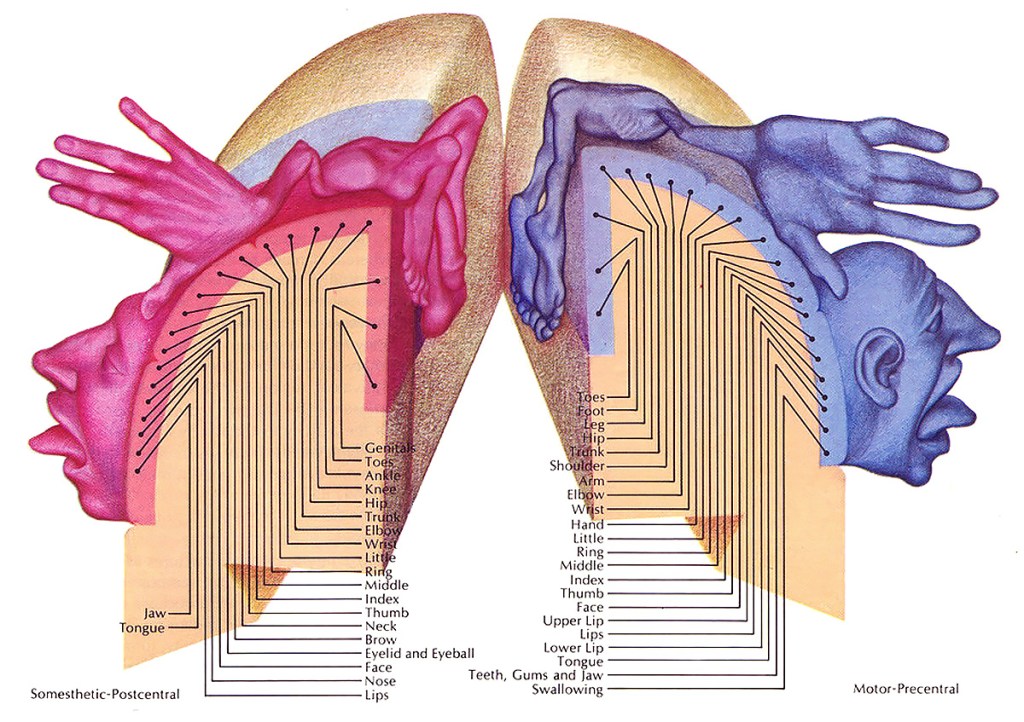
In its second half, the book focuses entirely on human concerns, and here the illustrations get much more surreal. A favorite of mine was the one featuring motor and sensory homunculi. These graphics depict distorted human figures whose anatomical parts are sized relative to the amount of brain synapses they employ. As a genre, drawings and models of this subject have been around since 1937; but never have they been presented as grotesquely and with such florescent colors as they were by illustrator Richard Oden.
Biology Today features the work of many amazing artists, but for me, Richard Oden steals the show. He draws most of the anatomical illustrations, and these grainy pictures (Colored pencil? Conté crayons? Pastels?) are both monumental and sexually charged. How explicit are these? He presents a series of depictions of male and female genitalia as each in turn goes through the stages of arousal, up to and including orgasm. The male images are particularly pink and bulbous; the female images are present as cut-aways so they are less indecorous. Perhaps in the interest of parity, Oden provides two pages of diagrams showing a woman inserting a diaphragm. Sadly, good taste (and my desire to avoid criminal prosecution) don’t allow me to show any of these illustrations here, but believe me when I say they make an impression.
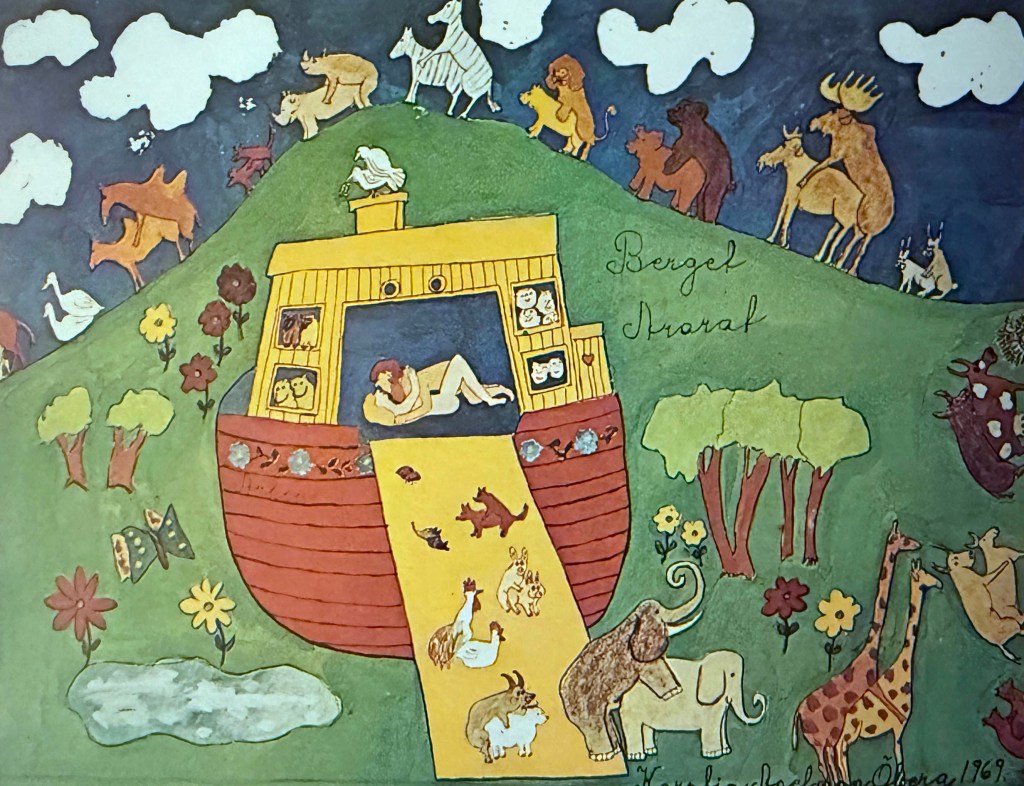
It was, of course, the images in the final third of the book that drew me back again and again as a teen. Images of sexuality, sure, but also of aberrant psychology, of drug use, and of general weirdness. Here are a few:
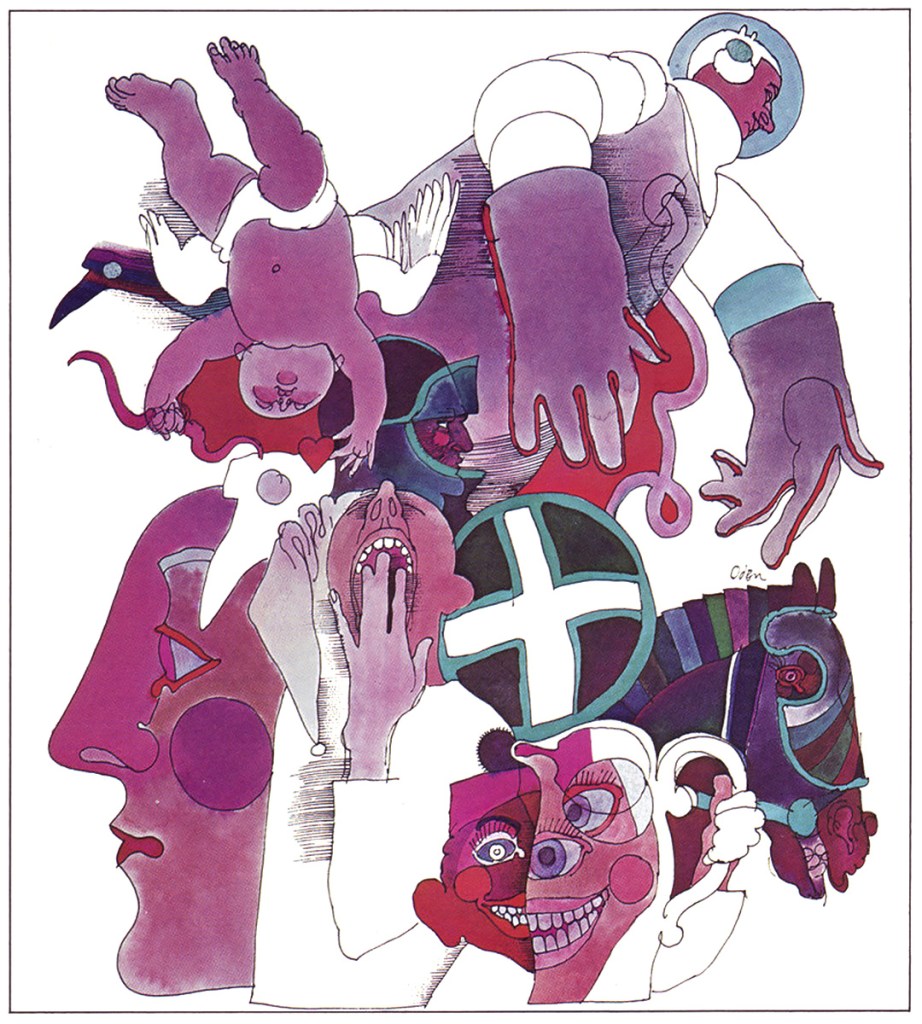
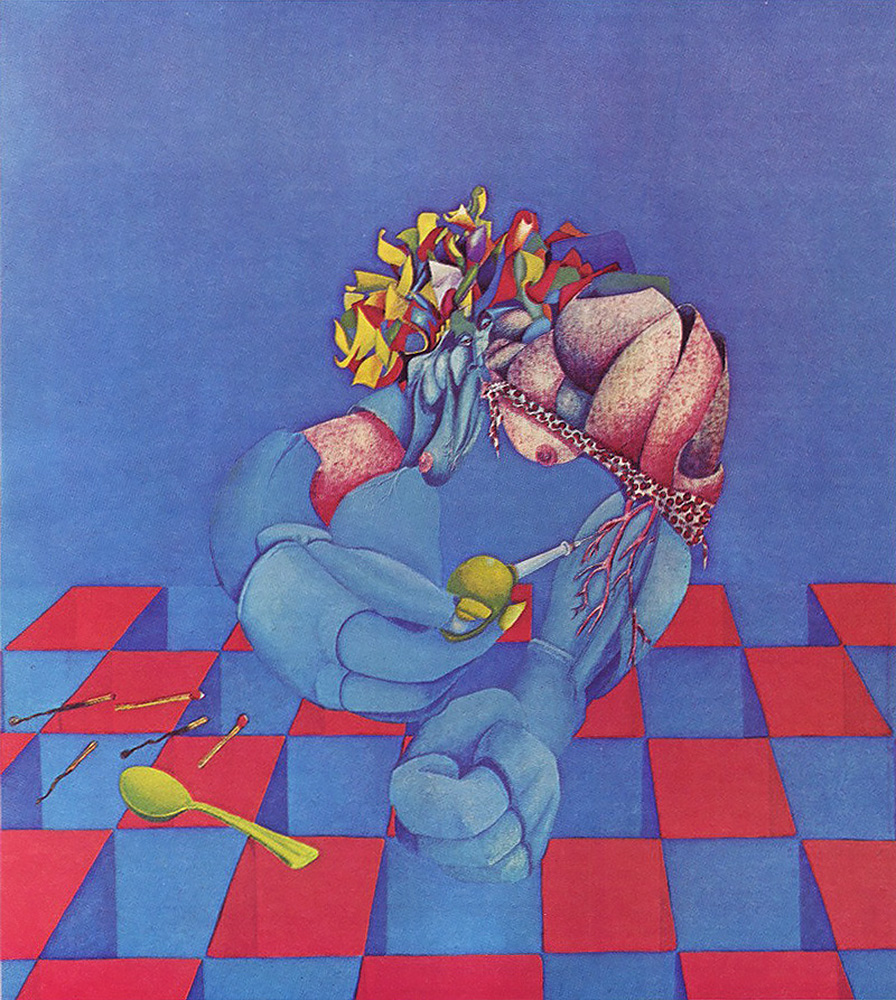

(For an incredible treasure trove of many more illustrations from this meshugana tome, visit this series of galleries at 50 Watts Books. I cribbed some of the scans on this website when I was too lazy to photograph them from my copy.)
In her 2009 essay about Biology Today for the History News Network, Cliopatria (presumably a pen name) offers this explanation of the book’s tendency towards pop sociology and lifestyle advice:
Molecular biologists, by the 1970s, thought of themselves not only as the future of science, but of culture more generally. Many adopted the scientific humanism that had been championed by the previous generation of public biologists like Julian Huxley, although the mechanistic and cybernetic worldview of molecular biology, rather than the neo-Darwinism of Huxley and his allies, was their gospel. For intellectually and sexually liberated biologists (like Watson), anthropology and sexology displaced parochial religious ideas, and science had nothing to offer religionists but contempt or pity.
So with this in mind, just who was responsible for Biology Today? An appendix lists the “consulting contributors” along with scratchy graphite portraits and biographical blurbs. This reveals an impressive lineup of late-midcentury scientific luminaries, including several Nobel laureates: the aforementioned Albert Imre Szent-Györgyi, as well as Konrad Emil Bloch, Macfarlane Burnet, Sir John Carew Eccles, Harold Urey; the most famous contributor being James D. Watson (of stealing the credit for the discovery of DNA fame). Beyond these, there are an eclectic variety of contributors, including gynecologist Robert Kistner (who helped develop the birth control pill), sexologist Paul Gebhard (who collaborated with Alfred Kinsey), British jingle composer Jonathan Hodge, and… Michael Crichton? Yes, right after his first major success with The Andromeda Strain (1969) but eighteen years before Jurassic Park (1990), Mr. Crichton was a contributor to groovy 70’s textbooks. (Aside: from Crichton’s portrait it seems he was portrayed by Love Story era Ryan O’Neal.)
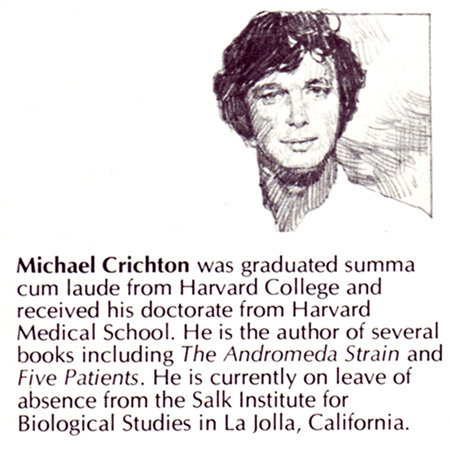
For all its weirdness and questionable content, there’s something almost utopian about the book. It does feel like the contributors wanted to produce a socially relevant work that not only taught but also celebrated its subject by making a work that was beautiful and memorable. In 1981, The American Biology Teacher3 ran a review of the third edition of Biology Today. By then, all of the strangeness and charm had been removed from the book, leaving a drab and forgettable husk. Reviewer William H. Yongue, Jr., lamented what had been lost:
The first edition (1972) […] was ablaze with stylized artwork, references to the humanities, photographs, colorful representation of biology at the sub-cellular level, and explicit materials on human sexuality and drug abuse. Such illustrations as that of heroin administration, insertion and placement of the diaphragm, two aging prostitutes on the streets of New York, diagram of the human male and female sex organs during coitus, and the painting “Noah’s Ark” outraged some educators, parents, and reviewers to such an extent that large-scale adoptions were few. That book might now be considered a “classic” for it is hardly likely that such a fine humanistic biology textbook will be published again. (If you have a copy, hold on to it.)
- In fine condition. You can get a reading copy for $25-$50, and maybe you should, before this essay causes the price to spike. Go ahead, I already bought mine. ↩︎
- They also published a textbook called Psychology Today, which is just confusing. ↩︎
- Vol. 43, No. 2 (Feb., 1981), pp. 108-109. ↩︎

