Red pill blue pill

Apothecary

Friend and ex-coworker John Siracusa—the man who taught me to always validate my web markup—has a podcast, Hypercritical, ostensibly about Apple Computers but increasingly about whatever he wants to complain about. Last Friday’s episode covered a variety of topics, but of interest to me was his discussion of patents, beginning at 1:16:30. Examining the mess that is the modern patent system, he talks about how as a programmer he has long been against software patents, but that as time has gone on he’s become against process patents until he’s arrived at the point that he sees all patents as a hindrance to innovation and commerce.

Siracusa isn’t the first to advocate scrapping patents altogether (here’s an annotated treatise if you’re interested in delving deeper), and I’m not going to summarize his arguments, but there was one point he raised to which I wanted to respond. Siracusa mentioned that he thinks the strongest case for patents was pharmaceutical companies and their need for an incentive to foot the bill for the research, development, and clinical trials. The argument goes, why would anyone front so much money to bring a drug to market without the assurance that competitors wouldn’t swoop in with their own versions of the product?

This case for patents carries emotional weight—when it comes to potential life-saving treatments, who wants to stand in the way? But if we can view the argument with a dispassionate eye we can see that drug patents fail in ways characteristic to the patent system in general. Patents incentivize treatments for the most lucrative medical problems and not the most pressing ones. One of the most devastating diseases in the world in terms of the number of people affected and the severity of suffering is malaria; however, it’s a disease limited to the tropics, and unfortunately the populations most hit are not markets with deep pockets. On the other hand, we sure do have a lot of erectile disfunction meds available these days—because boner pills are by definition made for sale to rich old men.

The fact that business models are built around the pursuit of exclusive products also leads to avoiding incremental innovation, even when that might be the most expedient course. There may be alternative therapeutic uses for existing medicines, or there may be more effective formulations, or better production methods, or new modes of delivery—but when R&D is focused on what is patentable, obvious and fruitful research will be passed over. In the absence of intellectual monopolies, companies might turn to more focused improvements and diversification as a way to distinguish themselves, instead of looking for the next big payday.

Surrender to the void

Lazarus

The final sequence of this Sunday’s Mad Men features a puzzled Don Draper listening to the Beatles’ song “Tomorrow Never Knows.” He’s doing this at the suggestion of his much younger wife who wants him to be more in tune with what’s going on in 1966. It’s an odd choice—even now, three dozen years later, it’s like giving someone who wants to understand James Joyce a copy of Finnegan’s Wake. In any case, it’s all too much for Don, who pulls the needle.

My wife and I watch the show together and we discussed how rare it is to hear an actual Beatles recording (not a cover) as part of a soundtrack and she wondered how much the producers had to pay. Well, the answer came today in a New York Times article: $250K. Producer Matthew Weiner, interviewed in the piece, focuses on his goal of authenticity to the period: “In my heart, I operate in a realistic world because I’m producing a TV show. I never, ever think about that—‘Oh, let’s not have a song here so I can save some money.’” Of Apple Corps (the corporation that acts on behalf of the Beatles and their heirs) and their requirements, which in addition to the money included review of the story ahead of time, Weiner says:

Whatever people think, this is not about money. It never is. They are concerned about their legacy and their artistic impact.

Weiner is being charitable, and he may believe this, but I find the argument that the best way to ensure the artistic integrity of the Beatles’ œuvre is to make it so only very rich people can use it specious. The song was used to great thematic effect in Mad Men, but perhaps there are any number of student filmmakers who might use it to even greater effect, not to mention dancers or mashup artists. And even if the song were used poorly—say to sell sneakers—let’s say Nikes—how would that tarnish the original work unless it were cynically sold at a great price?

“Tomorrow Never Knows” is a particularly interesting song to examine from a rights perspective. It’s credited to the songwriting team of Lennon and McCartney, but it was written by Lennon, or rather it was Lennon who came up with the ten or so repeated sonorous notes. The actual words were adapted from The Psychedelic Experience: A Manual Based on the Tibetan Book of the Dead, which was co-written by Timothy Leary (among others). But the passages used are from the Bardo Tholo, an 8th Century Buddhist funerary text attributed by tradition to Padmasambhava. So who ultimately wrote the lyrics? Musically, the importance of the song is not its (barely-present) melody or its droning harmonic structure, but its use of audio loops, a technique borrowed from Stockhausen. McCartney was interested in the avant-garde approach but it was George Martin and several EMI technicians that actually got it to work. So who ultimately made the song? And which amongst them will receive a portion of the $250K?

Defenders of copyright maximalism—those who seek ever-longer copyright terms and ever-broader interpretations for what is defined as use—like to characterize copyright reform as an effort to deprive artists of what is rightfully theirs. But for those of us who look at news of absurd fees for forty-six-year-old recordings with alarm rather than amusement, it’s not about getting things for free. Because ultimately the losers here aren’t the two unfathomably rich corporations exchanging money—it’s all the rest of us who are prohibited from using a work that was created in the first place from the culture at large.

Through the dark, out of his clothes

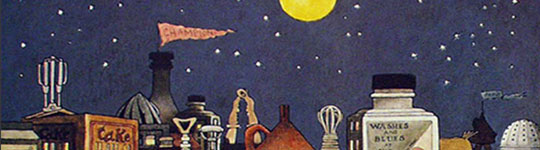
Night Kitchen

Sendak’s death has hit me hard, as I’m sure it has for anyone whose childhood was after 1960. Whenever a touchstone figure from our collective childhoods dies, the boundaries between public and private dissolve and our most intimate memories are revealed as shared experience. If you’re old enough to remember watching the Muppet Show during its original run you know what I mean. So it is with Sendak: all of us remember being sent to our rooms without any supper, and the forest that grew and grew and grew until the ceiling hung with vines and the walls became the world all around.

And yet, memory is also specific, and Sendak’s particular, peculiar role in my childhood was not only as a mirror to my own psychology but as my first bridge to times and places not my own. When I read (or more properly, when my mother read to me) In the Night Kitchen there was a rich strangeness that went far beyond the dream-logic of the plot. There was an odd cadence that I could not place: the strange clipped exclamations in the word balloons. Many years later (when I was ten) I discovered Little Nemo in Slumberland in a collection of old comic strips and my head exploded. Theme, plot, an style had been stolen from the 1905 cartoon, but they had also been transformed into something new.

Sendak’s world was full of the stuff of his own life as the child of Polish Jewish immigrants in Brooklyn, but it was also full of Oliver Hardy and Mickey Mouse and Tin Pan Alley and all of that rattled around in his mind and spilled onto his pages. As child I puzzled over who these strange identical cooks were and why they were intent on baking Mickey and those second- and third-hand memories stuck with me until I was old enough to understand whence they came.

So to Mr. Sendak, my thanks for the following lessons: The world is a very big place and very old. The past is still with us and will always be. Nostalgia isn’t only for your own memories.