Fight for your right

I’m not really the type to have role models; people are too complicated, too full of good and bad to be credible heroes to me. But if pressed for an example of someone who showed great courage in speaking truth to power I would have to go with William Gaines.

William Gaines

Gaines is best known today as the longtime publisher of MAD Magazine, and while financing a rag whose purpose was to pervert middle-American values and raise several generations of smart-ass punks would be enough to commend him, I think his finest moment came in 1954, when he was the publisher of the EC Comics line of horror comics: Tales from the Crypt, The Vault of Horror, Shock SuspenStories, etc. Red panic was in the air in those days, and a crackpot psychiatrist by the name of Frederick Wertham had just published a book entitled Seduction of the Innocent, which claimed that violent comic books were perverting American youth, turning them into either Communists or homosexuals or both. The upshot of all of this was that Gaines was called before the U.S. Senate Subcommittee on Juvenile Delinquency to give an accounting for why his comics were so gory and disgusting and devoid of redeeming qualities and really wasn’t he ashamed of himself.

You can read his testimony in its entirety online, but the long story short is he refused to play the game. When asked to justify himself—to explain what possible good could come of comics featuring beheadings and eviscerations played for laughs—he shrugged: “It would be just as difficult to explain the harmless thrill of a horror story to a Dr. Wertham as it would be to explain the sublimity of love to a frigid old maid.” 

He stood condemned before he spoke a word, of course, and within a year EC Comics was forced to stop publishing its horror line because of the new guidelines set forth by the Comics Code Authority. But I’ve always loved the image of this bespectacled, schlubby man effectively thumbing his nose at the idea that entertainment had to serve some noble purpose. Here was a guy who refused to justify something that had, and needed, no justification. There are many people who pay lip service to the idea of free speech when that speech is in service of a cause. It takes courage to defend free speech in the service of nothing other than simple self-gratification.

I often think of Gaines whenever someone ties themselves in rhetorical knots trying to answer scolds and censors who aren’t happy with the kind of fun others are having. Video games promote hand-eye coordination; I’m not wasting time on the Internet, I’m building my social network; I’m only reading it for the articles. Look at the convoluted points activists make when trying to legalize marijuana: they talk about pot’s medicinal uses, the ways the fibers can be used to make rope and the ways seeds can be used to make oil and the ways the roots can be used to make kitchenette sets. What they don’t say is: “I want to get high, and I think it’s fair that I be free to do that in a safe and legal way.” 

There are some things we do for shits and giggles. Most of the best things: roller coasters, horror movies, bourbon, sex. You have your own list, and it’s probably different, but you don’t have to justify it to me.

I get knocked down

Parenthood is a project made of anxiety, delight, but most especially drudgery: and of the tedious bits some of the worst are the endless hours spent playing first board games. The absolute nadir of these is of course Candyland, whose cruel and capricious nature has driven most parents to stack the deck in their child’s favor (or in their own favor, who cares, so long as the damn game ends already for God’s sake).  But a close second is the game Chutes and Ladders.

Chutes and Ladders

Chutes and Ladders is the kinder, gentler cousin of Snakes and Ladders; of the two, the latter name more accurately describes the feeling of playing the game, which not unlike a case of the DT’s. In the event you never were a child, here’s a description: the game consists of a race to the final square interrupted by a string of random reversals of fate in which your piece ascends ladders or descends chutes. These titular features are arranged in such a way that victory is eternally snatched from young innocent hands and the average game length is six hours (including two nap times).

The picture above is the version of the game I played with my daughter Kate when she was three; the board, apparently from the 1970’s, includes scenes that attempt to provide karmic justification for the players’ rises and falls. In one square, a girl mixes batter and so is rewarded by a ladder leading to a cake; in another, a boy reaches for cookies on a high shelf and falls down a chute that ends with a concussion and a possible lifetime of epilepsy. In one confusing pair, a child either hands his mother her purse or absconds with it and is rewarded via a ladder with ice cream; in yet another, a boy skates on thin ice, only to chute to what we must presume is an icy death.

I don’t think that Kate was impressed by the lessons of these scenes, but being a rational child she liked the depictions of cause and effect. She was especially pleased by a sequence where a pulling a cat’s tail results in a scratched face for the abuser. Kate herself has to this day a scar from the family cat that she received in exactly the same way; perhaps she found some sort of atonement via proxy. But for me there was no comfort in these tiny morality plays, because in spite of the veneer of a just universe the game is still entirely one of chance. In fact, the rewards and punishments only made the underlying randomness of it all that more depressing. What did it matter if sweeping the floor earned the little girl a trip to the movie when her stab at the housework was just one of six random options in the first place?

Fortunately, the days of playing this game are long behind me; I think we got rid of our copy at a garage sale, or maybe it’s squashed flat beneath the weight of better games on our basement shelves. But at night sometimes the game still haunts me. I wake from a dream of sudden falling and I wonder whether my life is really a series of actions and consequences or just one die roll after another.

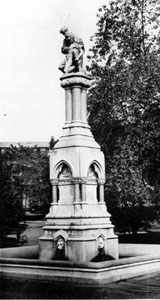
The Ether Monument, Boston Public Gardens

(An old essay I wrote back in ’97 for a journalism class.)

Ether Monument
Ether Monument, Public Gardens, Boston

Passers-by usually don’t notice. After all, one monument looks so much like another, especially in the Public Garden, which is littered with statues, fountains, and plaques. When someone does stop to look at the cluster of red marble columns and granite arches, set in an empty pool bed, they laugh or scratch their heads. “Would you look at that,” one elderly woman says to her companion, and reads aloud the inscription: “To commemorate that the inhaling of ether causes insensibility to pain at the Mass. General Hospital in Boston October A.D…” She fumbles with the Roman numerals of the date, laughs with embarrassment.

Today a monument to ether may seem strange, but for those living in the nineteenth century the drug was nothing short of a miracle. “The greatest invention for humanity since the printing press,” one contemporary wrote. Imagine having a tooth pulled without Novocain, a tumor removed without general anesthesia, or a leg amputated with only a bullet to bite. Then you can understand why private citizen Thomas Lee paid handsomely ($6,300 for the statuary alone) to publicly commemorate the first etherized operation, which took place in Boston in 1846. On October 16 of that year, dentist Thomas G. Morton electrified an audience of surgeons and medical students in the operating theater of Massachusetts General Hospital when he put a printer, Gilbert Abbot, to sleep. The attending surgeon then removed a tumor from the sleeping patient’s neck: no thrashing, no screams, no restraint by assistants. The theater broke into cheers.

Morton hadn’t invented ether. The volatile liquid was discovered in the thirteenth century—maybe earlier—and by Victorian times, many middle-class party-goers in Europe and America used the drug recreationally at so-called “ether frolics.” Sometimes the giggling, red-eyed revelers were so insensible they struck themselves on tables, chairs, or the floor—opening bloody wounds that went unnoticed until much later. Morton was the first to suggest ether’s surgical use, or so he claimed. Shortly after Morton’s demonstration at Mass General, another Boston dentist, Charles T. Jackson, claimed that Morton had stolen his discovery. Jackson was so open and persistent in his rancor towards Morton that the public joined the battle on both sides. Eventually, opinion decided in favor of Morton, but as late as 1882 Mark Twain sided with Jackson, proclaiming that the Ether Monument “is made of hardy material, but the lie it tells will outlast it a million years.”

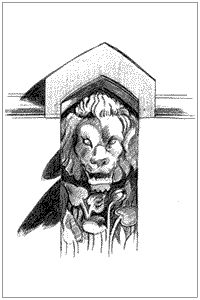
drawing
Lion detail from Ether Monument. Drawing by author.

Twain wasn’t being quite fair. Unveiled in 1868, in the full bloom of the controversy, the Ether Monument bears the name of neither dentist; Oliver Wendell Holmes called it a tribute “to ether-or either.” Avoiding the issue in typical Bostonian fashion, the granite statue crowning the memorial isn’t Morton or Jackson—it’s the Good Samaritan. When commissioning the piece, the monument’s architects asked young sculptor John Quincy Adams Ward for something that would show relief from suffering “in the rudest way consistent with artistic feeling,” and they got what they were looking for. The sculpture was just to the tastes of the conservative Boston elite, and made Ward’s career as a public artist.

When you visit the monument, be sure to look for the four reliefs by Ward, hidden under the monument’s Gothic arches. The south relief shows an operation under anesthesia; the doctors wear a mix of nineteenth century and classical costume. On the east relief, an angel of mercy descends to relieve a suffering figure. The inscription from the Book of Revelation reads, “Neither shall there be any more pain.” Then as now, people worried about the religious implications of medical science, and the relief on the west side also addresses these anxieties. Here, a woman who represents Science Triumphant sits atop a throne of test tubes, burners and distillers, while to the side, a Madonna and Child look on with approval. The inscription from Isaiah tells the viewer that anesthesia is a gift from God: “This also commeth forth/from the Lord of hosts…” Best of all is the horrific Civil War relief on the north side of the monument: A Union field surgeon stands ready to amputate a wounded soldier’s leg. But thanks to the wonder of ether, the soldier sleeps on peacefully while the doctor, heroic as Hercules, sets to his grim work.

Top: Ether Monument, south view; Bottom: Detail of south base of monument (author’s illustration).