A Case of Identity


Sheerluck

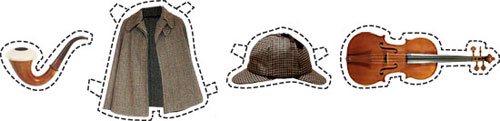
All of us know who Sherlock Holmes is. He’s that detective guy who wears a deerstalker cap and an inverness cape and the meerschaum pipe who says, “elementary, my dear Watson.” Except that only the detective part comes from Holmes’s creator, Arthur Conan Doyle. He once described Holmes as wearing a traveling cap with ear flaps but it was the illustrator Sidney Paget who gave Holmes the deerstalker and cape. Doyle described several pipes smoked by Sherlock, but they were straight pipes of clay, cherrywood, or briar, as were common among Victorian gentlemen; the large-bowled, curved pipe was introduced by American actor William Gillette, who became famous for his portrayal of the sleuth; the phrase “elementary, my dear Watson,” never appearing in any of Doyle’s stories, was first written by P.G.Wodehouse.

These days we have any number of complementary and competing Holmeses, including wonderful legacy portrayals by Basil Rathbone and Jeremy Brett; revisionist Holmeses like Guy Ritchie’s action hero as portrayed by Robert Downey, Jr.;  and alternative world Holmeses like the contemporary-world Stephen Moffat series as portrayed by Benedict Cumberbatch. There are hundreds if not thousands of Holmes stories, with some (like Nicholas Meyers’s famous Seven-Per-Cent Solution) taking great pains to fit within Doyle’s style and timeline, and others jettisoning verisimilitude entirely and having Holmes fight aliens or travel through time. And on top of all of these, we have a multitude of parodies and pastiches from muppet Sherlock Hemlock to Mad’s Shermlock Shomes to the Firesign Theatre’s Hemlock Stones, who finally took on the case for which the world was not ready.

One might think that with all these Holmeses, audiences might be confused. Where to start? Which one is “real?” And what about the integrity of the creation, is that being preserved? But in practice, there is no difficulty. Communities of readers and viewers can pick and choose which Sherlocks they’d like to support; most probably have several favorites. Likewise, if they find one portrayal out of character or another story’s plot falls flat, they’re free to ignore them. And the original stories are still there, still untouched and unrevised (although Doyle himself indulged in revisionism by bringing Holmes back from the dead after he killed his creation off). Doyle’s canonical works are unaffected by other writers’ contributions—if anything, the derivative works keep the originals fresh and relevant.

I like to bring up Holmes when people fret about authorial intent and an artist “owning” their work, or complain about fan fiction being an affront of some sort, or insist that working from another artist’s setting or character is unimaginative or a rip-off. The tendency is to see Sherlock Holmes as a special case, owing to his ubiquity in the culture. But isn’t his prominent position precisely because of the participatory way the culture at large uses him? In my post about George Lucas, I champion the idea (which I didn’t originate) that the eventual relevance of a piece of art owes more to the work of its audience than of its creator. I know this is a controversial idea, especially to people who like the idea of the Artist as an Auteur, uniquely responsible for his creation. But it seems to me that when artists practices their craft they are joining a game in progress, learning the rules by watching others, and then moving the ball along; and then it’s up to the audience to decide if they scored or not, and why it mattered, and how it mattered, and before long it’s the readers or viewers or listeners who have possession.
A bad motivator

Lucas Vader

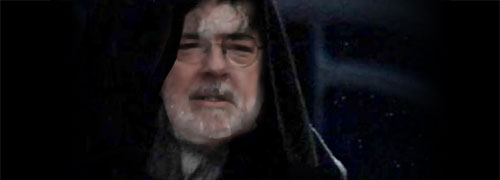
For the last couple of weeks there has been a great disturbance on the Internet, as if millions of geeks suddenly cried out in terror. I’m talking about the latest batch of changes George Lucas has made to his Star Wars movies, this time on the occasion of their blu-ray release. The long story short here is that ever since the “special edition” releases of the 1990s, Lucas has been altering the original three Star Wars films; sometimes substantially, with new scenes and actors swapped in digitally; sometimes trivially, with newer visual effects and bleeps and farts. This isn’t a bad thing in theory—directors’ cuts are usually greeted as definitive versions, and many artists can’t resist the urge to go back and tweak their earlier work. (Walt Whitman added poems to, subtracted poems from, and generally rewrote poems in every new edition of Leaves of Grass in his lifetime.)

But in the case of Lucas the changes to the original have been so awful, and the memories he’s tinkering with are held so dear, that it seems a kind of spite is driving him at this point. I’m not going to list the details of all the alterations here (that’s what Google’s for), but suffice it to say, it’s understandable that people might want to have available the original version of a film (and here I’m talking about the first, 1977 Star Wars) that holds such a central place in the history of film and society. But Lucas says no; this is his vision, you get it all—all retrofitted to mesh with the awful prequels—or you get nothing.

If the original film—now thirty-five years old—had been released under the original fourteen year copyright term (renewable once), this would all be moot. Criterion would be free to release a restored original version with commentary by historians. Wal-mart could release a budget version with all the incest taken out. And Lucas? Lucas would still be free to alter his films in any way he wanted to. He could stick Jar-Jar into every damn frame if he liked and all of the fans who valued his intent over their childhood memories (there must be at least four or five of them) would be free to purchase these enhanced versions. The point is, Art with a captial A would be served and Commerce with a capital ¢ would be served as well.

There are rights holders like Lucas whose bad dealings with the art they own comes from an honest belief that they’re doing what’s right. Then there are rights holders like Disney, who are motivated entirely by their desire to monetize their holdings as efficiently as possible. The famed “Disney Vault”—the practice of Disney of bringing properties in and out of print in cycles—is a good example of this. They aren’t doing this to benefit their films or their audience—they’re just making sure their products are not in competition with each other. Disney animation from the 30’s, 40’s, and 50’s is central to our cultural heritage, but we’re kept from it, not by the artists who actually produced it (they’re all gone) but by a marketing ploy. Similarly, Disney gets to remove any scenes or elements form its films that might affect their salability.

It’s not just pop culture that suffers from the heavy hand of rights holders: no less a luminary than James Joyce has also been affected. The current executor of this seminal Modernist, so central to world literature, is the artist’s grandson, Stephen Joyce. Under the name of protecting his grandfather’s legacy, the younger Joyce has aggressively hindered access to the artist’s letters: bringing suit (or threatening) against biographers and scholars whose work he deems harmful, prohibiting public performances of his grandfather’s work, destroying letters by Joyce’s daughter, and hoarding unpublished writings. He even said no to Kate Bush using Molly’s soliloquy in a song. Thankfully, the works of Joyce are about to enter the Public Domain—at the end of this year, only sixty years later than they should have.

Afterword: In the article on Joyce linked above, the author writes: “It is understandable and reasonable that the heirs of an author […] would gain a financial benefit for a certain time from that author’s work, in the same way that a descendant who has been left a farm or a house is entitled to a financial gain from it.” I note this because I think it’s a fallacy that’s often made to justify the passing of copyright to one’s heirs. The correct analogy would be that as a farmer may leave his farm and equipment to the next generation, so too an author may bequeath to their heirs their own tools of production: pens, paper, notes, typewriter or computer. An analog to copyright for the farmer would be if the farmer’s heirs continued to receive residuals on crops produced many decades before.

Safety dance

The museum where I work is considered a port by the TSA, because lenders in other countries ship us artwork in sealed crates. The upshot of this is my fellow staff and I have had to have our backgrounds screened and we’ve received training on terrorist threats. The process has been relatively painless, but it did lead me to try to imagine how anyone might possibly take advantage of us as a conduit for nefarious cargo. It would require the culprits to have prior knowledge of which exhibitions we were going to be staging long enough in advance to go to the country from which art was being lent (which would also require infiltration), get hired by whichever art moving company the lender was going to use (and as this gets bid on, they’d have to have operatives in several) and then under the watchful eye of the conservators overseeing packing they would slip their IED (or whatever) into the crate. Then they would have to perform a similar inside job once the art arrived in America.

hide

In short, it’s perishingly unlikely; but the TSA is just doing their job, which is keeping us safe. The question is, how safe is safe? That’s a question of nuance and the TSA doesn’t do nuance. We all know the result: the long lines to be groped, barefoot, at airports. But the far greater cost is the cost to the soul: the constant agitation, fear, paranoia. If you see something, say something. Security is everyone’s business. Think of the children. And so think of them, and we fret and obsess and distrust.

The most hilarious and shameful example of how this mindset messes with us is the Boston Mooninite scare of 2007. After the BPD misidentified the harmless LED signs as potential bombs and brought the city to a panicked halt, they proceeded to accuse the street artists who had installed the signs with intentionally perpetrating a hoax—when it was they who had misled the public. Instead of admitting their error and promising to adjust their policies to avoid such problems in the future, the police threatened the “perpetrators” with criminal action and accepted two million dollars from TBS as “compensation,” all the while complementing themselves on their vigilance.

In his novel White Noise, Don DeLillo posits that the more modern medicine staves off death, the more we end up fearing it. A similar calculus applies to safety: the more security we achieve, the more that last bit of safety eludes us. In the absence of clear and present threats we manufacture wars that cannot be won: on terror, on drugs. But here’s the thing: total security does not exist. As Kij Johnson wrote, “Nothing is certain. You can lose everything. Eventually, even at your luckiest, you will die and then you will lose it all.” It’s a hard truth, but accepting it is its only remedy.