Borkum Riff. About once a year, I’ll catch the distinctive smell of whiskey-soaked pipe tobacco, and for a moment I turn to look for my dad. When I do, I look up, because I’m six years old: my dad hasn’t smoked since the 1970’s. But that smell, of tobacco and sweet cream, was such a constant part of my childhood that it’s burnt into my memory so deeply it would take a pipe cleaner to remove it from my hippocampus.
Whenever this happens I don’t really know how to feel. On the one hand, it’s a smell that never fails to transport me to my youth. On the other, my dad quit smoking after I had a long outburst telling him with all the earnestness of a child that I hated the fact that he smoked and that it gave me headaches and that I was sure it was going to kill him and I wouldn’t have a father. I remember that I couldn’t stop shivering for hours from the emotional surge. I am, of course, very glad that my father did stop smoking, as he’s still with us today.
And yet. My father owned several pipes and they were all beautiful. He had curved rose-colored pipes made of burls (cherrywood? walnut?) that looked wise and mysterious, he had sharp-angled black pipes that looked like they belonged to Mr. Fantastic. He even had a corn-cob pipe that was hokey and wonderful. He had pipe tools for tamping and scraping and cleaning and a carousel that he kept his pipe in. And he had tins of tobacco with pictures of three-masted ships and peculiar European men and maps of the world on them. And when he read the Hobbit to my brother Robert and me and he got to the part about Gandalf and Thorin blowing magical smoke rings I knew exactly how that must have looked.
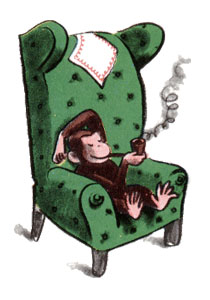
My ambivalence about pipes can be summed up nicely by Curious George. In the original H.A. Rey book from 1941, the monkey George is unceremoniously removed from the jungle by the Man in the Yellow Hat for sale to a zoo; Upon arrival in America, he spends what is supposed to be his last night of freedom in the Man’s home, where we are told After a good meal and a good pipe, George was tired.”
When my kids were little, they constantly watched a VHS recording of the 1982 stop-motion version of Curious George, which faithfully stuck to the text of Rey’s book and did in fact show George enjoying his pipe; however, immediately after George takes a couple of puffs the film shows George becoming ill and the Man in the Yellow Hat guiltily putting the pipe away—presumably shamed into quitting himself. And this part always made me very, very angry. Why? Why the need to editorialize? Children already know that George is doing something wrong, something forbidden. That’s what makes it fun. And Dad, I’m glad you stopped smoking. But I hope you can still find something wrong to do now and then.
So I haven’t blogged in a few weeks and this is where I give a lame excuse like my computer died. Except in my case, my computer died: the screen developed a dead stripe about 2 inches wide, slightly right of center. Googling (on my iPod) seemed to confirm that the LCD had become disconnected and would need replacing, which was probably more than the machine was worth, and so time for a new one.
I had been planning on getting a new Mac for some time; in spite of my reputation amongst friends and family as the guy who knows a lot about computers, I’d been nursing along an obsolete machine for many years now, running an operating system that was two generations gone. So I should have welcomed the death of my old box and skipped to the store with plastic in hand. Instead, I found myself begrudging the purchase; when I brought the bulky box home I felt a strange lack of enthusiasm.
There was a time when a new computer was a big deal, a life event, a first kiss. I remember my wife and I purchasing our first Mac (a Classic II) back in graduate school; I believe with an academic discount and a newly-introduced inkjet printer it cost us about $2K. We brought it home like nervous parents who feared crib death. It was hard to believe we had anything that valuable in our apartment. For the next five years we wrote every one of our grad school papers on that nine-inch black and white screen and dipped our toes into the exciting new world of Compuserv with our blisteringly fast 28.8K modem.
We’ve run through a lot of computers since then, and while each has been faster and prettier, acquiring them is less and less glamourous. As technology becomes more advanced, I care about it less and less. There was a time that I could from memory rattle off the hertz for any of a dozen CPUs currently on the market. I can’t begin to tell you any specs for my shiny new iMac. Is it dual core or quad core? For that matter, what’s a core?
Maybe it’s better for me to not care so much about this stuff. In the end, tech lust is simply more old-fashioned materialism, and maybe letting go of that is another step towards enlightenment. Maybe what’s good is the ubiquity of computers and smart devices means I’m not interested in the tools but what I can do with them. But to be honest, I sort of miss the obsession.
Author’s note: This is a recycled post that dates back originally to 1997.
I grew up in Eureka, Illinois, a town of about four and a half thousand souls. Eureka was once called Walnut Grove, but had to change names for reasons which remain mysterious to me. Someone once told me that the discovery of a second town in Illinois also called Walnut Grove necessitated the change. I tried to verify this story, but a glance through the atlas has revealed no other towns with that name. Perhaps this second Walnut Grove has also had a re-christening. In any case, today you will find few walnut trees in Eureka; a blight in 1910 killed nearly all. Eureka was also once called the Pumpkin Capital of the World, but somehow this title, too, has been lost. Today, our rivals in Morton, Illinois reign as pumpkin kings, and all that is left of Eureka’s cannery is a crumbling brick ruin.
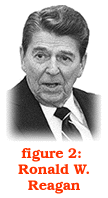
In fact, by the time I came along, Eureka had only one feature that distinguished it from other midwestern fourth-generation German farming towns: its college. And the college was famous because of Reagan. A tiny, private, church-affiliated school, Eureka College gave a diploma to future president Ronald Reagan in 1932. I was twelve when Reagan took the oath of office, and the town was bursting with pride. A large sign appeared in front of the court house which read “Visit Eureka College, alma mater of President Ronald Reagan. Go four blocks, then two blocks east.” It was left for the seeker to decide in which direction the initial four blocks lay. A year or so later someone noticed the mistake and added a tiny carat and the scrawled word “south” on the sign.
The college quickly scrambled to capitalize on Reagan’s fame. A portrait featured prominently on the prospectus and other recruiting materials. Eventually, a Reagan Scholarship was established—somewhat ironically, as Reagan himself claimed that his grade average in college was “closer to the C level required for [sports] eligibility than it was to straight A’s.” Perhaps the only one unhappy about the college’s love-in with the President was my father, at that time Dean of the College. My dad was (and remains) an old-school Stevenson liberal, as well as something of an academic conservative; apart from the obvious political differences he had with the Reagan Administration, the lauding of an such an undistinguished scholar by a place of higher learning rankled him.
During his two terms in office, Reagan made several trips to Eureka for photo-ops and the occasional speech. A week before each arrival the secret service would arrive in town, black-suited and comlinked. No one knew exactly where they stayed—Eureka has no hotels. One day they simply appeared, pacing intently up and down Main Street past the five and dime, lurking amongst the greeting cards in the Hallmark store. For the most part they stuck to the Eureka College campus, where they endlessly staked out the dozen or so dormitories and classroom buildings, whispering into their sleeves to one another.
On one visit, shortly before the 1980 elections when he was still only a candidate, Reagan came to light a bonfire at Eureka College. The cheering students arrived early and the pom-pon squad did routines dressed in skirts in spite of the autumn cold. The high school pep band, which included my brother on trombone, played the Eureka High School Fight Song (“On, Eureka/win this game/fight to put our foes to shame”) and the Star-Spangled Banner. They played those thirty-two bars again and again, for hours. The cheerleaders huddled together for warmth. Suddenly, Reagan’s limo arrived and the Secret service pushed back the teenagers to either side as the band played Hail to the Chief. Reagan emerged, smiling, from his car; an agent handed him an already burning torch, which the President threw onto the pyre. A few waves to the cameras and he was gone.
A more substantial visit by Reagan came when he spoke at Eureka College’s 1982 commencement. The speech took place in Eureka College’s Reagan Athletic Center, and drew a large audience from the national press as well as from the town. Observers filled the basketball court; along one foul shot line sat a row of boom microphones and videocameras huddled together. To one side of the gymnasium, the hundred or so matriculating seniors of Eureka College sat, humble observers of their own graduation. As Dean of the College, my father was to appear on the dais sitting next to Reagan. For this he needed security clearance in the form of a color-coded lapel pin; I was warned not to follow him beyond the marked areas (that is, into the men’s locker room). This was less than a year after John Hinkley Jr.’s attempt on Reagan’s life, and my youthful and paranoid mind raced with images of agents swarming over me and beating me to the linoleum after one misstep. As a self-pitying teen with something of a persecution complex, the thought of such a fate appealed to me, but I stayed in my place anyway. Two weeks after the graduation, my grandmother called my father to congratulate him: a photograph of him sitting next to the President had been printed in People Magazine. “I never thought I’d see my son there!” she proudly exclaimed.
The town’s biggest Reagan moment by far came two years later, when he spoke at Eureka College on its Founder’s Day. In a speech sponsored by Time Magazine, Reagan was to detail his proposed Strategic Arms Reduction Talks (and, at the same time, putt the final nail into SALT II’s coffin). Again he gave his speech in Reagan Athletic Center, and again the national press descended on Eureka, but in greater numbers that ever bofore or since. This time I was in the pep band, playing my brother’s discarded trombone. We played an enthusiastic, but error-laden, version of Eureka College’s song, ‘Neath the Elms, while listening for the sound of the Air Force One helicopter overhead. The gymnasium was filled with an army reporters, photographers, and cameramen from every major network, newspaper, and magazine in the country. My father had in the intervening years resigned as Dean, and he and a couple dozen other faculty members decided to wear armbands to protest both Reagan’s anti-Sandanista policy and his belligerence towards the Soviet Union. The college’s administration had been forewarned, however, and seated the faculty far in the back, out of sight of the cameras. So with that potential embarrassment diffused, the speech went off without a hitch. After the President spoke and the applause ended, Reagan flew off to spend the night in the Sands Hotel in Las Vegas. Behind him, the hundreds of reporters sent their copy off by wire. For one day at least, the byline of “Eureka, Illinois” would appear in papers around the world.
In 1986 I left Eureka to attend college. Like most teens from small, midwestern towns, I couldn’t get away from home fast enough. That I was leaving one backwater town behind to attend school in another backwater town didn’t matter much. Soon the day-to-day concerns of books, papers, and my sex life pushed aside political concerns. By the time Iran-Contra broke in 1987, it seemed more like a nightly sitcom to me than an national outrage. In 1988, the Reagan Administration was dead—long live the Bush Administration.
There was to be an epilogue to my dealings with Mr. Reagan. Starting in the final year of his presidency, Eureka College lobbied hard to receive his Presidential Library. For months, the college’s administration held its breath, but to no avail: Simi Valley, California got the papers. In Eureka the rumor was that Nancy Reagan, never a fan of her husband’s humble origins, had decided that a West Coast home for the library was more respectable. But the Reagans did throw a bone to Eureka in the form of the “Reagan Memorabilia.” If Simi Valley was to get the major documents of the Presidency, Eureka was to get the clutter from the Reagan’s attic: t-shirts, paperbacks, presentation gifts, and assorted bric-a-brac. Some items held marginal interest—several keys to several cities, for example—but on the whole the Memorabilia was the sort of detritus one finds at garage sales. The task of sorting out the few wheat berries from the plentiful chaff fell, coincidentally, upon my mother, newly-appointed librarian for Eureka College. Dutifully, she dusted off those items she could and placed them in glass cases on the first floor of Melick Library. But she still had several boxes of—well, of junk—left. What to do with those?
That Christmas, under the tree, all the children had special gifts, courtesy of the Reagans. My future wife, Marina, gratefully received Nancy’s copy of Jane Seymore’s Guide to Romantic Living, and I tore the wrapper off Ronald’s first edition of Tom Clancy’s The Hunt for Red October—a novel Reagan reportedly called “un-put-downable.” I’ve since given the book away unread, although I’ve seen and enjoyed the movie. But in this respect, at least, I resemble the former president—to judge by the wear on the pages, he only made it a third of the way through before setting the novel aside.