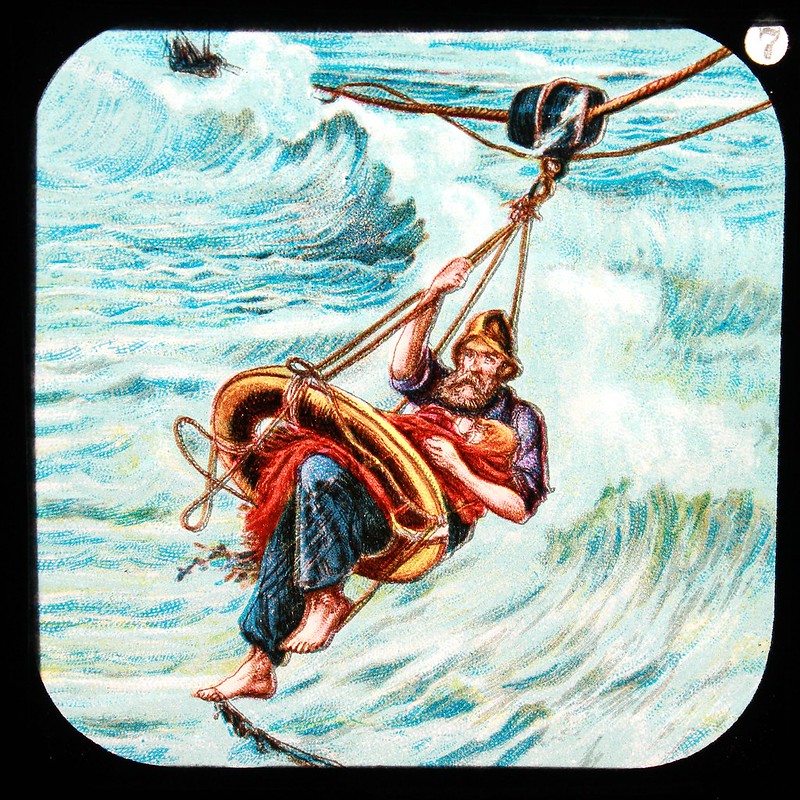
Shortly after recording the most recent Sophomore Lit episode about Robert Westall’s young adult novel The Watch House (1977), guest host Ross Cleaver pointed me towards an online discussion about a magic lantern series called Our Life Boat Men. While most of the eight-slide series features scenes of rescues involving life boats, there is one slide that depicts a rescue using a rope line and pulley, the technique that Westall describes in his book.
“The Pulley.” Slide no. 7 from the series Our Life-Boat Men, W. Butcher & Sons, c. 1901. Image from Tyne & Wear Archives & Museums.
Magic lanterns were a form of image projector popular in the 19th and early 20th century. The ability of curved glass to bend light was known from antiquity, with the earliest written reference appearing in Aristophanes’ The Clouds. Reading-stones (rounded glass magnifiers) and even spectacles were used in medieval times. But modern lenses as we know them started in the 17th and 18th century with the development of the telescope and the microscope. By the 19th century optics had become precise enough to sharply focus projected light. This development, along with increasingly bright light sources, such as gas and limelight, led to the commercial production and popularity of magic lanterns.
Butcher & Sons “Primus” magic lantern, c. 1890.
These projectors used glass slides that came in a variety of sizes upon which were the images to be projected. The first slides were hand-painted, but later, photographic techniques allowed for mass replication. At first, publishing companies mechanically transferred black line images to the slides, most commonly using decals; colors (if any) still had to be added by hand. But at the end of the 19th century chromolithography and semi-transparent inks made possible printing uniform editions of magic lantern slides, albeit with often imperfect registration of colors, as is evident from “The Pulley.”
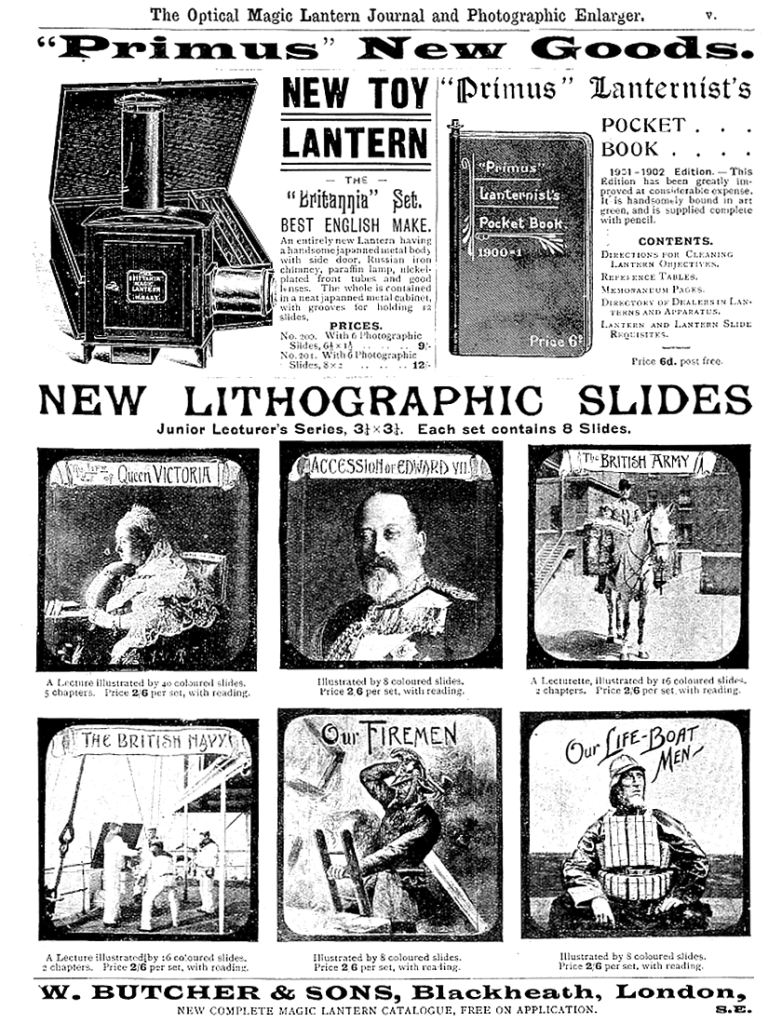
The series Our Life-Boat Men was sold as a part of London-based W. Butcher & Son’s Junior Lecturer’s Series. While the slides themselves are undated, a 1901 advertisement lists Our Life-Boat Men as one of six “new” lithographic sets produced to be used with their Primus line of lanterns. Butcher & Sons aimed at a market of well-to-do home users, and their chromolithographic slides were relatively inexpensive when compared to ones designed for theatrical use—and yes, in the 19th century people did pay admission for the privilege of viewing still projections in darkened rooms.
Advertisement for W. Butcher & Sons in The Optical Magic Lantern Journal and Photographic Enlarger, November 1901.
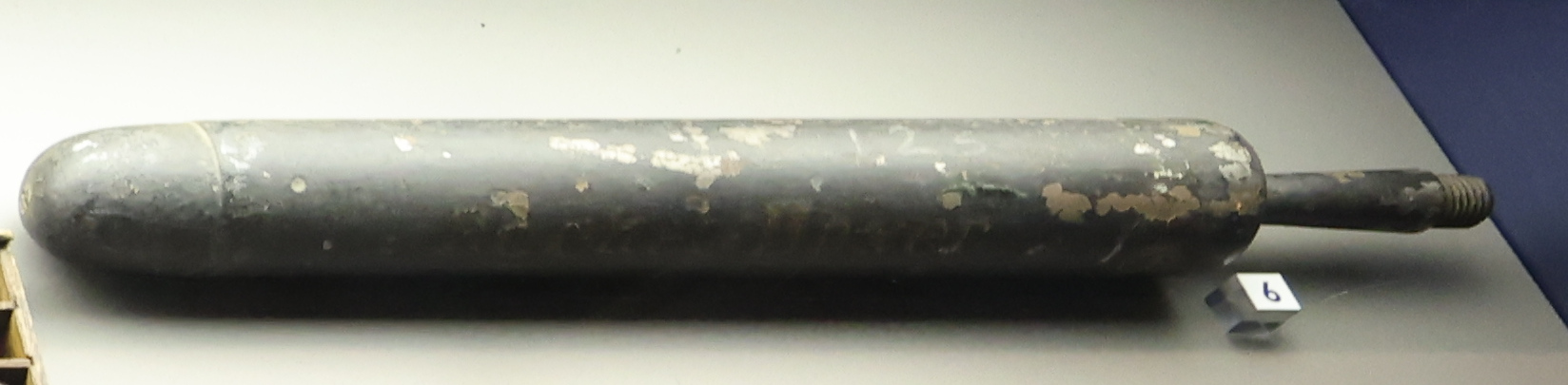
In Westall’s book, the book’s protagonist Anne is told of the techniques employed by the Victorian life-savers who used to work at the titular watch house. The port of the novel’s fictional town of Garmouth (based upon Westall’s hometown of Tynemouth) is bounded on its sides by shallows covered with mounds of rock, and in bad weather ships could beach themselves only a few hundred feet from shore. The watch house volunteers would shoot ropes to the ships using rockets and survivors could be drawn ashore using pulleys. As I mention on the podcast, when I read these passages—describing rescues carried out in the 1850’s—I was incredulous. It didn’t seem possible, especially with 19th-century rockets, to fire with such accuracy while dragging 20 pounds of rope (or more). But apparently this was a widely-used technique. The Shipwreck Centre & Maritime Museum of displays examples of the apparatuses that were employed.
In the slide “The Pulley” the intrepid hero is riding in a lifebuoy that is hitched to a hoist trolley—if something goes wrong, at least he has a flotation device. In his arms he appears to be holding a child wrapped in a tattered red blanket. The rescuer is lightly dressed for such cold weather, although he wears a sou’wester oilskin hat, which is standard rough weather maritime gear. There are narrative details that make me wonder. Why is the man barefoot? Is that standard practice, or did he loose his boots in the operation? He appears to have a strand of kelp trailing from one foot. Does this mean he’s grazing the water? Is he in danger of submerging? Come to think of it, how can the rope be staying that taut? Wouldn’t it dip with the weight of the passengers?
But mostly: Why can’t I stop obsessing over random bits of forgotten culture?
This Thanksgiving marks the 10th anniversary of drunken “special” episodes of my podcast, Sophomore Lit, featuring my brothers, Rob and Dan. Sophomore Lit is normally a podcast where a guest and I read a work of formational literature—often one that we were assigned to read in high school, or grade school, or college, but also simply works that young readers read. Then we discuss the work, but with the perspective of older readers. These special episodes with my brothers, however, are purposefully goofy, having as their subject pieces of culture that are obscure, marginal, and in most cases literature in only the loosest sense.
When I started Sophomore Lit, my concept was to humorously dissect the kind of book you only ever read in high school. I got the idea when one of my own kids had to read Lord of the Flies for their English class and I thought about all the books that are largely remembered today as assigned reading. Particularly A Separate Peace, which I think is a very weak novel, but which somehow won the lottery of staying perpetually in print because of high school lit classes. If you listen to the first dozen or so episodes of the podcast (I don’t recommend it), you can hear me trying to strike a comedic tone1. But as the show matured, I realized that my listenership was sincerely interested in discussing these works and nostalgic for the kind of discussion that only happens in the classroom. I remember a comment from a gentleman thanking me because he had never gone to college, but hearing books discussed was a way for him to partake in literary discourse.
As the episodes piled up I became more and more interested in the whole idea of literary canons. I realized that the teachers who taught me had themselves been in high school in the 1960s and 1970s, and the works they chose for their classes reflected Boomer tastes towards counterculture, science fiction, and social change. They were also mostly written by a bunch of white guys. So I started to go out of my way to enlarge the works the podcast covered, to include more women, minorities, non-Americans, and works that were not a part of my canon but a part of Millennial canon, or British canon, or others. I found that I was teaching myself by doing this, and that my listeners were getting exposed to a greater variety of works, and I’m glad for the evolution of the podcast. But in the back of my mind, I still occasionally wanted to do something silly.
Near where I live in Boston there are two streets a block apart called John Alden Road and Myles Standish Road. There is, however, no Priscilla Mullins Road. This amused me for a long time because I wondered how many people who lived on these streets had ever read “The Courtship of Miles Standish.2” I have a soft spot in my heart (and my head)3 for ponderous 19th century poetry—I find it fascinating that writers like Longfellow, Tennyson, or Greenleaf Whittier were the rock stars of their age, and that whole generations of schoolchildren were forced to recite their work for declamation. My father used to quote “The Midnight Ride of Paul Revere” to me all the time. I thought that I should eventually do an episode on “The Courtship of Miles Standish,” because the idea amused me, and because the poem was a card in the Whitman card game Authors that my family had when I was a kid.
Whitman Authors card for “Courtship of Miles Standish” c. 1967
Many years ago, in the early 2000’s, Dan had made fun of visiting me for Thanksgiving (or at least a fictionalized version of me) in an episode of his Channel 102 series 9 O’Clock Meeting. So when in 2016 he again came to Boston for the holiday, I decided it was fair game to put him on the spot.
Dan did this series with Matt Koff back in his pre-podcast days.
The characters in “The Courtship of Miles Standish” were all Pilgrims, which sort of made the poem appropriate for a holiday episode, and because we had eaten too much and were slightly drunk I was feeling festive. And to be honest, I try to have Dan on my podcast as much as he’ll put up with, because he’s the internet celebrity of the family and I always hope he’ll bring some of that sweet Flop House listenership along. (I don’t really know what my podcast stats are like, but I suspect they are perishingly small compared to his, which is probably why he’s never asked me to guest on the Flop House4.)
I can’t speak on Dan’s behalf, but I enjoyed recording the episode a lot, and so the next year I wanted to do another. That time my older brother Rob was also visiting, so I invited him to partake. Poor Rob, in spite of being a lawyer and therefore used to arguing in public, was a bit mic shy, but I got him drunk as well. That time we discussed Coleridge’s Rime of the Ancient Mariner, which is bona fide Literature, but also goofy as hell. And when I posted the episode, Jason Snell, the head honcho of the Incomparable Network (my podcast home), made a very nice tweet comparing the three of us to the McElroys, in the sense of being three brothers, not in the sense of being anywhere as funny. And so the Thanksgiving episodes became Sophomore Lit tradition. At least a tradition for me; I guess it became tradition for my brothers to dread my annual pitch for increasingly silly topics. Here’s a full list of all the previous specials:
As for this year’s subject of protest songs: the idea came to me from a combination of my memories of Dad playing Alice’s Restaurant on the piano and of my irritation with the smug coyness of the fictional “Mountain People” in One Tin Soldier, who really must take some responsibility for their own demise. And then I threw in Where Have All the Flowers Gone? because of the rule of threes.
I should stress that I have genuine affection for all the songs we discussed. I’m sure that much of that comes from hearing these when I was very young, but a lot of it also comes from admiring their earnestness. By the 1980s a veneer of sarcasm and cynicism covered most of American pop culture, and this was the formative decade for Generation X, so it was sort of inevitable that we would be seen as ironic and nihilistic. But our childhoods were steeped in sincerity, however mawkish, and I like to think that that’s the gooey core hidden under our hard candy shells. Anyway, Happy Thanksgiving.
You can also hear a lot of abrupt audio jumps from me fumbling about in Audacity, trying to correct all my verbal tics. ↩︎
Standish, Alden, and Mullins were all real people who arrived on the Mayflower, but only remembered through Longfellow’s fictional poem. ↩︎
This is not my original joke but I forget where I read it. ↩︎
In the summer of 1981 my family took a cross-country trip from our tiny college town of Eureka, Illinois to spend the summer Claremont, California, where we would live in a loaner house that was part of an affluent retirement community. My father was on sabbatical from his professorship and planned to spend a few months writing. I have many memories of this trip, but the three big ones were: 1) going to Disneyland, where I was able to experience Mr. Toad’s Wild Ride and the 20,000 Leagues Beneath the Sea: Submarine Ride, both of which are now but memories; 2) the release of Raiders of the Lost Ark, which is now a classic but at the time arrived seemingly out of nowhere with almost no promotion (Superman II was supposed to be the biggest movie that year); and 3) afternoons playing roque.
I remember the day my father first described the sport of roque to my mom, my brother Rob, and me over the dinner table. He said that a group of the retirees at the village were all hooked on a game that was sort of like pool, except instead of a table, it was played on a big hard court, and the players used mallets and hoops like croquet, but you hit your ball using a cueball, and also there was also a sort of a curb around the entire court, so that players could make bank shots, like the rails of a billiards table. I was confused but intrigued, and then my dad said that if we were interested, we were allowed to use the roque court when no one else was there—as long as we took part in its cleaning and upkeep.
The next day, Rob and I watched a game and it was fascinating. The court was only a short walk away in a central shared area of the community, surrounded by short palm trees. It was recessed into the ground and dog-eared at each corner, resembling an emerald gem cut. The surface was warm red clay, much like that of a clay tennis court, and it was dusty and got on the soles of the shoes of the elderly gentlemen who carefully and precisely lined up their shots. The mallets were short, compared to croquet mallets, and they had a soft rubber head on one side, for better control and possible spin on the cueball. The wickets were thick metal and were permanently anchored in place by cement below the clay. And boy howdy were the players serious. There was absolutely no talking when someone was taking his turn, and usually none after as well, unless to murmur approval for a good shot or to sympathetically click their tongues for a bad one.
My father had apparently petitioned the locals on Rob’s and my behalf—perhaps he realized we had little to do that summer on a daily basis—because a couple of the aged fellows took us aside and took us through the rules, which were mostly the same as croquet’s except when they weren’t. They showed us the proper way of holding the mallet straight up between the legs and making contact with the cueball. But most importantly, they showed us how to maintain the court. It had to be swept clean of debris (the California foliage produced stray leaves year-round). It had to be lightly sprinkled with water, to prevent cracking in the sun. When it inevitably did crack, there was a reserve of clay powder that was sifted into the fissure by hand and wetted. Finally there was a large metal roller, pushed like a lawn mower, that was used to keep everything level.
If the sport of roque is remembered at all today, it’s as a plot point in Steven King’s 1977 novel The Shining (but not in the Kubrick film adaptation of 1980). In the novel, the haunted Overlook Hotel features a roque court, and towards the start of the book the hotel’s owner, Stuart Ullman, describes the structure to Jack Torrance, the troubled author who has taken on a position as winter caretaker:
“It was Derwent who added the roque court I saw you admiring when you arrived.”
“Roque?”
“A British forebear of our croquet, Mr. Torrance. Croquet is bastardized roque. According to legend, Derwent learned the game from his social secretary and fell completely in love with it. Ours may be the finest roque court in America.”
“I wouldn’t doubt it,” Jack said gravely. A roque court, a topiary full of hedge animals out front, what next? A life-sized Uncle Wiggily game behind the equipment shed?
Late in the novel, after he has been possessed by the malevolent spirit of the hotel, Jack uses a roque mallet to terrorize his wife and child, as well as to mutilate his own face (early King novels, am I right?). It’s remarkable that King went so out of his way to feature a forgotten sport and then get absolutely nothing right about its history. Roque is an American invention, developed in New York and named by Samuel Crosby in 1899; the name was derived by removing the first and last letters of “croquet.” Croquet itself was not a particularly old sport at the time. The earliest description of that game comes from 1856 in London, although it seems likely to have derived from previous vernacular sources. When Alice’s Adventures in Wonderland was published in 1865, the Queen of Heart’s croquet game, played with flamingo mallets and hedgehog balls, was a reflection of a recent craze for the invention.
Roque was something of an overnight sensation at the turn of the century. The innovations it brought to croquet greatly increased opportunities for skillful play, and the permanent courts, which required a significant investment of resources, made it into a serious sport for serious players. Competitive roque was played by two teams of two players and high-level play included the technique of hitting your ball into your partner’s ball, thus pushing the two balls along in tandem.
How big did roque get? It was a sport in the 1904 Olympics, replacing croquet, which was an event in 1900. The United States won all the medals, largely because roque wasn’t played outside of the country. In his 1954 novel Sweet Thursday, a sequel to Cannery Row, John Steinbeck spends a chapter describing how the town of Pacific Grove, California became torn apart by a rivalry between retiree players and fans of two opposing roque teams:
Once, during its history, Pacific Grove was in trouble, deep trouble. You see, when the town was founded many old people moved to the retreat, people you’d think didn’t have anything to retreat from. These old people became grumpy after a while and got to interfering in everything and causing trouble, until a philanthropist named Deems presented the town with two roque courts.
Roque is a complicated kind of croquet, with narrow wickets and short-handled mallets. You play off the sidelines, like billiards. Very complicated, it is. They say it develops character.
In the novel, Deems, the benefactor who paid for the courts regretted the rift they were causing and had them bulldozed in the dead of night right before a big tournament.
While I was researching the history of roque for this essay, I discovered that in its basic form it did not use a cueball, and that the version I had been taught was called “two-ball” roque. There was also, apparently, a version called “royal” roque, but what that entailed I can only imagine. In any case, roque’s popularity faded quickly after World War II. The American Roque League last published official rules in 1959 and the National Two Ball Roque Association last published its rules in 1961. In 2004 the American Roque and Croquet Association suspended its national roque tournaments.
A 2011 article in Croquet World Online Magazine details the construction of a contemporary court in Stuart, Florida. Its builder, Chris Bullock, remembered the game from having played it at Cape Cod in the 1950’s. The article say that Mr. Bullock and his friends play a new variant, “golf” roque, designed to be faster-playing. This article, now more than a decade old, is the most recent mention of play I could find, and I wonder if Bullock’s court sparked new interest or if it was the last of the dodos.
Whether or not there’s anyone left playing the game today, roque left a lasting impression in my mind, mostly for the memory of one ill-fated evening. It was late in my family’s stay in Claremont and Rob and I were a bit squirrelly with the realization that we were heading home soon after two and a half months. And we were going to miss roque. Generally we played in the late mornings because those were the only times that the courts were free. But that evening Rob and I decided we wanted to play late.
It had been raining that day, which of course is rare in southern California, and the court was a bit tacky, but we were determined to go through the upkeep routine, because that was in its own way as fun as playing. There was a sizable crack and I thought we should really fill that in as much as we could so we heaped on a few handfuls of the clay dust, but it wasn’t really settling in place, so we pulled out the hose and soaked the pile through. The court around the crack was already saturated and excess water from our repair attempt was puddling.
Now we had a sticky mound of clay that was noticeably higher than the rest of the court. So we did what seemed obvious—we pulled out the roller and set to work, running it back and forth as if we were making a pie crust. The mound was not getting smaller, so we took running starts; and then disaster struck: a layer of the court peeled off entirely, stuck to the roller, leaving a gash about two feet long, six inches wide, and maybe a quarter of an inch thick. The tacky clay had crumbled unevenly and the exposed surface was pockmarked and cratered.
We were horrified. We had been entrusted with the use and care of these men’s most prized possession, their passion in life, and we had ruined it. I was absolutely losing it while Rob was trying to figure out how we might fix things. The answer seemed to be more clay, and more rolling, but now nothing stuck at all. Any powder we put down just added the smear stuck to the roller, which would not scrape off. Darkness was falling, and we were supposed to return to the house. Eventually, we simply gave up. We replaced the roller and the hose and walked back in shame. We didn’t tell our parents, but we knew that the next day there would be a reckoning. I didn’t sleep well that night.
Late the next morning, Rob and I walked slowly out the back door and onto the path that lead to the scene of our crime. I played through scenarios in my head, mostly involving us having to somehow pay for the damage with a lien on any future wages, which were more than a decade off. I also imagined the sad retirees returning home to their wives and trying to hold back the tears. But instead, what greeted us was nothing of the sort. There were four old guys, lost deep in play at a forgotten sport. The court was immaculate. Nothing was ever said.