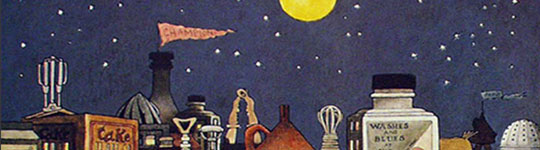
Through the dark, out of his clothes

Night Kitchen

Sendak’s death has hit me hard, as I’m sure it has for anyone whose childhood was after 1960. Whenever a touchstone figure from our collective childhoods dies, the boundaries between public and private dissolve and our most intimate memories are revealed as shared experience. If you’re old enough to remember watching the Muppet Show during its original run you know what I mean. So it is with Sendak: all of us remember being sent to our rooms without any supper, and the forest that grew and grew and grew until the ceiling hung with vines and the walls became the world all around.

And yet, memory is also specific, and Sendak’s particular, peculiar role in my childhood was not only as a mirror to my own psychology but as my first bridge to times and places not my own. When I read (or more properly, when my mother read to me) In the Night Kitchen there was a rich strangeness that went far beyond the dream-logic of the plot. There was an odd cadence that I could not place: the strange clipped exclamations in the word balloons. Many years later (when I was ten) I discovered Little Nemo in Slumberland in a collection of old comic strips and my head exploded. Theme, plot, an style had been stolen from the 1905 cartoon, but they had also been transformed into something new.

Sendak’s world was full of the stuff of his own life as the child of Polish Jewish immigrants in Brooklyn, but it was also full of Oliver Hardy and Mickey Mouse and Tin Pan Alley and all of that rattled around in his mind and spilled onto his pages. As child I puzzled over who these strange identical cooks were and why they were intent on baking Mickey and those second- and third-hand memories stuck with me until I was old enough to understand whence they came.

So to Mr. Sendak, my thanks for the following lessons: The world is a very big place and very old. The past is still with us and will always be. Nostalgia isn’t only for your own memories.

Smells like victory

My older brother used to play an elaborate game with a friend of his using those little plastic army men you’d buy in buckets. An entire back yard was the playing surface and moves were made in turns using a ruler; each piece got a set number of inches. Once in range of enemy pieces, dice were rolled to determine  damage inflicted. Then once a piece had been “killed” the real fun took place: using a lighter and a spray aerosol can of lubricant, the poor soldier would be torched until it caught fire and melted into an olive drab pool.

Melty

Later variations on this game included using napalm in the form of setting a two gallon milk jug alight and dripping flaming gobs of polyethylene on the hapless fighters; I also remember one afternoon where the a fort was constructed of styrofoam and also torched, although it never really fully caught. But it did produce large oily plumes of smoke that seemed half ink and half air and were no doubt full of dozens of toxins. For that matter, none of us stopped to consider if the can we were using for flamethrower fuel was likely to ignite; or that the late-August grass was crisp and brown.

As pointless and dangerous as these pyrotechnics were, I have fond memories of them. In fact, it’s because they were pointless and dangerous that I have fond memories. If I had ended up burning myself I’d probably enjoy the memory more, because everyone loves their scars. I have a particularly large one on the bottom of my right index finger where I almost chopped the digit off by sticking it into a spinning exercise bike wheel when I was four; I have another at the base of my thumb to mark the time I fell backwards down some stairs and slammed my hand through the window of my back door. I love them both.

Looking back on our stupid choices and telling scandalous stories about the bad things we did is one of life’s joys. There’s the old adage that our mistakes are what makes us who we are; this is true, but I think our love of  stories of drinking binges and disastrous romantic encounters and quarry diving and childhood games on thin ice speak to us on a baser level. We like to imagine a time free from responsibility and filled with possibility.

We just don’t want to imagine these things for our own kids.

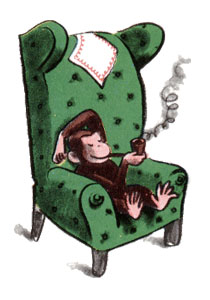
After a good meal and a good pipe

Borkum Riff. About once a year, I’ll catch the distinctive smell of whiskey-soaked pipe tobacco, and for a moment I turn to look for my dad. When I do, I look up, because I’m six years old: my dad hasn’t smoked since the 1970’s. But that smell, of tobacco and sweet cream, was such a constant part of my childhood that it’s burnt into my memory so deeply it would take a pipe cleaner to remove it from my hippocampus.

Whenever this happens I don’t really know how to feel. On the one hand, it’s a smell that never fails to transport me to my youth. On the other, my dad quit smoking after I had a long outburst telling him with all the earnestness of a child that I hated the fact that he smoked and that it gave me headaches and that I was sure it was going to kill him and I wouldn’t have a father. I remember that I couldn’t stop shivering for hours from the emotional surge. I am, of course, very glad that my father did stop smoking, as he’s still with us today.

And yet. My father owned several pipes and they were all beautiful. He had curved rose-colored pipes made of burls (cherrywood? walnut?) that looked wise and mysterious, he had sharp-angled black pipes that looked like they belonged to Mr. Fantastic. He even had a corn-cob pipe that was hokey and wonderful. He had pipe tools for tamping and scraping and cleaning and a carousel that he kept his pipe in. And he had tins of tobacco with pictures of three-masted ships and peculiar European men and maps of the world on them. And when he read the Hobbit to my brother Robert and me and he got to the part about Gandalf and Thorin blowing magical smoke rings I knew exactly how that must have looked.

My ambivalence about pipes can be summed up nicely by Curious George. In the original H.A. Rey book from 1941, the monkey George is unceremoniously removed from the jungle by the Man in the Yellow Hat for sale to a zoo; Upon arrival in America, he spends what is supposed to be his last night of freedom in the Man’s home, where we are told After a good meal and a good pipe, George was tired.”


George

When my kids were little, they constantly watched a VHS recording of the 1982 stop-motion version of Curious George, which faithfully stuck to the text of Rey’s book and did in fact show George enjoying his pipe; however, immediately after George takes a couple of puffs the film shows George becoming ill and the Man in the Yellow Hat guiltily putting the pipe away—presumably shamed into quitting himself. And this part always made me very, very angry. Why? Why the need to editorialize? Children already know that George is doing something wrong, something forbidden. That’s what makes it fun. And Dad, I’m glad you stopped smoking. But I hope you can still find something wrong to do now and then.