

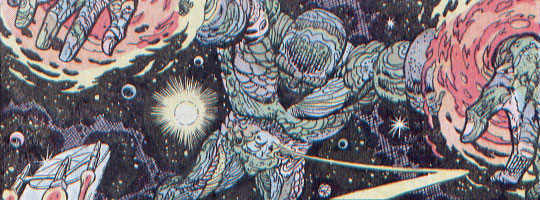
We all have favorite books that we re-read compulsively when we’re sick; or favorite movies which we can’t help but watch again while channel surfing, even though we own the five-disc collector’s Blu-ray. There are songs that we want sung at our funerals even if the choice might only pile confusion onto the grief of the mourners (Radiohead’s “Airbag” for me, please). And then there are works of art that aren’t necessarily favorites, whose aesthetic merits we would be hard-pressed to defend, but which were somehow at the right place at the right time to burrow deep into our subconscious like psychic earwigs.
Back in the day, when comic books were still mainly sold in five and dimes, the practice was for unsold issues to have their covers torn off and sent back to the distributors. While technically these books were supposed to be written off, some did re-emerge at the very bottom of the retail food chain in plastic bags sold three for a dollar. I believe that it may have been through this dicey trafficking that a copy of Marvel Presents #7 (1976) made its way into my older brother’s hands. All I know is that the ragged, torn, and smudged copy I re-read compulsively for the next several years of my young life never had a cover, which only added to the aura of mystery of the thing.

Also adding to the mystery: I had no idea who any of the characters were, or what the events leading up to this comic were, only HOLY HELL THIS MAKES NO SENSE. The story—titled “Embrace the Void!”—involved a group who called themselves “the Guardians of the Galaxy,” only apparently the main characters in the story didn’t consider themselves members. They are a ragtag group of aliens from various planets—Mercury, Jupiter, and Pluto are mentioned—and for some reason they are visiting the Convent of Living Fire, a nunnery run by a sisterhood of green webbed-handed zealots whose religion involves a process of psychic self-immolation resulting in oneness with the universe, as well as eventually collapsing into a pile of ashes. Nikki, the voluptuous, flame-headed Mercurian who may or may not be a member of the group is being encouraged by Starhawk, the omniscient and brooding instigator who is definitely not a member of the group, to undergo the ritual that will result in her combustion. An explanation as to why she must do this is not forthcoming.
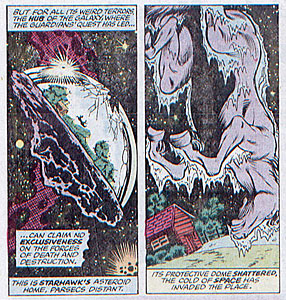
Neither is there an explanation of a sudden cutaway scene occurring in a spaceship orbiting the convent’s planet. Only it’s not a planet per se, it’s an enormous man, the “Topographical Man,” whose body spans light years and who holds twin stars in his grasp. Aboard this ship a final member of the Guardians, Vance Astro, is locked in a psychic battle with a creature who has assumed his appearance, a battle he apparently loses when he collapses to the floor. And then there’s yet another jump-cut to a scene that chilled me to my eight-year-old core: a shattered biodome floating through space with a frozen horse suspended lifelessly within. This is apparently Starhawk’s home, but the narrative doesn’t dwell on this scene of distruction: we return to Nikki, who has willingly strapped herself to a ritualistic throne and burst into flame in a scene which can only be described as orgasmic, although that particular detail only became clear to me years later.

Adding to the mélange of crazed hedonism, Starhawk suddenly lurches forward in the grips of his own spasms, and beats a hasty retreat from the temple, pursued by the Plutonian member of the group, a figure composed of silicon who can apparently melt solid rock with his hands. When the crystal pursuer reaches his prey, Starbuck confuses the sexuality of children across the nation by transforming into a woman (his outfit also morphs into something much more revealing). Before you can say weirdest boner, the scene cuts once again to the orbiting spaceship, where—surprise!—instead of having been defeated, Vance Astro has merely switched minds with his foe. But before he can luxuriate in his own new body, he dissipates, his consciousness seeping out of the ship into space to become part of the Topographical Man (remember him?)

And just in time, too, because the now engulfed-in-flames Nikki has astrally projected herself into space as a translucent naked entity—to engage in congress with the celestial humanoid, whose mind is now at least partially Astro’s. Yes, that’s right: this has all been leading up to a ghost fucking a planet. Which causes the planet to explode. Which is…good, I guess? Apparently this Topographical Man has been absorbing other planets, which is bad, although the inhabitants of these worlds seem to have done all right for themselves starting strange religions and constructing huge convents and all. Somehow the Guardians all escape, leaving presumably billions of the Topographical Man’s inhabitants to die, but they seem happy enough with what they’ve done to call it a victory. Nor do they seem all that surprised that their companion Starhawk is now a chick, but that will apparently be resolved in another issue.
Except for me there was no other issue. Until I became an adult, this coverless issue was my one and only glimpse into this crazy universe and to say it left me with questions would be an understatement. But in spite of my confusion, the comic book haunted me. Actually, the confusion only fanned the flames of my obsession. This was a window into something cosmic, bizarre, and intensely sexual in a way that broke my brain. It made me feel like I was reading something forbidden that was just on the verge of making sense. And the art! The gorgeous sinewy line work by Al Milgrom, given a Kirbiesque flair by inker Bob Wiacek, so much more visceral and connected to the id than any digitally produced comics today. The author of this story was none other than Steve Gerber, writer of Howard the Duck, which makes perfect sense.
In recent years I’ve tracked down copies of the other issues in this run of stories—copies with their covers intact—and while the plot lines are more or less explained, I can’t say that knowledge has led to enlightenment. I can now place this comic in the context of the culture of the mid-70s, of waning psychedelia’s last gasps and a counterculture being absorbed into the mainstream. I can also see the comic for the narrative and derivative mess it sometimes is. But that doesn’t matter. The damage was done long ago, and for that I’m grateful.

