Surrender to the void

Lazarus

The final sequence of this Sunday’s Mad Men features a puzzled Don Draper listening to the Beatles’ song “Tomorrow Never Knows.” He’s doing this at the suggestion of his much younger wife who wants him to be more in tune with what’s going on in 1966. It’s an odd choice—even now, three dozen years later, it’s like giving someone who wants to understand James Joyce a copy of Finnegan’s Wake. In any case, it’s all too much for Don, who pulls the needle.

My wife and I watch the show together and we discussed how rare it is to hear an actual Beatles recording (not a cover) as part of a soundtrack and she wondered how much the producers had to pay. Well, the answer came today in a New York Times article: $250K. Producer Matthew Weiner, interviewed in the piece, focuses on his goal of authenticity to the period: “In my heart, I operate in a realistic world because I’m producing a TV show. I never, ever think about that—‘Oh, let’s not have a song here so I can save some money.’” Of Apple Corps (the corporation that acts on behalf of the Beatles and their heirs) and their requirements, which in addition to the money included review of the story ahead of time, Weiner says:

Whatever people think, this is not about money. It never is. They are concerned about their legacy and their artistic impact.

Weiner is being charitable, and he may believe this, but I find the argument that the best way to ensure the artistic integrity of the Beatles’ œuvre is to make it so only very rich people can use it specious. The song was used to great thematic effect in Mad Men, but perhaps there are any number of student filmmakers who might use it to even greater effect, not to mention dancers or mashup artists. And even if the song were used poorly—say to sell sneakers—let’s say Nikes—how would that tarnish the original work unless it were cynically sold at a great price?

“Tomorrow Never Knows” is a particularly interesting song to examine from a rights perspective. It’s credited to the songwriting team of Lennon and McCartney, but it was written by Lennon, or rather it was Lennon who came up with the ten or so repeated sonorous notes. The actual words were adapted from The Psychedelic Experience: A Manual Based on the Tibetan Book of the Dead, which was co-written by Timothy Leary (among others). But the passages used are from the Bardo Tholo, an 8th Century Buddhist funerary text attributed by tradition to Padmasambhava. So who ultimately wrote the lyrics? Musically, the importance of the song is not its (barely-present) melody or its droning harmonic structure, but its use of audio loops, a technique borrowed from Stockhausen. McCartney was interested in the avant-garde approach but it was George Martin and several EMI technicians that actually got it to work. So who ultimately made the song? And which amongst them will receive a portion of the $250K?

Defenders of copyright maximalism—those who seek ever-longer copyright terms and ever-broader interpretations for what is defined as use—like to characterize copyright reform as an effort to deprive artists of what is rightfully theirs. But for those of us who look at news of absurd fees for forty-six-year-old recordings with alarm rather than amusement, it’s not about getting things for free. Because ultimately the losers here aren’t the two unfathomably rich corporations exchanging money—it’s all the rest of us who are prohibited from using a work that was created in the first place from the culture at large.
A bad motivator

Lucas Vader

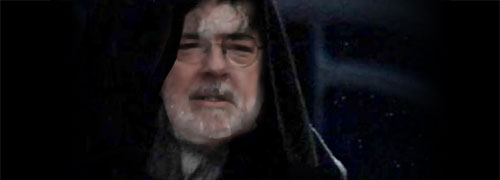
For the last couple of weeks there has been a great disturbance on the Internet, as if millions of geeks suddenly cried out in terror. I’m talking about the latest batch of changes George Lucas has made to his Star Wars movies, this time on the occasion of their blu-ray release. The long story short here is that ever since the “special edition” releases of the 1990s, Lucas has been altering the original three Star Wars films; sometimes substantially, with new scenes and actors swapped in digitally; sometimes trivially, with newer visual effects and bleeps and farts. This isn’t a bad thing in theory—directors’ cuts are usually greeted as definitive versions, and many artists can’t resist the urge to go back and tweak their earlier work. (Walt Whitman added poems to, subtracted poems from, and generally rewrote poems in every new edition of Leaves of Grass in his lifetime.)

But in the case of Lucas the changes to the original have been so awful, and the memories he’s tinkering with are held so dear, that it seems a kind of spite is driving him at this point. I’m not going to list the details of all the alterations here (that’s what Google’s for), but suffice it to say, it’s understandable that people might want to have available the original version of a film (and here I’m talking about the first, 1977 Star Wars) that holds such a central place in the history of film and society. But Lucas says no; this is his vision, you get it all—all retrofitted to mesh with the awful prequels—or you get nothing.

If the original film—now thirty-five years old—had been released under the original fourteen year copyright term (renewable once), this would all be moot. Criterion would be free to release a restored original version with commentary by historians. Wal-mart could release a budget version with all the incest taken out. And Lucas? Lucas would still be free to alter his films in any way he wanted to. He could stick Jar-Jar into every damn frame if he liked and all of the fans who valued his intent over their childhood memories (there must be at least four or five of them) would be free to purchase these enhanced versions. The point is, Art with a captial A would be served and Commerce with a capital ¢ would be served as well.

There are rights holders like Lucas whose bad dealings with the art they own comes from an honest belief that they’re doing what’s right. Then there are rights holders like Disney, who are motivated entirely by their desire to monetize their holdings as efficiently as possible. The famed “Disney Vault”—the practice of Disney of bringing properties in and out of print in cycles—is a good example of this. They aren’t doing this to benefit their films or their audience—they’re just making sure their products are not in competition with each other. Disney animation from the 30’s, 40’s, and 50’s is central to our cultural heritage, but we’re kept from it, not by the artists who actually produced it (they’re all gone) but by a marketing ploy. Similarly, Disney gets to remove any scenes or elements form its films that might affect their salability.

It’s not just pop culture that suffers from the heavy hand of rights holders: no less a luminary than James Joyce has also been affected. The current executor of this seminal Modernist, so central to world literature, is the artist’s grandson, Stephen Joyce. Under the name of protecting his grandfather’s legacy, the younger Joyce has aggressively hindered access to the artist’s letters: bringing suit (or threatening) against biographers and scholars whose work he deems harmful, prohibiting public performances of his grandfather’s work, destroying letters by Joyce’s daughter, and hoarding unpublished writings. He even said no to Kate Bush using Molly’s soliloquy in a song. Thankfully, the works of Joyce are about to enter the Public Domain—at the end of this year, only sixty years later than they should have.

Afterword: In the article on Joyce linked above, the author writes: “It is understandable and reasonable that the heirs of an author […] would gain a financial benefit for a certain time from that author’s work, in the same way that a descendant who has been left a farm or a house is entitled to a financial gain from it.” I note this because I think it’s a fallacy that’s often made to justify the passing of copyright to one’s heirs. The correct analogy would be that as a farmer may leave his farm and equipment to the next generation, so too an author may bequeath to their heirs their own tools of production: pens, paper, notes, typewriter or computer. An analog to copyright for the farmer would be if the farmer’s heirs continued to receive residuals on crops produced many decades before.

The same old played out scenes

This week in copyright comes the news that the rights to many songs from 1978 could transfer from record companies to the original artists. It’s a provision in the 1976 Copyright Act called “termination rights” which allows artists to acquire copyrights held by their publishers after 35 years.

copyright tug

I’ll admit that the main attraction to this story is watching the publishers hem and haw over the finer points of the law while maneuvering to hold onto these properties. These are the same people who pose as protectors of artists’ rights when they sue file sharers (and pocket the settlements); now that their interests are in conflict with the creators they allegedly champion they are making no attempt to hide their hypocrisy.

But while I’ll happily grab a bag of popcorn to watch the recording industry’s shameful display, I think there’s a deeper lesson here. The fact that the RIAA is spending lawyers on 35-year-old rights demonstrates once again that Copyright in its current form is failing at its basic goal of promoting the production of new work. Why should Columbia be looking for new talent when it’s more profitable to fight over Darkness on the Edge of Town? For that matter, why should Bruce Springsteen write anything new if he can snag those rights?