This post is a companion piece to Sophomore Lit episode 187, Plato’s The Apology. Why not listen to that podcast before reading?
As we mentioned on our Apology episode, Marina and I recently traveled to Athens, Greece. The trip was a surprise birthday present she arranged for me. Marina is the planner of the two of us, and if there’s one piece of advice I would give to my fellow Autistics, it would be to marry a planner. Your life will be 256% better1. The trip was something we had discussed for a long time as an intersection of our professions: hers as a philosopher specializing in Plato, and mine as an art historian. However, my areas of interest are 19th and 20th century art and popular culture, and my last formal study of ancient art was one of the final classes I took for my M.A. waaay back in 1993. But actually being on the Acropolis brought back a flood of memories of lectures about Phidean sculpture and the thesis I wrote about the Museum of Fine Art’s late classical fragmentary statue of Leda and the Swan (or perhaps Nemesis and the Swan, but that’s a story for another day). This essay is notes on our visits to the Acropolis and the Ancient Agora. We saw many other sites in and around Athens, but in this essay I’m focused on places that are relevant to Soph Lit listeners.
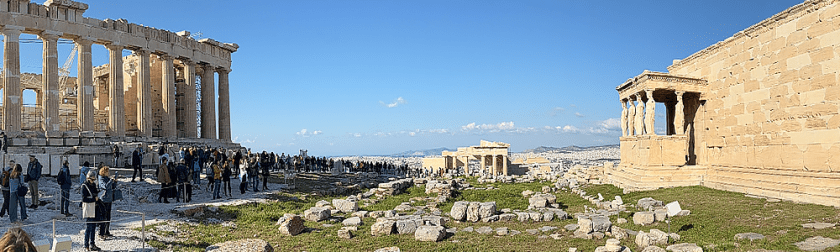
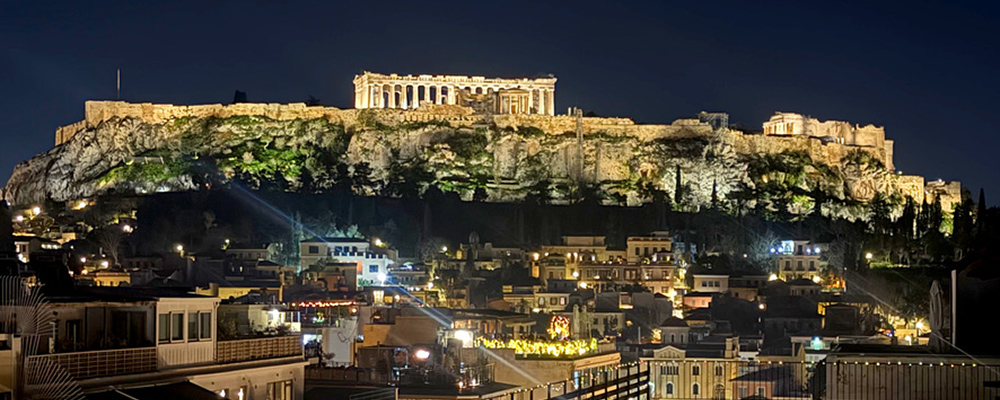
While most people have heard the words Acropolis and Parthenon, it might be good to lay down a few terms: The Athenian Acropolis is a rocky plateau that was on the edge of the ancient city of Athens and is currently at the center of Athens, surrounded by the tourist district. The word “acropolis” actually means “highest point in the city,” and many cities had acropolises that were used for sacred spaces and citadels, not just Athens, but today when someone says “the Acropolis,” we know which one they mean. The Parthenon (447–432 B.C.E.) is one of several buildings that were built on the Acropolis in the 5th century BCE, and is the famous example of ancient Greek architecture, if not the most famous example of a building in the world. The Parthenon is a Doric temple that once housed an enormous chryselephantine (ivory and gold) statue of Athena, the patron god of Athens, designed by Phidias, the sculptor credited with developing the high classical style. He also designed the architectural statuary for the Parthenon, including the metopes, frieze, and most importantly the statues in the pediment which were stolen by the English nobleman Thomas Bruce, 7th Earl of Elgin, a.k.a. Lord Elgin in 1803 and for God’s sake, Britain, just give Greece their damn marbles back already. Sheesh.
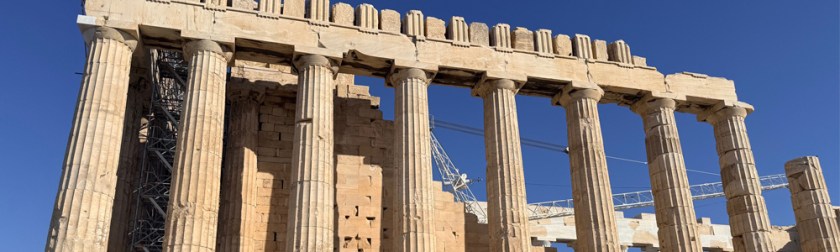
The building of the Parthenon was designed by the architects Iktinos and Callicrates, and classicists since the 18th Century have lauded it as perhaps the greatest achievement of Western Civilization, and a testament to the uniquely mathematical aesthetics of the ancient Greeks. The Parthenon is very beautiful and its construction was a marvel. However, the oft-told story that the building’s proportions are based around the Golden Mean are largely the fabrication of 18th century German psychologist Adolf Zeising, who was obsessed with this proportion and saw it everywhere. The Golden Mean, denoted φ, is about 1: 1.618 (φ is irrational); it means that two numbers a and b, where a > b, have the the same ratio as the ratio of (a + b) to a. Look, it’s pretty heady, don’t worry about the specifics. The important thing is that Zeising saw this ratio in all kinds of things, and believed that it was the most beautiful mean and that it stirred a sense of awe and beauty in viewers even if they didn’t know the math, and Zeising was enormously influential to aesthetic theory at the time, and so people like to claim that φ is everywhere, from the Mona Lisa to tree growth and especially in the Parthenon. The trouble with this theory is that it is entirely made up and there’s no evidence that Greek architects of the fifth century had any concept of the Golden Mean, in spite of what Donald in Mathemagic Land would have you believe. It turns out it’s surprisingly easy to superimpose a diagram of the Golden Mean (or, for that matter, a Pythagorean Spiral, or a Fibonacci Sequence) over a photo of anything and claim that it’s proof of the Mathematical Basis of Everything.

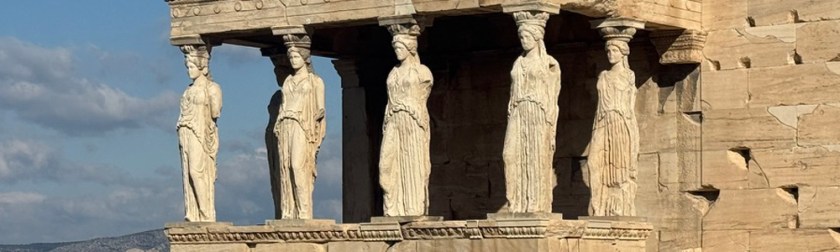
But none of this should diminish the remarkable achievement of the Parthenon, or of the other buildings that were built on the Parthenon during the space of a few decades from about 440 to about 400 B.C.E. The Erechtheion (421–406 B.C.E.) is the site of the remarkable Caryatids, enormous sculptures of maidens supporting the weight of the porch roof2. My own favorite is probably the tiny Temple of Athena Nike (c. 420 B.C.E.), a small square Ionic temple that sits on the very edge of the Acropolis, facing outwards. Long-time listeners to Sophomore Lit may remember the episode on Thucydides’s Peloponnesian War, in which Daniel Daughetee and I discussed the way the Athenian statesman and military leader, Pericles, used funds from the Delian League of cities to pay for all this marble and gold and ivory and whatnot. These funds had been pledged as a reserve to fund the League in case of further attacks by the Persian Empire, and Pericles’s appropriation of these funds to benefit Athens are often seen as one of the major complaints fueling the war. But when Marina and I visited the Acropolis Museum and saw the exhibitions focused on the Persian destruction of Athens in 480 B.C.E., we found ourselves for the first time sympathizing with Pericles, who I’d always imagined as something of a dudebro. The shame and despair of the loss of the previous Acropolis was still living memory. I can see how skimming some funds from the League would be appealing.
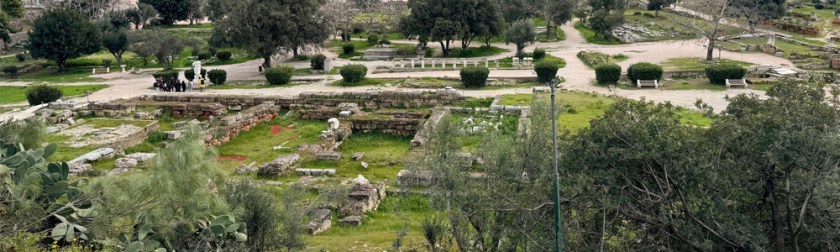
As magnificent as the Acropolis is, I think it was more affecting for us both to visit the Ancient Agora, situated in the city below. The Agora was a common area of land and buildings that combined both city operations and commerce. Being a direct democracy (for free male Athenian citizens, at least) Athens did not have a government per se, but various councils and official functions had buildings in and among the stoæ, which were long covered colonnades where merchants could rent space. Then, as now, the political health of the polis was entwined with economic activity. It was in the Agora the Socrates did the majority of his work, engaging directly with people, posing questions, picking apart beliefs. And it was here in the Agora that he was jailed before execution. Today most of the Agora is crumbling rows of foundation stones, and no one knows where the courtroom in which Socrates was tried was, but archeologists have a pretty good guess of where his cell was, in a structure on the northeast side. Close by are the remains of a water clock: in the Apology, Socrates refers to the practice of timing a prisoner’s defense speech by such a device, although whether this one is the one to which he refers is unknown. If you are the type to get emotional over these things, you will get emotional there.
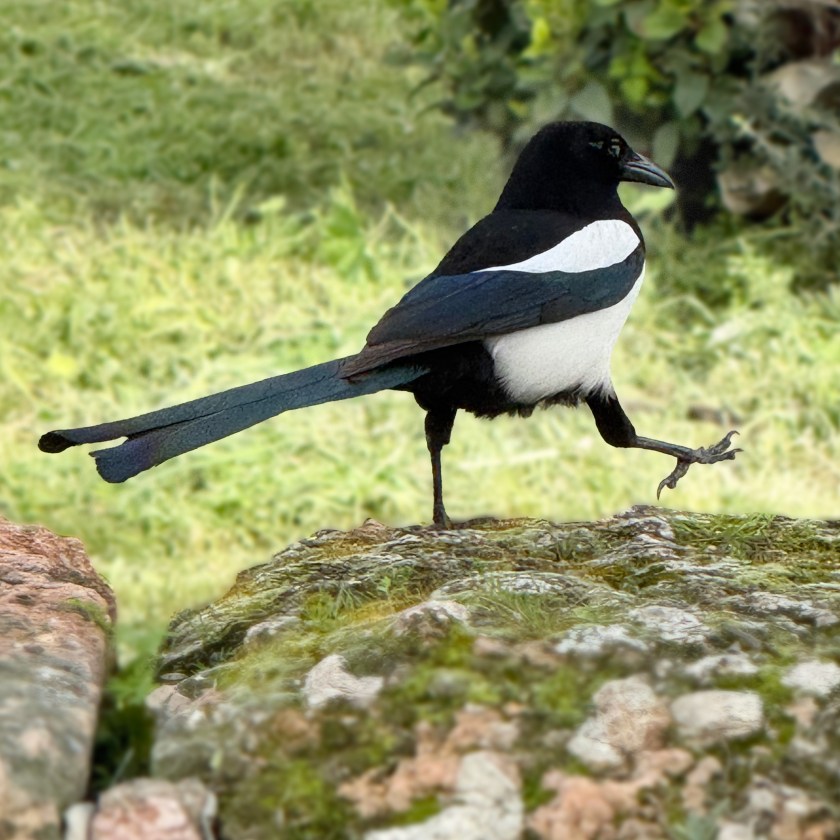
One final note—the Agora site is full of sleepy cats and flocking birds, including my favorite bird, the Eurasian Magpie, which is perhaps the smartest of the corvids (the family containing crows and ravens). This bird doesn’t inhabit North America, but in Europe and especially Greece they’re everywhere, and I spent much of my time trying to get a perfect picture of one, which to native Athenians would be like someone trying to photograph a pigeon.