A Case of Identity


Sheerluck

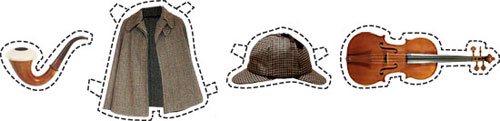
All of us know who Sherlock Holmes is. He’s that detective guy who wears a deerstalker cap and an inverness cape and the meerschaum pipe who says, “elementary, my dear Watson.” Except that only the detective part comes from Holmes’s creator, Arthur Conan Doyle. He once described Holmes as wearing a traveling cap with ear flaps but it was the illustrator Sidney Paget who gave Holmes the deerstalker and cape. Doyle described several pipes smoked by Sherlock, but they were straight pipes of clay, cherrywood, or briar, as were common among Victorian gentlemen; the large-bowled, curved pipe was introduced by American actor William Gillette, who became famous for his portrayal of the sleuth; the phrase “elementary, my dear Watson,” never appearing in any of Doyle’s stories, was first written by P.G.Wodehouse.

These days we have any number of complementary and competing Holmeses, including wonderful legacy portrayals by Basil Rathbone and Jeremy Brett; revisionist Holmeses like Guy Ritchie’s action hero as portrayed by Robert Downey, Jr.;  and alternative world Holmeses like the contemporary-world Stephen Moffat series as portrayed by Benedict Cumberbatch. There are hundreds if not thousands of Holmes stories, with some (like Nicholas Meyers’s famous Seven-Per-Cent Solution) taking great pains to fit within Doyle’s style and timeline, and others jettisoning verisimilitude entirely and having Holmes fight aliens or travel through time. And on top of all of these, we have a multitude of parodies and pastiches from muppet Sherlock Hemlock to Mad’s Shermlock Shomes to the Firesign Theatre’s Hemlock Stones, who finally took on the case for which the world was not ready.

One might think that with all these Holmeses, audiences might be confused. Where to start? Which one is “real?” And what about the integrity of the creation, is that being preserved? But in practice, there is no difficulty. Communities of readers and viewers can pick and choose which Sherlocks they’d like to support; most probably have several favorites. Likewise, if they find one portrayal out of character or another story’s plot falls flat, they’re free to ignore them. And the original stories are still there, still untouched and unrevised (although Doyle himself indulged in revisionism by bringing Holmes back from the dead after he killed his creation off). Doyle’s canonical works are unaffected by other writers’ contributions—if anything, the derivative works keep the originals fresh and relevant.

I like to bring up Holmes when people fret about authorial intent and an artist “owning” their work, or complain about fan fiction being an affront of some sort, or insist that working from another artist’s setting or character is unimaginative or a rip-off. The tendency is to see Sherlock Holmes as a special case, owing to his ubiquity in the culture. But isn’t his prominent position precisely because of the participatory way the culture at large uses him? In my post about George Lucas, I champion the idea (which I didn’t originate) that the eventual relevance of a piece of art owes more to the work of its audience than of its creator. I know this is a controversial idea, especially to people who like the idea of the Artist as an Auteur, uniquely responsible for his creation. But it seems to me that when artists practices their craft they are joining a game in progress, learning the rules by watching others, and then moving the ball along; and then it’s up to the audience to decide if they scored or not, and why it mattered, and how it mattered, and before long it’s the readers or viewers or listeners who have possession.

I stop being polite and start being Real (McCoy)

My surname is McCoy, which is a funny name because when I tell it to people they either shoot back some incredibly witty question about whether I’m the real or or not, or they stare blankly and ask if I said McCory. This is odd because while there is a famous space doctor named McCoy and a famous feuding hillbilly family named McCoy and a famous pottery company named McCoy and a famous jazz pianist named McCoy and a famous perky cruise director named McCoy, I have never once met a McCory or even heard of the name aside from having it repeated back to me by the aforementioned vacant starers.

Out here in Boston everyone is Irish or pretending to be Irish and most of them will ask if my family is from Ulster or Cork and then squint intently as though my reply will result in either a hug or an uppercut. However, the story I was told as a wee bairn was that our family name was changed from MacKay when we  came from Scotland, no doubt  searching the new world for peat. My father had a book of the tartans of Highland clans and my brother Robert and I looked at the page for our ancestors family so often the spine cracked to fall open on the MacKay’s somewhat plain green-and-blue plaid.

tartan

I was a credulous child and I accepted this story about my heritage without question until my mid-twenties, when doubt began to settle in. Too many people I met seemed to think that the name was Irish. Digging around I discovered that while the McCoys were in fact related to the MacKays, the name variants go back many centuries and predate any Atlantic crossings: the name change may have originated with gallowglasses who moved to Ulster in the 13th century. My father has confirmed that the first immigrant in our family named McCoy, James, came to America in the 18th century from Ulster when he was 14, and there’s a charming story about how during the passage he boasted about being good with horses, eventurally secure employment in the New World at a stable.

The thing is, whoever he was and wherever he came from, he was just a guy who happened to share my last name. Going back a few generations I have more English surnames than Scots (or Scots-Irish or whatever), and somewhere in there are German names, and French, and allegedly four or five generations back I have Cherokee and Creek great-great-great-great grandmothers. Calling myself Scottish seems as ridiculous as calling myself Native American based on whatever fraction of genetic material I share with these ancestors. My father grew up in Oklahoma and Indiana; my mother in Virginia and Indiana; really I’m a mutt.

But don’t tell my uncle; he is proud enough of our alleged Scottishness to have purchased a kilt, a Tam o’Shanter, a set of bagpipes, and an Aberdeen Terrier. When I married my wife Marina (who is, by the way, unquestionably 100% Latvian in descent), he presented her with a pin to welcome her into the Clan MacKay. I often wonder what actual Scotts would think of him, if he were magically transported in full costume to some pub. Probably if it were in Edinburg they’d humor him, but I can’t imagine it ending in anything other than a pummeling in Glasgow.

The fact is, despite having a distinctively Gaelic name, I have no sense of myself as having any ethnicity at all.  I have lived in small towns and big cities; even though I’ve lived in Boston for over 20 years, I don’t think of myself as “from” here. But I don’t think of myself as “from” anywhere. The idea of having a strong sense of ethnic identity is foreign to me. Maybe it’s my white male privilege talking, but I like to think that my personality and abilities arise organically from my own choices and experiences and are not the result of any national character. Ethnic pride has a dark side—the belief that your own clan or race or creed is exceptional is the seed of prejudice and nationalism.

Still, I am not immune to the charms of ethnic imagination. I see Marina’s strong connection to her Baltic heritage and it makes sense as the daughter of immigrant parents. Everywhere you go in Boston you see shamrock tattoos and that’s nuts, but kind of cool, too. And as for me, I will happily recite Burns if you hand me a wee drap o’ whisky.  But bagpipes? That’s just silly.