The latest episode of my podcast, Sophomore Lit, is a discussion of Henry David Thoreau’s Walden, Or, Life in the Woods (1854), with guest host Daniel Daughtee. As I mentioned in my discussion with Dan, I’ve been to Walden Pond several times over the years. When my wife and I first moved to Boston we were broke graduate students living in an overpriced one-bedroom apartment with two cats to our name. When various family members visited us in those first years, we went sight-seeing with them, and ended up visiting many places two or three times. Walden Park was a go-to location of us, by which I mean it was free.
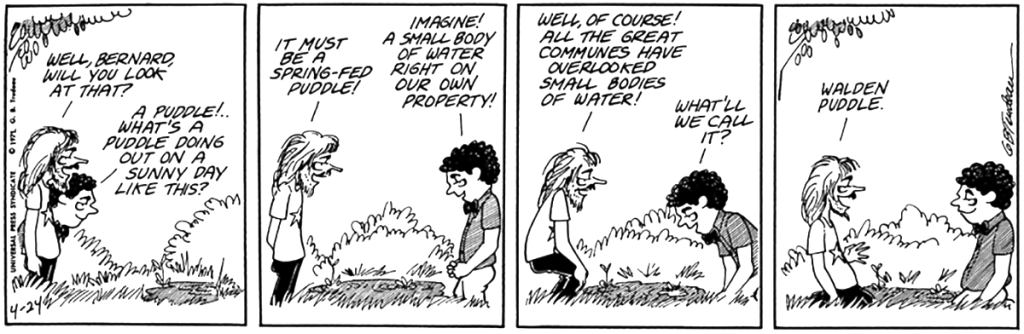
I remember the first time I saw the actual body of water being surprised by its size. I suppose this was because my imagined vision of the pond was built around the depiction of “Walden Puddle” from the Doonesbury comic. And yes, I did read Doonesbury from an early age, along with Pogo, and in both cases the comic strips confused me greatly, and I would ask my mom to explain what they were about. When I asked her why “Walden Puddle” was a punchline she tried her best to explain Thoreau to me. I think I was eight, and all I can remember was thinking a tiny house in the woods would be pretty cold. All in all, it went better than her trying to explain who Spiro Agnew was and why he was a hyena in Pogo, but I was six then.
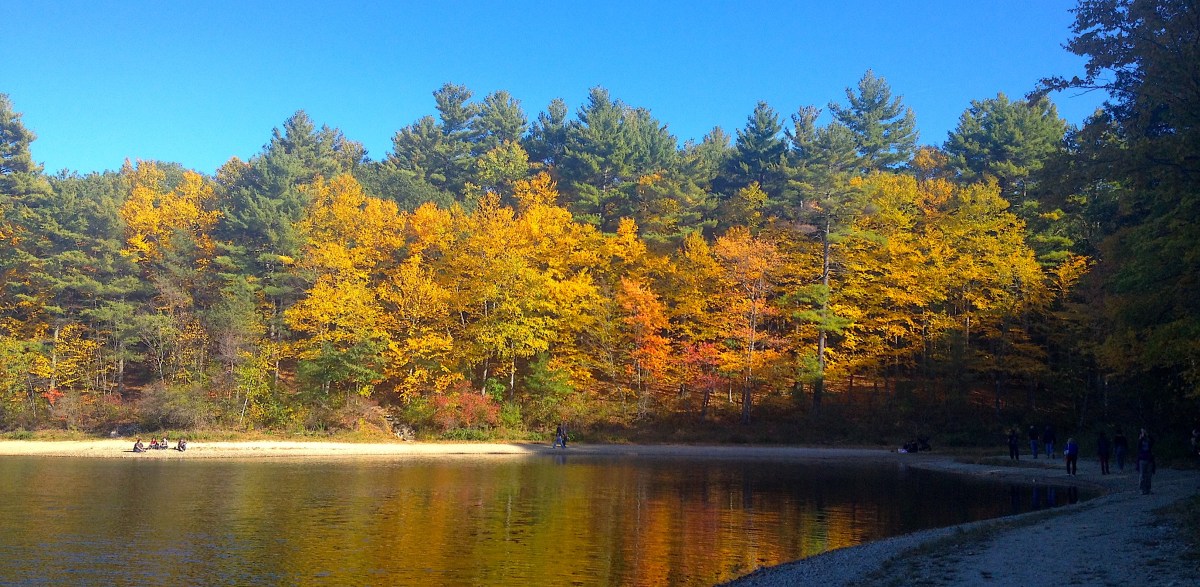
The current-day Walden Pond State Reservation is run by the Commonwealth of Massachusetts and features an outstanding visitor’s center with a scale model of the pond, information on local wildlife, and best of all (to me at least) they have an edition of Thoreau’s journal which is open to an entry with the same date as one’s visit to the park. The pond itself is lovely year-round, but especially in the fall, when the local New England trees are in full color, as in the header photo I took. It even has a small sand beach.
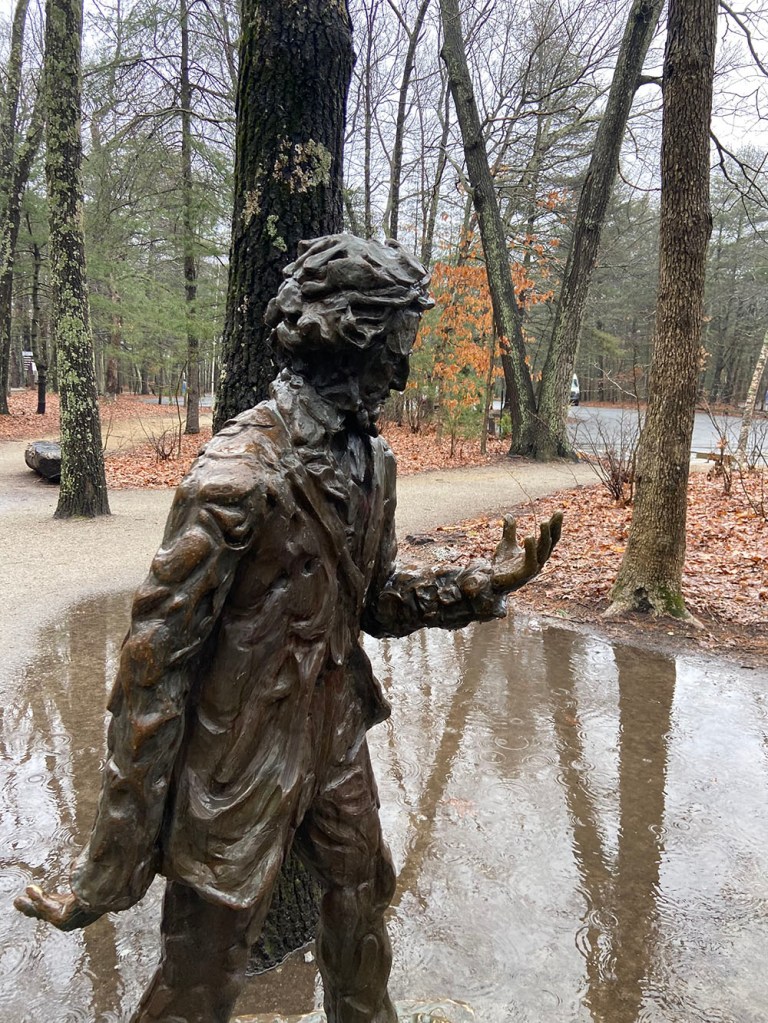
Thoreau’s cottage is long gone (although some foundation stones remain), but there’s a reconstruction that shows just how spartan the living space was, with its only furniture a bed, three chairs, a writing desk, a table, and a firewood crate. A short distance away from the cabin is a statue of Thoreau by sculpture Jo Davidson (1883–1952) rendered in a very loose style that somewhat obscures the likeness. The effect comes from first modeling using a plastic medium, probably clay or plasticine, and then casting the original form in bronze using the lost wax technique. Davidson did many portrait sculptures (for example, one of Walt Whitman), but this is one of his roughest in appearance, While this statue was executed in the mid 1940s, it was not placed in the reservation until 1995, when it was presented along with the cabin replica.