

By now you’ve had a little time to make your peace with the new Instagram icon. In the accelerated, media-savvy world of Internet 2.0 (or whatever release number we’re on), there have been already been critical essays on how bad the redesign is (for an example, see this Adweek piece) and a backlash about how old farts just hate change of any sort (for an example, see the comments section of the Adweek piece). Instagram themselves shared a statement about the change, with the usual design-speak explanation that skeuomorphism is old news, that the icon is a doorway into the app and that the app GUI is tailored to the way users use the lightweight photo-manipulation / sharing system.

For me, the rationale is depressingly predictable. In the mobile scene, the clinical eye of Jonny Ive has cast its gaze over everything, and we’re told that all users want is an interface that gets out of the way and disappears entirely into a mist of flat gradients and semi-transparencies. Never mind that bright colors and heavily-stroked geometric forms are as invisible as traffic signs—which are, after all, brightly-colored, heavily-stroked geometric forms—in about five years they are going to be as dated as 90s’ bevels and drop shadows.
But I get that Instagram wants to move on. When it first launched (only four years ago) it was known primarily for its filters, which gave a patina of vintage charm to the most ephemeral of digital productions, the smart phone photograph. Instagram was adopted by the hipsters, who delighted in making their locally-sourced artisanal breakfast sandwich look as though it had been photographed in 1973 by a Poloraid Land camera, or as though that afternoon’s thrift-shop find had been kicking around since 1932, as evidenced by the sepia tone of this faux silver print. Of course, everyone hates hipsters, especially hipsters, and Instagram was snapped up by Facebook, which means it’s time to move on and embrace a more generic identity.
But what’s lost in the rebranding is the sense of play. Social media platforms operate on one level as convenient publishing systems for nonspecialists to share information, but on another level they are games whose rules become defined by their user base. Tumblr is technically a lightweight blog platform, but its character comes from the community drawn to it, whose users have developed a protocol for the correct way to appropriate media and repost it. Snapchat’s character arises from the community’s interest in intimacy and immediacy. Twitter is where everyone wants to be the most clever. For its brief life, Instagram’s quirks (square photos, obvious filters) have combined with urbane hipster tastes to encourage an aesthete’s view of the world: photos of alleyways, wrought-iron fences, graffiti on brick walls. No doubt Facebook wants users of all stripes to embrace the application, and your aunt and uncle may have no use for another picture of a manhole cover, but they might consider dropping $40 on a photo book of baby pics.
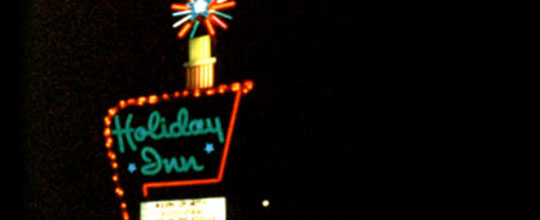
Still, I had a lot of fondness for the Instagram camera icon. In the iPhone’s sea of flat infographics, it was the one hold-out for charm and play. It was sort of oddball, it was sort of ugly. Mostly, it was distinctive, and that loss of distinction is the saddest part. When I was a child, the Holiday Inn “Great Signs” still dotted highways in the midwest. Incongruous and garish, they spoke to the past futurism of the Atomic Age. I remember looking for them on the horizon under the stars during family road trips. They were weird, they were unique. And when at last Holiday Inn decided to replace them, they went for the most bland, most uninteresting alternative. No child would search the night sky for that sign. And no one will pause and smile before tapping the new Instagram icon.


