American Gothic, et al.

Content warning: this post contains nothing but digressions.

Typography is a mess. Or at least, its argot is a mess. In an earlier post I discussed the various meanings of the word font. An even more schizophrenic typographical term is Gothic, which is most often used to refer to typefaces that imitate Medieval Blackletter hands. Blackletter itself isn’t a specific typeface—the term predates typefaces—it’s a family of associated hands, and a hand is a standardized manner of forming letters by writing. As opposed to inscription, which is the primary way we know the original Latin alphabet (which is also variously called a Roman or Antique alphabet, depending on where you’re from).

Carol Gothic
A contemporary interpretation of Blackletter, Carol Gothic.

Blackletter was used in Western European scriptoriums starting in the 12th century, and was designed as a decorative style that could be uniformly employed by trained scribes; it is characterized by extremes of thick and thin lines and letterforms that show the individual strokes by which they are made using broad pen nibs. This broken, fractured quality of Blackletter is reflected in the name of a German subset of styles: Fraktur, which was used in Germany and the Baltic states from the 16th Century on up to the 1930s. As they rose to power, National Socialists used Fraktur in printing as a marker of German identity, which is why Blackletter has a contemporary association with Nazism—even though Hitler himself hated the form and outlawed its use in 1941.

Schriftzug Fraktur
All Fraktur is Blackletter but not all Blackletter is Fraktur.
Graphic by Manuel Strehl CC BY-SA 3.0, https://commons.wikimedia.org/w/index.php?curid=12778207

But to return to the word Gothic: in the United States, this word has, since the 19th Century, been used typographically to describe geometric, unilinear, sans-serif typefaces. It’s unclear why this usage was chosen, although it is likely related to the European term for this style, Grotesque. While today the word grotesque is synonymous with deformed, repulsive, or bizarre, the word literally means “coming from the cave,” and referred to designs found in underground Roman ruins from the time of Nero. When discovered in the 1500s, these ruins were called le Grotto, in spite of not being a cave at all, but the basement to an unfinished palace complex. But in the Rococo period, artists and architects went crazy for these roman wall decorations and adapted them into increasingly complex and ostentatious patterns of their own, which they called Grotesques. In the 17th century, these extravagant and fantastical motifs were criticized as distorted caricature, leading to the modern, disparaging use of the word, which is an unusual transformation in art history, where for the most part terms coined as ridicule eventually lost their negativity: Impressionism, Pointillism, Fauvism, Cubism—or even, Gothic.
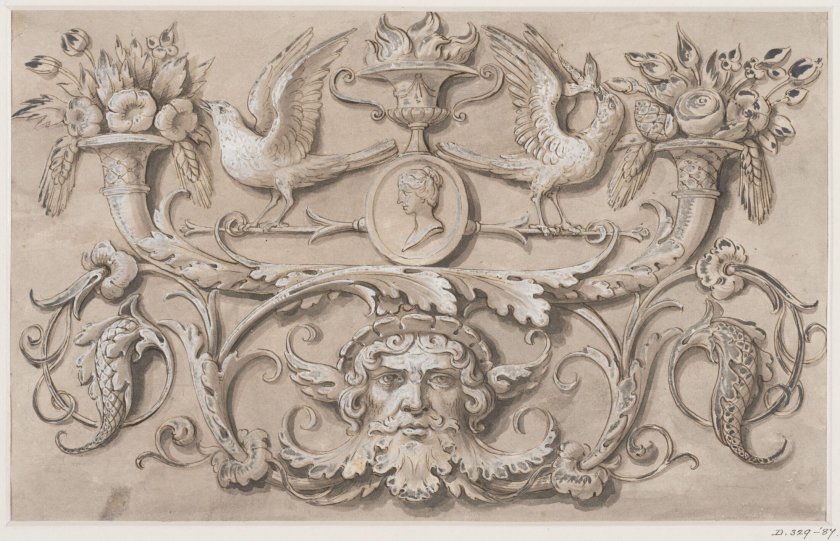
Italian. Grotesque ornament, 16th century.
Victoria and Albert Museum.

But to return to typography—which is the ostensible subject of this essay—the typographic term Grotesque (or its German form still seen in many typeface name, Grotesk) was likely used to mean “unorthodox,” or “brutal.” In this manner it is like the original architectural term Gothic, coined in 1550 by Giorgio Vasari, meaning “of the Goths.” This, as mentioned above, was not a compliment—Vasari was comparing the new style’s displacement of Italianate forms to the conquest of Rome by barbarians. (Which is another pejorative word meaning “bearded,” because beards were considered uncultured.) It may be that this usage of Grotesque informed the American term Gothic, similarly used to refer to typefaces that were stark, Spartan, dispensing with cultural niceties like serifs, which were, after all, vestiges of writing text by hand. Or maybe not! Who knows! All that is certain is the term was first used in the 1830’s by the Boston Type Foundry to describe its line of geometric, mono-line, sans serif typefaces.
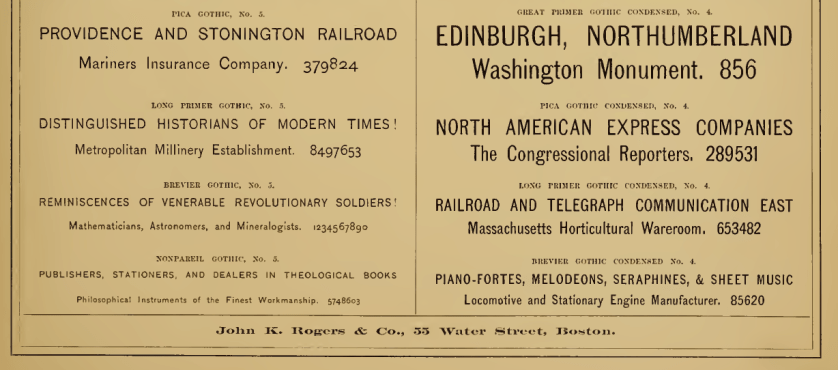
"Gothic" typefaces
“Gothic” typefaces in the 1860 Boston Type Foundry Specimen Book.

Oddly enough, at about the same time, American typographers began to use the term Egyptian to refer to mono-line slab-serif typefaces. This may have been because they recalled hieroglyphs—Ancient Egypt was something of a fad, owing to the era of modern archeological excavations as carried out by Napoleonic surveyors in the early 1800s.

Or maybe not. As I said, typography is a mess.
Fonts of Knowledge

Nobody likes a smart ass, and I try my best not to be one. But there’s one pedantic quibble that I struggle with, and that’s pointing out when someone uses a word isn’t quite the word they want. I come by this honestly enough: I’m a writer who values clarity and I have that autistic compulsion to be precise, even when I know it’s a linguistic battle I won’t win.

For example, back in the 90’s, people started using the word “impact” as a verb: This decision impacts us all. This drove me absolutely nuts, because “impact” was and had always been a noun, and it meant “a point of collision,” and when people used it as a verb what they really meant was “affect:” This decision affects us all, and using “impact” was dumb business-speak, using a word that sounds important instead of the perfectly good word that is the right one. I remember talking about this with a professor of mine and she pointed out that exactly the same sort of complaint was lodged against the word “contact” which was not used as a verb to mean get in touch with, reach out to, write, phone, etc. until the 1920s. She told me this as a friendly way to say “just let it go,” but the effect on me was I immediately stopped using “contact” as anything but a noun.

This is a lot of preamble to arrive at the subject of this essay, the word “font,” which these days generally means “typeface,” or “the digital file that describes a typeface.” But this isn’t its exact use, at least, it wasn’t until very recently, and I feel like something has been lost in the contemporary definition—precision, yes, but more importantly the richness of printing history, and understanding the transition from an analog to a digital world.

When in the 15th century moveable type printing came to the Western world from its origin in China, the models printers used to design letters came from existing medieval and Renaissance hands. Gutenberg’s Bible (c. 1455) used a movable type equivalent of the 12th century hand blackletter, an ornate style executed with a chisel nib, which these days is mostly used on diplomas and other formal or legal documents (or, sadly, by white supremacists). As the technology of moveable type spread, Venetian printers modeled their letters after the humanist minuscule hand, a Renaissance cross between classical Roman carved text—which only had capital letters—and the manuscript style used in copies of the vulgate bible—letterforms we would now identify as lowercase. Nicholas Jenson (c. 1420–1480) is today credited with developing the modern printed Roman alphabet.

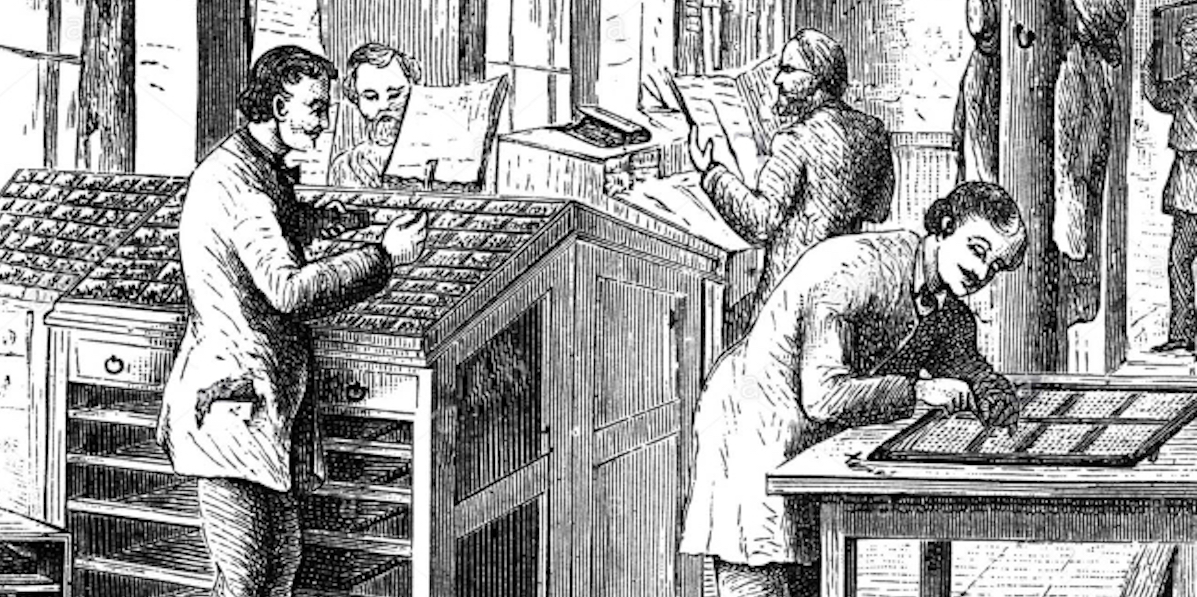
To produce enough type to set pages, designers would cut master forms called “punches” from slugs of steel; the craftspeople who did this were called “punch cutters.” These punches would be hammered into copper molds which would then be cast into individual letterforms using easily melted, inexpensive alloys of lead, tin, and/or antimony. The characters produced in this manner were uniform and plentiful. But they were also unique to the print shop, and guarded from duplication, since they were a valuable commodity. Making these alphabets by hand required much labor up front and printers had access to only a few variants.

In 1476, William Caxton brought the printing press to London, and the commercial use of moveable type exploded. Soon after, Paris also became a center for printing, culminating in the type designed by Claude Garamond in the years 1520 to 1560 (there are many contemporary typefaces called “Garamond” which imitate his work, to a greater or lesser degree). With the growth of an industry, print shops looked for alternatives to cutting their own punches. Developing an alphabet was a specialized skill, and printers wanted to have a variety of styles and sizes of characters on hand. So an associated industry emerged: foundries, companies that designed and cut punches and then cast the alphabet on demand. A matching set of characters, including numbers, punctuation, and duplicates, was sold as a set called a font, from the Middle French fonte, meaning cast in metal.

By the by, there’s a popular etymology that says the word “font” was derived from “fount,” as in the case of letters being a source like a fountain. This is charming but entirely made up.

It’s important to note that in this context a font was a complete set of characters at a specific size and style. If you wanted a larger or smaller size of the same typeface, that was a different font and was a different purchase. Likewise, the italic or bold style of a typeface required a separate font. Being a collection of physical metal objects, fonts had to be sorted and stored. When a typesetter was to set a block of text, they organized the font in a large open boxes called type cases, with individual characters in their own separate cubbyholes. The majuscule characters were placed in an upper case, and the minuscule characters were in the lower case, which is where the terms uppercase and lowercase originated. (Other phases that come from moveable type include “mind your p’s and q’s,” referring to how easily the characters could be confused, especially since the metal type was in reverse; and “out of sorts,” which originally meant “lacking enough of a character to finish setting a page,” like when a typesetter ran out of E’s or ampersands. There are more!)

Flash forward to 1986 and the original Macintosh operating system. Macintoshes were the first inexpensive consumer computers that had proportional type (that is, letters that varied in width, unlike typewriters whose letters were all spaced the same). They also shipped with a variety of different typefaces built into the system; these could communicate with photostatic laser printers, which were also newly available to consumers and institutions at (relatively) low costs. The practical upshot of this was that text could be typeset and printed at the desktop level. While the printed text could be at any arbitrary size, the on-screen text had to be designed for the screen’s resolution. This required different description files for italics and boldface, as well as for each size: 9 point, 10 point, 12 point, etc. This division by typeface, style, and size was closely analogous to traditional cast metal fonts and so that’s what Apple called the files that stored this information.

As screens increased in resolution and CPUs increased in speed, eventually computers could resize text without needing separately sized files. But for a generation with no knowledge of fonts as anything but files on a computer, the name stuck, and neither Apple nor Microsoft, nor any third-party typeface designers, changed or clarified the file type. And so now “font” is synonymous with “typeface,” and in fact, few people who aren’t graphic designers even know what at typeface is.

And so it goes. Language always evolves, and people complain that words changing are being misused. The title of this essay is another example of this: many claim the phrase should be “fount of knowledge,” not “font,” because in this case we are talking about a fountain. It’s kind of silly. But as Ms. Mitchell sings, something’s lost and something’s gained. Sometimes we loose a bit of history, a bit of perspective, a distinction that goes beyond mere definition.

But, as I said at the start, I try not to be a smart ass. Some times I try harder than others.

And Other Tales

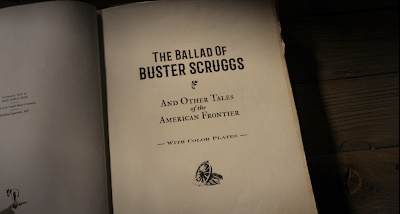
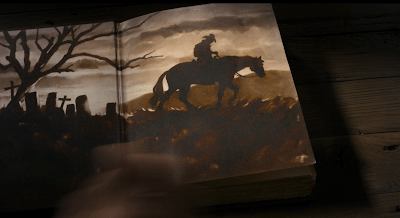
The new Coen Brothers film The Ballad of Buster Scruggs features an impressive cast, but for me the true star of this anthology is the prop book used to join these violent, nihilistic western stories together.

Buster

The book is presented as cloth-bound with an embossed cover. Cloth binding began in the 1820s and by the 1830s embossing was developed as well, leading to increasingly ornate treatments and eventually to foil-stamping. The understated, two-color printing marks this as a humbler work for a popular audience. I can’t place the typeface, but it looks quite a bit like Weiss (1928), which in turn was based on Italian Renaissance printer’s faces. The bold, simple design of the cover illustration brings to mind book designs from the 1910’s and 1920’s—a popular time for western literature, which had its major flowering of popularity with the publication of Owen Wister’s The Virginian (1902).

Buster

All of which makes it a bit surprising that the front matter dates the book to September, 1873. The decision seems to have been to locate the fictional book closer to the time the movie depicts, the 1840s (as referenced by the inclusion of stories of the Gold Rush and the Oregon Trail). But there are many details to the book which would make it an artifact of the turn of the century or even later. The barred “western” typeface used for the title here appears to be Barbaro Roman, a contemporary face mimicking Victorian sources. The type shows a slight embossing, which is the sign of letterpress, or movable type. But overall the title page “feels” contemporary rather than historic. The leading (space between lines of text) is much tighter than a 19th century source would be. The text is sized subtly as in the slightly smaller “THE BALLAD OF” and the slightly larger “BUSTER SCRUGGS”; an actual 19th century printer would not have such a collection of font sizes in metal, particularly for a display face.

Buster

The color plates are the perhaps the most remarkable feature of the prop. Color lithography had been used to decorate letterpress books since the late 18th century, but it became more popular in the late 19th. These images had to be printed separately and were much more fragile than the letterpress pages, and so required protective sheets of onionskin or glassine to keep the ink from rubbing off. The illustrations in the prop book evoke the Brandywine School of illustration, named after the artists’ colony founded by Howard Pyle in 1895. It was to this school that illustrator N.C. Wyeth belonged, whose famous illustrations for Treasure Island (1911) and The Boy’s King Arthur (1922) set the tone for lush illustrations of adventure for decades to come. It’s these illustrations that would lead me to guess the book was a product of the 1910’s or the 1920’s if we were not given a “copyright.”

Buster

Even more anachronistic are the illustrated endpapers, rendered in a watercolor style that strikes me as more 1950’s or even 1960’s.

Buster

Lastly, I have nothing historical to say about the book’s dedication, except that I’m sure there’s a story here somewhere.