Netflix’s Stranger Things firmly displays its retro intentions by using International Typeface Corporation’s Benguiat, a face by Ed Benguiat that was released in 1978. Although obviously inspired by Art Nouveau typography, Benguiat was very much a product of its time and of ITC, with its typically large x-height (the height of a lowercase “x” when compared to a capital) and the bold contrast between thick and thin strokes.
ITC Benguiat Bold (1978)
It’s informative to look at Benguiat in comparison with a well-known Art Nouveau typeface, Desdemona (1886), from which it cribs a few features, including the upward slanting bowls of the P and the R; the high beams of the E, F, and H; and how the slanted beam of the N connects two-thirds of the way down the right stem. But true Nouveau fonts would never have the extreme stroke variation of Benguiat, as they drew their inspiration from vegetal forms.
Desdemona Black (1886)
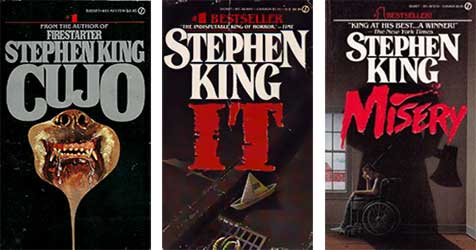
The bold readability of Benguiat and its wiff of nostalgia made it a particular favorite for paperback designers of the early-to-mid 1980s, where it displaced fussier, swash-serifed and flourish-heavy faces like Tiffany (1974) (also designed by Ed Benguiat). The simple, wedge serifs were well-suited to embossed titles, which were becoming the vogue, especially for genre fiction such as romance, sci-fi, and horror. Bespoke hand-drawn adaptations of the face eventually became the standard setting for Stephen King’s name in Signet paperback editions and it’s these books that the producers of Stranger Things specifically want to evoke.
Signet King paperbacks showing letterform variation
While researching Benguiat I was struck by the variation I found in the treatment of King’s name on paperback covers. Before desktop publishing, there was no simple way to manipulate letterforms and designers had to draft logos by hand, particularly if they wanted the letter block set close or to add a flair to a serif or swash. This meant long hours with a set of French curves, and I can actually remember as a baby designer back in the late 80s designing some titles this way. I doubt I still could.
Typefaces by Ed Benguiat Benguiat had a long career at ITC and was responsible for many of its signature faces.
By now you’ve had a little time to make your peace with the new Instagram icon. In the accelerated, media-savvy world of Internet 2.0 (or whatever release number we’re on), there have been already been critical essays on how bad the redesign is (for an example, see this Adweek piece) and a backlash about how old farts just hate change of any sort (for an example, see the comments section of the Adweek piece). Instagram themselves shared a statement about the change, with the usual design-speak explanation that skeuomorphism is old news, that the icon is a doorway into the app and that the app GUI is tailored to the way users use the lightweight photo-manipulation / sharing system.
For me, the rationale is depressingly predictable. In the mobile scene, the clinical eye of Jonny Ive has cast its gaze over everything, and we’re told that all users want is an interface that gets out of the way and disappears entirely into a mist of flat gradients and semi-transparencies. Never mind that bright colors and heavily-stroked geometric forms are as invisible as traffic signs—which are, after all, brightly-colored, heavily-stroked geometric forms—in about five years they are going to be as dated as 90s’ bevels and drop shadows.
But I get that Instagram wants to move on. When it first launched (only four years ago) it was known primarily for its filters, which gave a patina of vintage charm to the most ephemeral of digital productions, the smart phone photograph. Instagram was adopted by the hipsters, who delighted in making their locally-sourced artisanal breakfast sandwich look as though it had been photographed in 1973 by a Poloraid Land camera, or as though that afternoon’s thrift-shop find had been kicking around since 1932, as evidenced by the sepia tone of this faux silver print. Of course, everyone hates hipsters, especially hipsters, and Instagram was snapped up by Facebook, which means it’s time to move on and embrace a more generic identity.
But what’s lost in the rebranding is the sense of play. Social media platforms operate on one level as convenient publishing systems for nonspecialists to share information, but on another level they are games whose rules become defined by their user base. Tumblr is technically a lightweight blog platform, but its character comes from the community drawn to it, whose users have developed a protocol for the correct way to appropriate media and repost it. Snapchat’s character arises from the community’s interest in intimacy and immediacy. Twitter is where everyone wants to be the most clever. For its brief life, Instagram’s quirks (square photos, obvious filters) have combined with urbane hipster tastes to encourage an aesthete’s view of the world: photos of alleyways, wrought-iron fences, graffiti on brick walls. No doubt Facebook wants users of all stripes to embrace the application, and your aunt and uncle may have no use for another picture of a manhole cover, but they might consider dropping $40 on a photo book of baby pics.
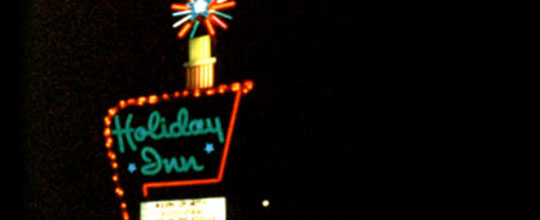
Still, I had a lot of fondness for the Instagram camera icon. In the iPhone’s sea of flat infographics, it was the one hold-out for charm and play. It was sort of oddball, it was sort of ugly. Mostly, it was distinctive, and that loss of distinction is the saddest part. When I was a child, the Holiday Inn “Great Signs” still dotted highways in the midwest. Incongruous and garish, they spoke to the past futurism of the Atomic Age. I remember looking for them on the horizon under the stars during family road trips. They were weird, they were unique. And when at last Holiday Inn decided to replace them, they went for the most bland, most uninteresting alternative. No child would search the night sky for that sign. And no one will pause and smile before tapping the new Instagram icon.
We all have favorite books that we re-read compulsively when we’re sick; or favorite movies which we can’t help but watch again while channel surfing, even though we own the five-disc collector’s Blu-ray. There are songs that we want sung at our funerals even if the choice might only pile confusion onto the grief of the mourners (Radiohead’s “Airbag” for me, please). And then there are works of art that aren’t necessarily favorites, whose aesthetic merits we would be hard-pressed to defend, but which were somehow at the right place at the right time to burrow deep into our subconscious like psychic earwigs.
Back in the day, when comic books were still mainly sold in five and dimes, the practice was for unsold issues to have their covers torn off and sent back to the distributors. While technically these books were supposed to be written off, some did re-emerge at the very bottom of the retail food chain in plastic bags sold three for a dollar. I believe that it may have been through this dicey trafficking that a copy of Marvel Presents #7 (1976) made its way into my older brother’s hands. All I know is that the ragged, torn, and smudged copy I re-read compulsively for the next several years of my young life never had a cover, which only added to the aura of mystery of the thing.
Also adding to the mystery: I had no idea who any of the characters were, or what the events leading up to this comic were, only HOLY HELL THIS MAKES NO SENSE. The story—titled “Embrace the Void!”—involved a group who called themselves “the Guardians of the Galaxy,” only apparently the main characters in the story didn’t consider themselves members. They are a ragtag group of aliens from various planets—Mercury, Jupiter, and Pluto are mentioned—and for some reason they are visiting the Convent of Living Fire, a nunnery run by a sisterhood of green webbed-handed zealots whose religion involves a process of psychic self-immolation resulting in oneness with the universe, as well as eventually collapsing into a pile of ashes. Nikki, the voluptuous, flame-headed Mercurian who may or may not be a member of the group is being encouraged by Starhawk, the omniscient and brooding instigator who is definitely not a member of the group, to undergo the ritual that will result in her combustion. An explanation as to why she must do this is not forthcoming.
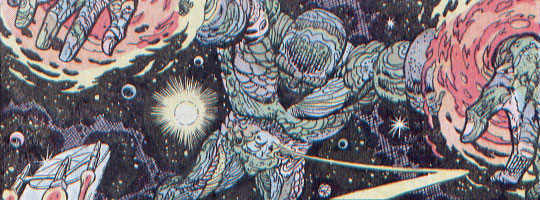
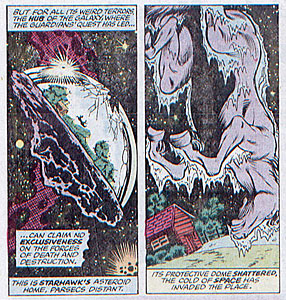
Neither is there an explanation of a sudden cutaway scene occurring in a spaceship orbiting the convent’s planet. Only it’s not a planet per se, it’s an enormous man, the “Topographical Man,” whose body spans light years and who holds twin stars in his grasp. Aboard this ship a final member of the Guardians, Vance Astro, is locked in a psychic battle with a creature who has assumed his appearance, a battle he apparently loses when he collapses to the floor. And then there’s yet another jump-cut to a scene that chilled me to my eight-year-old core: a shattered biodome floating through space with a frozen horse suspended lifelessly within. This is apparently Starhawk’s home, but the narrative doesn’t dwell on this scene of distruction: we return to Nikki, who has willingly strapped herself to a ritualistic throne and burst into flame in a scene which can only be described as orgasmic, although that particular detail only became clear to me years later.
Adding to the mélange of crazed hedonism, Starhawk suddenly lurches forward in the grips of his own spasms, and beats a hasty retreat from the temple, pursued by the Plutonian member of the group, a figure composed of silicon who can apparently melt solid rock with his hands. When the crystal pursuer reaches his prey, Starbuck confuses the sexuality of children across the nation by transforming into a woman (his outfit also morphs into something much more revealing). Before you can say weirdest boner, the scene cuts once again to the orbiting spaceship, where—surprise!—instead of having been defeated, Vance Astro has merely switched minds with his foe. But before he can luxuriate in his own new body, he dissipates, his consciousness seeping out of the ship into space to become part of the Topographical Man (remember him?)
And just in time, too, because the now engulfed-in-flames Nikki has astrally projected herself into space as a translucent naked entity—to engage in congress with the celestial humanoid, whose mind is now at least partially Astro’s. Yes, that’s right: this has all been leading up to a ghost fucking a planet. Which causes the planet to explode. Which is…good, I guess? Apparently this Topographical Man has been absorbing other planets, which is bad, although the inhabitants of these worlds seem to have done all right for themselves starting strange religions and constructing huge convents and all. Somehow the Guardians all escape, leaving presumably billions of the Topographical Man’s inhabitants to die, but they seem happy enough with what they’ve done to call it a victory. Nor do they seem all that surprised that their companion Starhawk is now a chick, but that will apparently be resolved in another issue.
Except for me there was no other issue. Until I became an adult, this coverless issue was my one and only glimpse into this crazy universe and to say it left me with questions would be an understatement. But in spite of my confusion, the comic book haunted me. Actually, the confusion only fanned the flames of my obsession. This was a window into something cosmic, bizarre, and intensely sexual in a way that broke my brain. It made me feel like I was reading something forbidden that was just on the verge of making sense. And the art! The gorgeous sinewy line work by Al Milgrom, given a Kirbiesque flair by inker Bob Wiacek, so much more visceral and connected to the id than any digitally produced comics today. The author of this story was none other than Steve Gerber, writer of Howard the Duck, which makes perfect sense.
In recent years I’ve tracked down copies of the other issues in this run of stories—copies with their covers intact—and while the plot lines are more or less explained, I can’t say that knowledge has led to enlightenment. I can now place this comic in the context of the culture of the mid-70s, of waning psychedelia’s last gasps and a counterculture being absorbed into the mainstream. I can also see the comic for the narrative and derivative mess it sometimes is. But that doesn’t matter. The damage was done long ago, and for that I’m grateful.