Hang in there

Note: this is another companion essay to an episode of podcast, Sophomore Lit. Maybe listen to it before reading this?

Shortly after recording the most recent Sophomore Lit episode about Robert Westall’s young adult novel The Watch House (1977), guest host Ross Cleaver pointed me towards an online discussion about a magic lantern series called Our Life Boat Men. While most of the eight-slide series features scenes of rescues involving life boats, there is one slide that depicts a rescue using a rope line and pulley, the technique that Westall describes in his book.
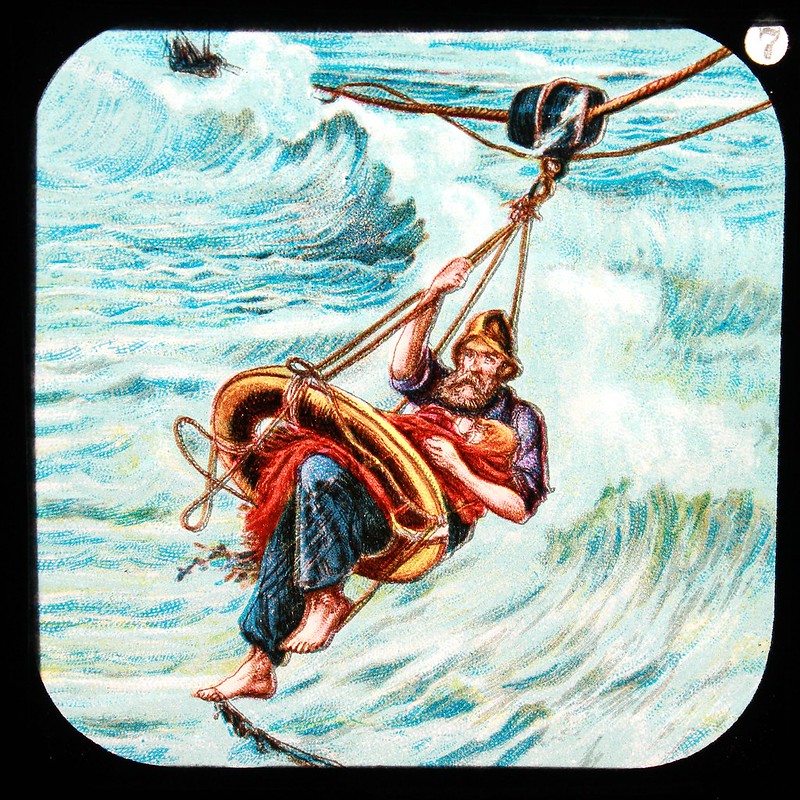
The Pulley
“The Pulley.” Slide no. 7 from the series Our Life-Boat Men, W. Butcher & Sons, c. 1901.
Image from Tyne & Wear Archives & Museums.

Magic lanterns were a form of image projector popular in the 19th and early 20th century. The ability of curved glass to bend light was known from antiquity, with the earliest written reference appearing in Aristophanes’ The Clouds. Reading-stones (rounded glass magnifiers) and even spectacles were used in medieval times. But modern lenses as we know them started in the 17th and 18th century with the development of the telescope and the microscope. By the 19th century optics had become precise enough to sharply focus projected light. This development, along with increasingly bright light sources, such as gas and limelight, led to the commercial production and popularity of magic lanterns.

Butcher & Sons “Primus” magic lantern, c. 1890.

These projectors used glass slides that came in a variety of sizes upon which were the images to be projected. The first slides were hand-painted, but later, photographic techniques allowed for mass replication. At first, publishing companies mechanically transferred black line images to the slides, most commonly using decals; colors (if any) still had to be added by hand. But at the end of the 19th century chromolithography and semi-transparent inks made possible printing uniform editions of magic lantern slides, albeit with often imperfect registration of colors, as is evident from “The Pulley.”

The series Our Life-Boat Men was sold as a part of London-based W. Butcher & Son’s Junior Lecturer’s Series. While the slides themselves are undated, a 1901 advertisement lists Our Life-Boat Men as one of six “new” lithographic sets produced to be used with their Primus line of lanterns. Butcher & Sons aimed at a market of well-to-do home users, and their chromolithographic slides were relatively inexpensive when compared to ones designed for theatrical use—and yes, in the 19th century people did pay admission for the privilege of viewing still projections in darkened rooms.
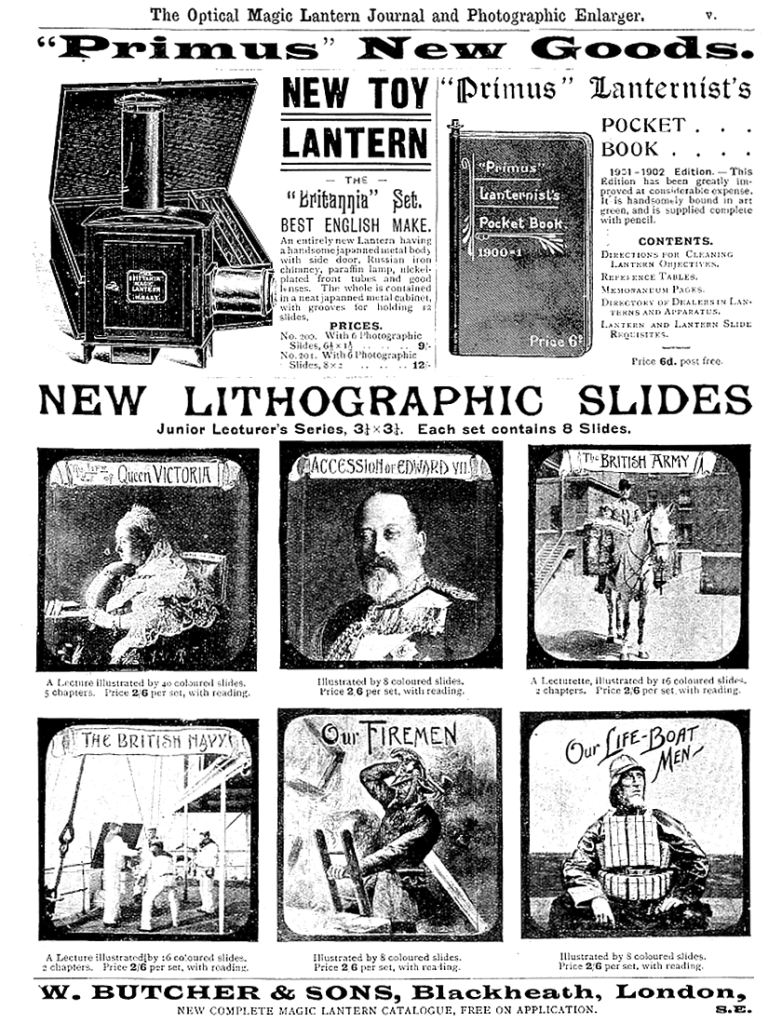
Butcher and Sons
Advertisement for W. Butcher & Sons in The Optical Magic Lantern Journal and Photographic Enlarger, November 1901.

In Westall’s book, the book’s protagonist Anne is told of the techniques employed by the Victorian life-savers who used to work at the titular watch house. The port of the novel’s fictional town of Garmouth (based upon Westall’s hometown of Tynemouth) is bounded on its sides by shallows covered with mounds of rock, and in bad weather ships could beach themselves only a few hundred feet from shore. The watch house volunteers would shoot ropes to the ships using rockets and survivors could be drawn ashore using pulleys. As I mention on the podcast, when I read these passages—describing rescues carried out in the 1850’s—I was incredulous. It didn’t seem possible, especially with 19th-century rockets, to fire with such accuracy while dragging 20 pounds of rope (or more). But apparently this was a widely-used technique. The Shipwreck Centre & Maritime Museum of displays examples of the apparatuses that were employed.
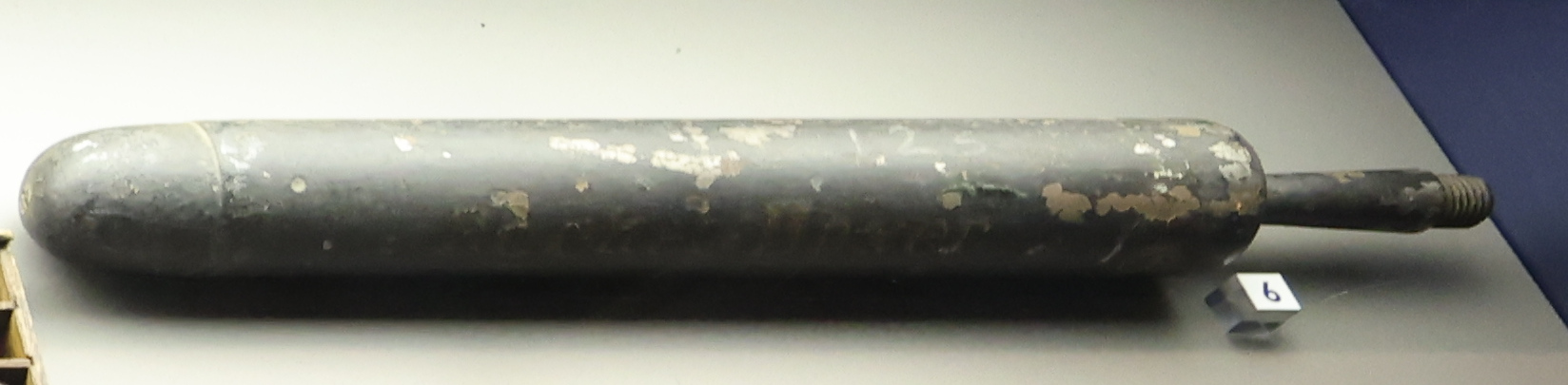
The Boxer rocket, developed in 1855, was a two-stage rescue rocket.
Image by Geni, CC BY-SA 4.0, via Wikimedia Commons

In the slide “The Pulley” the intrepid hero is riding in a lifebuoy that is hitched to a hoist trolley—if something goes wrong, at least he has a flotation device. In his arms he appears to be holding a child wrapped in a tattered red blanket. The rescuer is lightly dressed for such cold weather, although he wears a sou’wester oilskin hat, which is standard rough weather maritime gear. There are narrative details that make me wonder. Why is the man barefoot? Is that standard practice, or did he loose his boots in the operation? He appears to have a strand of kelp trailing from one foot. Does this mean he’s grazing the water? Is he in danger of submerging? Come to think of it, how can the rope be staying that taut? Wouldn’t it dip with the weight of the passengers?

But mostly: Why can’t I stop obsessing over random bits of forgotten culture?

Hoorah for the pumpkin pie

This post is a companion piece to this year’s Thanksgiving Special episode of Sophomore Lit. If you’re not a listener, why not give it a try? But if podcasts aren’t your thing, go read another post on this blog.

This Thanksgiving marks the 10th anniversary of drunken “special” episodes of my podcast, Sophomore Lit, featuring my brothers, Rob and Dan. Sophomore Lit is normally a podcast where a guest and I read a work of formational literature—often one that we were assigned to read in high school, or grade school, or college, but also simply works that young readers read. Then we discuss the work, but with the perspective of older readers. These special episodes with my brothers, however, are purposefully goofy, having as their subject pieces of culture that are obscure, marginal, and in most cases literature in only the loosest sense.

When I started Sophomore Lit, my concept was to humorously dissect the kind of book you only ever read in high school. I got the idea when one of my own kids had to read Lord of the Flies for their English class and I thought about all the books that are largely remembered today as assigned reading. Particularly A Separate Peace, which I think is a very weak novel, but which somehow won the lottery of staying perpetually in print because of high school lit classes. If you listen to the first dozen or so episodes of the podcast (I don’t recommend it), you can hear me trying to strike a comedic tone1. But as the show matured, I realized that my listenership was sincerely interested in discussing these works and nostalgic for the kind of discussion that only happens in the classroom. I remember a comment from a gentleman thanking me because he had never gone to college, but hearing books discussed was a way for him to partake in literary discourse.

As the episodes piled up I became more and more interested in the whole idea of literary canons. I realized that the teachers who taught me had themselves been in high school in the 1960s and 1970s, and the works they chose for their classes reflected Boomer tastes towards counterculture, science fiction, and social change. They were also mostly written by a bunch of white guys. So I started to go out of my way to enlarge the works the podcast covered, to include more women, minorities, non-Americans, and works that were not a part of my canon but a part of Millennial canon, or British canon, or others. I found that I was teaching myself by doing this, and that my listeners were getting exposed to a greater variety of works, and I’m glad for the evolution of the podcast. But in the back of my mind, I still occasionally wanted to do something silly.

Near where I live in Boston there are two streets a block apart called John Alden Road and Myles Standish Road. There is, however, no Priscilla Mullins Road. This amused me for a long time because I wondered how many people who lived on these streets had ever read “The Courtship of Miles Standish.2” I have a soft spot in my heart (and my head)3 for ponderous 19th century poetry—I find it fascinating that writers like Longfellow, Tennyson, or Greenleaf Whittier were the rock stars of their age, and that whole generations of schoolchildren were forced to recite their work for declamation. My father used to quote “The Midnight Ride of Paul Revere” to me all the time. I thought that I should eventually do an episode on “The Courtship of Miles Standish,” because the idea amused me, and because the poem was a card in the Whitman card game Authors that my family had when I was a kid.

Authors card
Whitman Authors card for “Courtship of Miles Standish” c. 1967

Many years ago, in the early 2000’s, Dan had made fun of visiting me for Thanksgiving (or at least a fictionalized version of me) in an episode of his Channel 102 series 9 O’Clock Meeting. So when in 2016 he again came to Boston for the holiday, I decided it was fair game to put him on the spot.

Dan did this series with Matt Koff back in his pre-podcast days.

The characters in “The Courtship of Miles Standish” were all Pilgrims, which sort of made the poem appropriate for a holiday episode, and because we had eaten too much and were slightly drunk I was feeling festive. And to be honest, I try to have Dan on my podcast as much as he’ll put up with, because he’s the internet celebrity of the family and I always hope he’ll bring some of that sweet Flop House listenership along. (I don’t really know what my podcast stats are like, but I suspect they are perishingly small compared to his, which is probably why he’s never asked me to guest on the Flop House4.)

I can’t speak on Dan’s behalf, but I enjoyed recording the episode a lot, and so the next year I wanted to do another. That time my older brother Rob was also visiting, so I invited him to partake. Poor Rob, in spite of being a lawyer and therefore used to arguing in public, was a bit mic shy, but I got him drunk as well. That time we discussed Coleridge’s Rime of the Ancient Mariner, which is bona fide Literature, but also goofy as hell. And when I posted the episode, Jason Snell, the head honcho of the Incomparable Network (my podcast home), made a very nice tweet comparing the three of us to the McElroys, in the sense of being three brothers, not in the sense of being anywhere as funny. And so the Thanksgiving episodes became Sophomore Lit tradition. At least a tradition for me; I guess it became tradition for my brothers to dread my annual pitch for increasingly silly topics. Here’s a full list of all the previous specials:

2024 Comfort Reads
2023 Poor Richard’s Almanack
2022 The Wreck of the Hesperus
2021 Burma-Shave
2020 Trees
2019 Casey at the Bat
2018 Over the River and Through the Woods
2017 The Rime of the Ancient Mariner
2016 The Courtship of Miles Standish

As for this year’s subject of protest songs: the idea came to me from a combination of my memories of Dad playing Alice’s Restaurant on the piano and of my irritation with the smug coyness of the fictional “Mountain People” in One Tin Soldier, who really must take some responsibility for their own demise. And then I threw in Where Have All the Flowers Gone? because of the rule of threes.

I should stress that I have genuine affection for all the songs we discussed. I’m sure that much of that comes from hearing these when I was very young, but a lot of it also comes from admiring their earnestness. By the 1980s a veneer of sarcasm and cynicism covered most of American pop culture, and this was the formative decade for Generation X, so it was sort of inevitable that we would be seen as ironic and nihilistic. But our childhoods were steeped in sincerity, however mawkish, and I like to think that that’s the gooey core hidden under our hard candy shells. Anyway, Happy Thanksgiving.


  1. You can also hear a lot of abrupt audio jumps from me fumbling about in Audacity, trying to correct all my verbal tics. ↩︎
  2. Standish, Alden, and Mullins were all real people who arrived on the Mayflower, but only remembered through Longfellow’s fictional poem. ↩︎
  3. This is not my original joke but I forget where I read it. ↩︎
  4. Hint, hint. ↩︎

I’m Aliiiiiiive

In the most recent episode of Sophomore Lit, Kathy Campbell and I discuss Peter S. Beagle’s 1968 fantasy novel The Last Unicorn. This is in some ways a companion piece to an episode of Caroline Fulford’s late great podcast, Loose Canon, in which she and I discussed the 1982 Rankin-Bass animated adaptation of the book, arguably the more familiar version of the story. The movie falls into that category of “scarred for life” movies that Gen-Xers saw when they were young1.

Alas, it appears that Loose Canon has disappeared entirely from the internet, and so it falls to me to bring up here on this blog my strange obsession with the movie’s title song, sung by 70s-80s soft rock band America (which was a band from London).

1982 was past America’s heyday, which came in the early 1970s, when they were inescapable on FM radio, with their moody, evocative, but ultimately nonsensical songs like “Horse with No Name,” “Sister Golden Hair,” and “Tin Man.” They also had one of two (!) versions of “Muskrat Love” to be a top 40s hit in 1973. What can I say, it was another time, a time more open to ballads about semiaquatic rodents.

Returning to “The Last Unicorn”: This song, and others in the movie, were written by the amazing Jimmy Webb, one of the last of the old school songwriters who wrote hit songs for other artists, a contemporary of Carole King, Burt Bacharach, Paul Williams, and the like. Webb had a penchant for soaring melodic jumps and for dramatic lyrics that happily went over the top. He wrote “Wichita Lineman,” “Up Up and Away,” and the crazy, operatic “MacArthur Park.”

It’s this combination of soaring melody and histrionic lyrics that makes “The Last Unicorn” such a natural for covers. Just do a search on Spotify or Youtube (and ignore the limp 1994 Kenny Loggins cover) and you will find dozens of earwormy remixes. Most of the singers doing the covering were not even born when the movie came out, but have some formative, melancholic half-memory of seeing the animation, perhaps on HBO, perhaps in the crappy pan-and-scan DVD that was released in 20042. The covers run the gamut from comedy bands to cosplayers to whatever the hell this is.

But for me the most peculiar thing about the song is the life it has in German heavy metal. I have no idea what the specific connection is, but somehow the tune has become a mainstay, particularly for symphonic and death metal bands. My favorite cover is by Munarheim, whose growled delivery really sells the “I’m alive” bit.


  1. Other obvious examples being The NeverEnding Story, Return to Oz, Labyrinth, etc. The 80s were truly the golden age of scaring the bejeezus out of kids. ↩︎
  2. It was later released in a better, albeit censored version, and eventually restored and encoded for HD play. ↩︎