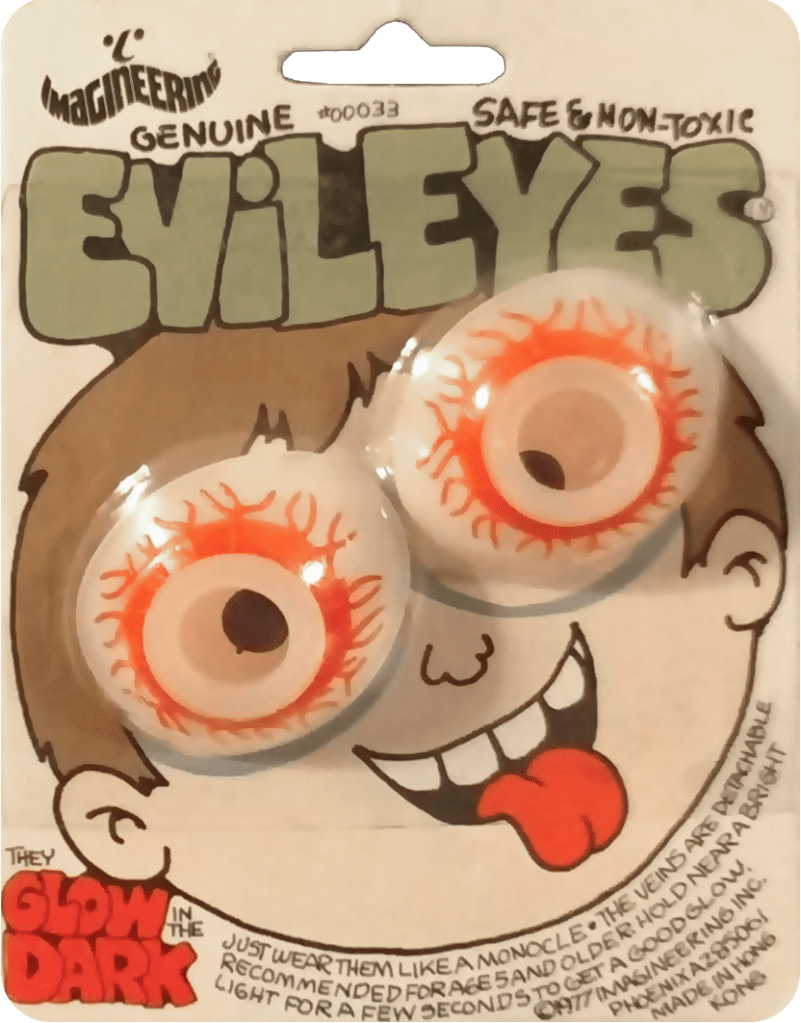
Safe & non-toxic

Back in the days when Halloween was primarily a night for kids to knock on doors to get stray change and popcorn balls; back before the holiday morphed into an excuse for young adults to dress as sexy versions of 90’s cartoons and get their slutty drink on; that is, back in the 70s, store-bought costumes were crap. They consisted of thin vacuum-formed plastic masks and silkscreened bodysuits which were made of a mystery fabric that was not quite muslin, not quite plastic, but 100% flammable. Eventually even this material was deemed too costly to produce and the suits were made entirely from vinyl, lending them all the drape of a deflated beach ball. These were the ubiquitous licensed character costumes made by Ben Cooper, inc., which, defying all reason, are highly collectable today. Nostalgia is a hell of a drug.

Ben Cooper
Ben Cooper brand costumes: bring them up the next time a Gen-Xer complains about how everything was better back when.

Of course, there were kids and parents who wished to avoid paying a whopping three bucks for commercially-produced outfits that were only marginally recognizable (owing to the fact that they had the characters’ names emblazoned on their chests). For the non-conformists, costumes of hoboes, pirates, ghosts, and mummies were good options because you could make them out of last year’s ratty clothes and sheets and felt and other bits of stuff lying around (toilet paper was often involved). But for the true weirdos, those who aspired to be something scary or gross for Halloween, there was only one game in town, and that was the Imagineering line of makeup and prosthetics. They were cheep, funky, grungy, and surprisingly effective, especially when it came to making gaping wounds and the like, and I loved them so much.

Imagineering
Imagineering products from the early-to-mid 1970s. I would dearly love to know who illustrated these. Also, note that these were vacuum sealed to their card backs—blister packs were still a few years off.

Instead of selling full costumes of specific characters, the Imagineering line consisted of theatrical building blocks you could mix and match. There were evil teeth and fake fingers. There was fake blood and tooth blackout. And there were small pallets of ingenious stage makeup, such as Scar Stuf™, a mixture of beeswax and cotton fibers that seemed like it couldn’t possibly work but which did in fact produce startlingly realistic scars, wounds, and other abrasions.

Evil Eyes

For much of my childhood I was limited to the pointy teeth and fake blood. I was not particularly flush as a kid, and while most items in the Imagineering line ran 50-75 cents, that was still a lot for me. Until one October—maybe ’78 or ’79—when I finally had some income of my own from delivering The Peoria Journal Star (afternoon edition). That year I finally splurged on a pair of Evil Eyes, the prosthetic eyes that GLOWED IN THE DARK. In light they were just a couple of ovals of plastic but in complete darkness, they were Fire from the Very Depths of Hhell. To maximize the glow effect, I would hold the plastic eyes under my reading lamp—a gooseneck 75 watt lamp clipped to the headboard of my top-level bunk bed—for about five minutes. Then I would run to the darkest place in the house (mostly under a blanket in my closet) and stare in horror at the glowing orbs until they faded into blackness. Of course, like all glow-in-the-dark toys, the magic was over far too soon, and the best effect could only be achieved by holding the eyes a long time as close as I could to the incandescent bulb, which was blisteringly hot. To save my fingertips, I took to placing the eyes on my bed and bending the lamp down as close as I could. One day I decided I would get the best glow ever by bringing the lamp down so that the hood touched my quilt and the bulb pressed against the eyes, shutting the precious lumens in entirely. Pleased with this set-up, I went off to get a snack before I would take the eyes into the dark.

Two hours later, my mother came into the living room where I was sitting reading and asked if I smelled something funny. My father also was alarmed. We walked down the hall and it became apparent that thin black smoke was coming out of my bedroom door. When we entered there was a cloudy, oily plume coming from under my lamp, which was still directly on my quilt. My father grabbed a sock to push away the lamp, which had deformed from the heat. We were greeted with a massive billow of inky miasma; and underneath, a soupy, sticky mess of plastic making tendrils from the bulb to the quilt, which now had a smoldering hole in one block. My shocked parents asked me what on Earth I had been doing and I was at a loss to explain myself. Secretly, all I could think of was if there were a way to block out the windows because holy hell, those goopy, melted eyes would’ve glowed like the sun.

Just sit right back and you’ll hear a tale

When, as a kid, I learned the word raconteur, I thought that the role wasn’t simply a matter of one being good with stories; I thought it was a career one could have, and even be paid for. I’m not sure why I came to this conclusion, or who I thought would be writing the checks, but it seemed to me like would be a good job to have.

It may have been this early misconception of what the life of the raconteur entails that has inspired me to tell and re-tell so many dumb, over-sharing stories about myself. I think I have gotten quite good at it. This is a collection of my go-to yarns I employ at parties and other events. If you’ve met me in person, you may have heard some of these anecdotes before.

These anecdotes are guaranteed1 to be 95% True. The other 5% is poetic license2.


One of my earliest memories is the time I nearly cut my own finger off. I was around the age of four or five and I was attending another kid’s birthday party. The event was happening in a large apartment in Manhattan and it was early 70’s mod in design, full of funky furniture and ficus plants. There were several dozen kids on hand, and looking back on it, this family must’ve been fairly well-to-do; they had two televisions—unheard of at the time.

We kids were pretty rambunctious, running through all the rooms and jumping on beds. In the master bedroom there was an exercise bicycle. To understand what happened you need to know that in the 70’s exercise bikes looked like half of a regular bike, jacked off the ground; they had a normal bike wheel in front, with a rubber tire and spokes. So some of the kids were hopping up on the device (which was a novelty at the time) and pedaling as furiously as their five-year-old legs could go. I was waiting my turn, but their were a lot of kids in front of me, so I stuck out my right hand and let the whirring spokes brush against my fingers, and—

When I pulled my hand back it was gushing blood. There was a tear that extended across the width of my index finger, which felt a bit wobbly like it might come off entirely. All around me kids were shrieking and running in circles. Eventually the grownups in the other room discovered what had happened and my mom wrapped my hand and swept me up in her arms. As I was taken away to the hospital, all I could think was, I’ve ruined the party. I’ll never be invited again.


scars

When I think about it, I’m amazed that I still even have hands. The bike incident was just the start of a long line of dumb injuries. I have slammed my fingers in doors; I have been bitten by dogs; I got a staph infection in my wrist when I ill-advisedly caught a frog in a stagnant puddle. Aside from the massive scar under my index finger, I have one about as large on the ball of my right thumb. Here’s its story:

The house we were living in when I was seven was a strange building whose basement had storage spaces that were cut out of the ground and left unfinished; a landscape mural that was screen-printed on the living room wall and had a scalloped wood trim glued around it by way of a frame; and a couple of built-on additions. One of these was a weird narrow hallway with stairs leading to the back yard, and it was pretty unusable as a living space. My parents stuck old newspapers in a pile back there to await recycling, and I remember that when I was bored I would sift through these to find old comics pages, and particularly look for old Jumble puzzles. These were the old skool ones drawn by Henri Arnold and Bob Lee, and they were drawn weird in a way that fascinated me. Also by the Jumble was the bridge column, and that made no sense at all, but the printed ♠♥♣♦’s were pretty neat.

One day I was looking at a Jumble and trying to figure out what GNATFREM might be rearranged to. As was my habit while in thought, I was hopping up and down (a stim I’ve grown out of) and paying no attention to my surroundings. I landed wrong, on the edge of the top stair, and I fell down backwards, trying to remain upright. Reaching the bottom, I held out my right hand to stop the fall, and it went straight through a diamond-shaped pane of glass in the door. And as my long-suffering mom gathered me up for another trip to the hospital, all I could think was, oh no, not this again.


The dot.com I worked in as a web designer back from 1999 to 2002 was never going to succeed, but not for lack of confidence. It was full of a bunch of cocky twenty-somethings burning through VC like it was an ATM and was led by a fast-talking hirsute ex-hippie who could convince you that we were all headed straight to the moon and would be retiring on our stock options any day now. It was a silly time, not just for my company, but for the entire new economy™ generation. How silly? There was a service at the time, kosmo.com, that would purchase and deliver anything you asked for without a fee. In my office there was a competition to see how badly we could abuse this by ordering, say, a single pen or a container of Tic Tacs.

At the office I would get a whole different mess of junk mail than what I got at home. For the most part this consisted of endless AOL free trial CDs, which I eventually made into an elaborate mobile with the use of dowels, string, and duct tape. (I hung this over our conference room table because it was the new economy! Japes and waggery were right there in the job description.) But my single favorite solicitation was an invitation to join yet another subscription-based classics book club. Printed across the back flap of the offer’s envelope was the motto “Because your taste in literature soars above the quotidian.” This struck me as so comically pompous that I immediately cut the flap off and pinned it to my workspace’s cork board. My coworkers also found the phrase ridiculous, and eventually “soars above the quotidian” became a catchphrase amongst us all, as in “this pizza really soars above the quotidian.”


When I was young my parents never had alcohol of any sort around the house3. Drinking felt like something forbidden and I was actively embarrassed by beer commercials on television. But my paternal grandparents always had two liqueurs squirreled away on their crowded basement shelves: crème de menthe and crème de cocoa; as their drinking years began in 1933 with the end of prohibition, their drink of choice was grasshoppers. But I had no context for this when I discovered the cache, which both scandalized and intrigued me. This was my first exposure to spirits, and I thought this candy-flavored cocktail must be the height of sophistication, still imbibed by alcoholics everywhere. Years later, when I was a young adult I tried ordering a grasshopper at a tavern; all I got was an exasperated look from the bartender.


During my undergraduate years I did work-study at the college’s science library, which was far less busy than the main library, so I got to spend time checking out the various academic science journals and their esoteric titles, of which my favorite was The Journal of Sedimentary Petrology. When eventually I took an introductory Geology class I understood the periodical’s name, and that took away some of the fun. However, my familiarity with Geologic terms did eventually come in handy.

One slow afternoon I sat at the circulation desk reading comics (this was ’87? I was probably reading Love and Rockets, let’s say I was, that makes me seem hip). All was silent, even for a library, and that’s why I had a jump-scare when I glanced up from my book and saw a smiling, balding man standing before me. He could have been there several minutes. He said nothing, but nodded and widened his grin.

“Can I help you?” I asked. “Yes, mm-hmm,” he said, and nodded and grinned more.

Since it was apparent he was not going to offer more, I inquired, “Are you… are you looking for a book?”

“Yes, a book, that’s right. I’m looking for a book on eras.”

I blinked. “Eras? um… do you mean like geologic eras?”

“Yes, geologic eras, a book on that.”

“Any, uh, era in particular?” I had just covered these in class. “Paleozoic, Mesozoic, Cenozoic?”

“Oh, Mesozoic, yes. A Mesozoic book.”

I paused, confounded. “Are you… are you looking for a book about dinosaurs?”

He nodded and smiled. “Yes, that’s it, dinosaurs. I would like a book about dinosaurs.”


When my oldest child was a toddler, my wife and I were still enrolled in graduate programs at Boston University, and our schedules necessitated child care hand-offs, often on campus. I spent many afternoons carrying our kid through the halls of the twin buildings that make up the College of Arts and Sciences. One afternoon I was walking down a hallway with my child on my shoulders. They had only recently started to talk in semi-complete sentences. So I was surprise to hear them say, “Daddy, this floor looks waxed.”

I looked at the floor, which was some sort of worn but glossy mid-century rolled linoleum. I couldn’t understand why my kid would care about the floor or how they would know what waxing was. I said, “Well, it does look pretty shiny, I guess.”

“Yes,” they said. “Shiny.” Then, after a pause, they asked, “Daddy, what am I talking about?”


I regularly donate platelets at my local Red Cross blood center, which requires being hooked up by needles and tubes to an apheresis machine for about two and a half hours, at which point you are rewarded with a seat at a table full of terrible snacks. I like giving platelets because it forces me to be still. It’s moving to think that out there in the world are people whose lives were saved by being given a literal part of you. Also I get to watch dumb shows on Netflix. Last time it was a couple of episodes of Wednesday.

Once when I was done with a donation two of the phlebotomists were clucking over me as they removed the medical tape that held the plastic tubing in place. This tape is tenacious and requires a sharp pull to detach, and they were both amused and alarmed by how much of my arm hair was being lost. This was the conversation they had:

Phleb. # 1: Oh lord, this takes so much of you with it! It’s like a waxing!

Phleb. # 2: (holding up tape covered in hair) Yes, just like a waxing ain’t it!

Phleb. # 1: (laughing) Yeah that’s just like when I get my— (long pause) …my eyebrows done.


When my son was about five he became curious about the relative power of animals, machines, and anything else. He expressed this interest by asking his parents who would win in a fight by saying, for instance, “shark against bear who wins?” His queries were always in the form of X against Y who wins? “car against truck who wins?” “dragon against giant who wins?”

Eventually his questions became very weird, like “house against lightning who wins?” or “cake against fork who wins?” and even “plane against television who wins?”

To this day I still think about pairs of things in this manner.


In 1985, my senior year in high school, I was an AFS exchange student to Israel. Most of the other kids in the program were Jewish and were using the exchange as sort of a Birthright Tour (this was before Birthright Israel was an organization), but I was a goy and I had never studied Hebrew before and I found it very difficult.

One evening in my host family’s home I was trying to use what little Hebrew I knew, and so I asked for a glass, which is pronounced in Hebrew as “cōhs,” but instead I said “coos.” My host sister’s face drained of color. My host brother said, “you mustn’t say that, it’s a very dirty word, you must say cōhs.” “Oh,” I said, and then I asked, “but you say couscous, don’t you?” And he said, “Yes, of course, but—” and then he snorted and said, “oh yes, very funny!” And from then on whenever my host mother, who was from Morocco, served couscous, my brother and sister would laugh uncontrollably.


When I first met my wife Marina, I apparently blew her off at an orientation party thrown by the college’s theater group. As she tells it, she approached me while I was standing at the snack table and said, “oh, we’ve met before, you’re on the same dorm floor as me”; to which I said, “uh-huh,” loaded up on cheese and crackers, and wandered off. I, of course, have no memory of this, although I did remember passing her on the dorm floor we shared and thinking that there was no earth on which I would have a chance with a woman like her.

Eventually we did start to date. One afternoon early on I suggested we take a walk around Earlham’s campus. I mentioned that I knew where there was a grave on the wrong side of the fence. By this I mean Earlham College borders a cemetery on its western side, and there is indeed a grave which, strangely enough, is on the wrong side of the fence, on college property.

She agreed to go on the walk. When we came across the headstone, Marina was very surprised and said “oh, I thought this was like the glass tomb.” I asked her what she meant and she said that during new student week she was told that a common pickup move was for older students to tell new students there was a glass tomb somewhere in the cemetery and then take them out looking in the middle of the night, to eventually put the moves on them. I was taken aback by this and asked if she really thought I was just using a line on her, to which she replied, “Yes, but I went along anyway.”


In our early 20s, my wife and I were living month to month in grad-school poverty. We rented a car to drive back to the midwest for the holidays, and lacking the money for a hotel, we asked to stay at the home of a distant relative on the way. This person’s relationship to us was never (and still isn’t) quite clear to me; I believe he was my step-father-in-law’s cousin. Maybe second cousin. I think he was some sort of medical doctor?

In any case, he and his wife (they didn’t have kids) were in their mid-30s. Their house was a huge McMansion and we were fed more food in one evening than we could get in a week. Our host was also extremely enthusiastic about red zinfandel wine and he poured us both many large glasses and insisted we drink more. Then he said there was one thing we must do to repay his hospitality, and for one horrifying moment I thought that he was going to request that we swing with him and his wife. But instead, he showed us to a sort of rec room which had an enormous television (by 90s standards) and there he had us watch along three VHS recordings of Gallagher concerts. And honestly? That was worse.


One winter I slipped on the cement and brick stairs outside our house. This could have been a serious accident if I had hit my head; as it was, I was bruised all up and down my torso and it was painful to draw a deep breath. So I went to a doctor to see if I might have cracked a rib.

Dr.: It could be a cracked rib or maybe not; we could get you an x-ray, it’s up to you.

Me: Up to me? Aren’t you the doctor? Isn’t this something you need for your diagnosis?

Dr.: Not really. We don’t actually do anything for a cracked rib.

Me: Then why get an x-ray?

Dr.: Then you’d know if you had a cracked rib.


At the turn of the millennium my wife and I had just had our second kid and we were all living stuffed together in a small condominium, two kids, two grownups, and one fat black cat. His name was Prospero and he was constantly sneezing up massive boogers. He always wanted to run away from home, and if the door were open even a few seconds he would dart out. Looking back on him now, I realize he was a bit of a jerk, but we couldn’t have a dog in any of the four rentals we’d had during the 90s, and so we were happy with what we could get.

The condo didn’t have much going for it, but it did have a shared pool, and my older kid wanted to have their birthday party as a swim party, so the day of the party Marina drove around getting food and decorations and such. As we returned back from our last errand, with about a half-hour to go to the party, Marina pointed and said, “It’s Prospero! He must have escaped while we were running in and out!” I looked and saw the fat black cat crouched under a bush. It was so close to the party and we still had to set up so Marina asked me to catch Prospero while she got everything ready. She went into our condominium’s building and I crouched down. It was evident that the cat was not going to cooperate; as I reached out, he swatted my hand, first with the pads of his paw, then with extended claws.

I was already tired from our activities and feeling grumpy so I snatched up the protesting feline, holding him at arms length as he squirmed. I was heading for the door when Marina came down the stairs and yelled, “John, that’s not Prospero! Prospero’s inside!”

I looked at the hissing creature to see if I were holding some other fat, pure black cat. And then it sunk its fangs deep into the web between thumb and index. It curled its body up and began raking its back claws against my hand, shredding large gashes into my palm and fingers. I was dumbfounded and it didn’t quite register that I was holding the wrong cat. “Let it go! Let it go!” Marina shouted. So I released the cat, who hung on a few seconds longer by its teeth, and then tore off across the parking lot and into a neighboring yard.

My hands were an absolute mess and I was bleeding everywhere. Marina got me some gauze. We decided that it was too late to call off the party, so she would drive me to our HMO clinic, drop me off, and hurry back to greet our guests. As I wrapped my dressing, I could see my kid looking at me with sad eyes. And all I could think was, I’ve done it again, I’ve ruined another party.


  1. This statement does not constitute an actual guarantee. ↩︎
  2. This does not imply an actual license. ↩︎
  3. Or at least they hid it well? ↩︎

header image: Lucia Mathilde von Gelder (1865-1899), Der Märchenerzähler

The Quest Begins Anew

From 1974 until 1977, when I was between six and nine years old, my dad was the minister at Youngstown, Ohio’s First Christian Church. This was a position which came with some strange perks: the church owned a literal mansion, the Myron Israel Arms home, which they called the “Disciple House,” and my family lived in this building for several months after moving to Youngstown from New York City, while we sought an affordable place of our own. Some of my memories of this time include sleeping on a tiny mattress placed in the center of a cavernous, empty room with marble floors1; the bathroom that adjoined it had been furnished sometime in the 1920s in elaborate Art Deco tiling and still had a toilet whose tank hung on the wall overhead and flushed with a pull-chain2.

Disciple House
The crazy mansion of my youth. It was all downhill from here.

The church building and the Disciple House were right next to the Butler Institute of American Art, which I visited often to see the fantastic scale models of masted ships, some tossed in realistic resin waves3. It was also surrounded by the Youngstown State University campus, whose Modernist library I wandered through freely; there was no security in those days, and I explored anywhere that wasn’t locked. As I recall the library had a floating staircase and that seemed like something straight out of The Jetsons.

YSU seniors
YSU seniors in swingin’ ’72.

One day when I was gadding feral4 about the campus, I discovered under a bush a discarded YSU yearbook, the 1972 Neon. The book was in tatters, and many of its pages had been cut to ribbons (presumably to remove personally-relevant photos), but what remained was intact, and so I flipped through it; to my kid mind, whatever this book was, it looked like it was probably full of adult stuff, and that made it enticing. There was a color section of grainy art photos of students staring into sunsets, or their post-degree futures, or whatever. There were stiff group photos of the Math Club and the Libertarian Society (which had four members).

swords and stuff
The Neon, 1972

But then, without warning, near the end of the book there was a many-paged comics section—but not a ha-ha funny comics section. It was a weird fantasy story drawn in the style of Frank Frazetta, featuring a bare-chested barbarian who walked through blasted landscapes strewn with corpses, and who confronted an antagonistic wizard. Interspersed between fantasy panels there were brief vignettes, drawn in a much more cartoonish style that recalled Vaughn Bodē5; these featured (mildly) satirical scenes student life on the YSU campus.

The Neon, 1972

At the end of the story, the wizard opens a dimensional tear and spirits the barbarian away into the present-day university, where the barbarian, not understanding what happened, or why he is surrounded by disaffected hippies, smites everyone dead with his sword. In a final two-page spread he stands alone amidst yet another field of carnage as the entire scene dissolves into the John Tenniel illustration of the hookah-smoking caterpillar from Alice in Wonderland.

Mayerik
The Neon, 1972

Of course, being six or seven, I had no context for any of this. My child-mind saw only death and destruction involving the campus I was currently inhabiting. Looking about, I saw the students wandering to class, long-haired and bell-bottomed, apparently un-smitten by barbarians. I was shaken to my core. What even was this? Why would someone draw this? I was nearly as upset as I was after sneaking a peek at an issue of National Lampoon and reading a photo comic that featured a mother shooting her kids in the head.6

So of course, I did the reasonable thing: I took the yearbook home with me and hid it in my bedroom where my parents couldn’t find.

At first I would regularly steal furtive glances at my contraband for the illicit thrill of its wrongness. But over time, I looked at it less and less, and eventually the yearbook was lost—a casualty, I suspect, of one of the many flooded basements my family suffered after moving to a ranch home with terrible drainage. By that time, I was no longer discomfited by the comic, understanding it to be a pastiche of sword and sorcery tropes; but I did wonder about how it came to be, and who the weirdo responsible was.

Okay, so to cut to the chase that I’m sure you’ve anticipated by now, a few years back I recalled this bit of childhood trauma and I searched online to see if any record of it existed. At the time, I didn’t even remember the title of the yearbook or its specific year, but after a bit of digging I found an online repository of digitized YSU stuff, and lo and behold, after scanning through several PDFs, there was the Barbarian of my youth. And after I re-read the story (and found it neither as frightening nor as confusing as I remembered, I checked the yearbook credits to see if I could find the cartoonist and there he was: Val Mayerik.

If that didn’t make you gasp, you probably weren’t reading comic books in the 1970s, so I will explain: Mayerik was a comics artist who initially made his name in fantasy titles, working alongside and sometimes with P. Craig Russell and Barry Windsor-Smith; eventually he transitioned to illustration, particularly work for TSR games and Magic: The Gathering. But it was in 1973 that he achieved his place in comics history by being the original artist to draw Steve Gerber’s creation Howard the Duck, in Fear 19. The YSU book I had discovered dated only one year before.

Howard's first appearance
Howard the Duck’s first appearance, drawn by Val Mayerik, Marvel Comics’ Fear 19 (December, 1973)

If it isn’t obvious by now, I’m someone who holds onto childhood obsessions, particularly when they’re only half-remembered. Time and again I have attempted to track down a movie, book, or comic that thrilled, horrified, or confused my young mind. These fragments of mental effluvium had their origins in a pre-Internet world, making them difficult and sometimes impossible to recover. Most of the time, when I’m successful in identifying and re-acquiring the artifacts of my memory, they turn out not to live up to expectations. But every once in a while, I am genuinely delighted by the outcome of my search—and the discovery of a young Mayerik’s contribution to my mind’s warping is one of these times.


  1. Or, you know, linoleum? I was a kid, in my mind it was marble. ↩︎
  2. The building was sold to YSU in 1983 to be used for alumni relations and its stately halls were divided into fluorescently lit cubicles. ↩︎
  3. In 2005 the Butler Institute purchased the Disciples’ church building and it is now home to folk art and Americana collections. ↩︎
  4. As all proud Gen-X kids did. ↩︎
  5. This is me editorializing after the fact. No way was I a cool enough kindergartener to know who Vaughn Bodē was. ↩︎
  6. I don’t know what issue this was and I don’t want you to tell me. ↩︎