

Mobile game ads are weird. If you spend any time on the half-dozen social media sites that now run the internet, you will have probably run into ones featuring sad cartoon heroines who have been spurned by their lovers for literally being covered in dripping mud, or horny cartoon knights in armor being harassed by giant sexy demon women. Recently I’ve been noticing a trend in puzzle games that claim “only the highest IQ players can solve this!” or comparing the player’s IQ to historic figures such as Albert Einstein, Leonardo da Vinci, or (confusingly) the Mona Lisa, who (aside from being a painting and not a person) has never been credited as a great thinker, as far as I can tell. The strangest IQ-based ads feature dynamic IQ counters that go up and down when the player makes a successful or unsuccessful move, suggesting that the game is actively making you smarter or dumber.
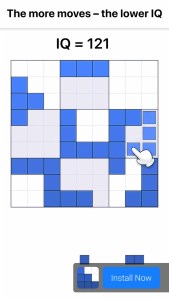
There are a couple of things going on here. First, the American distrust of having fun for its own sake. Mobile games aren’t a waste of time because they heighten your intelligence, improve your memory, make you more attractive to potential partners, etc. But the recent cultural emphasis on IQ is another thing. The current Administration is obsessed with it, from Trump’s favorite insult of “low IQ” to Vance’s statement that Trump’s IQ “either near the top or at the top” compared to that of other Presidents.
The metric of an Intelligence Quotient (a number comparing one’s intelligence to that of people in general) has been around in one form or another since around 1912, although from the very beginning IQ tests have been criticized for bias, pseudoscience, and a general lack of clarity as to what is actually measured in these tests. The scores tend to be repeatable across various well-administered tests, so they seem to correlate to something, but is that something intelligence? What even is intelligence? Is it erudition, logic, insight, or intuition? Is it the ability to take advantage of situations or the ability to produce new things?
For the most part, the emphasis of IQ tests has been on pattern recognition, things like what is the next in a sequence of numbers, which of these figures represent how the sample figure would look when rotated, how to best divide a pie between an absurd number of people. This method has two advantages: it can be administered using multiple choice so grading is easy, and it is seemingly free from cultural bias, which it really isn’t. Besides, I’m not entirely sure that a propensity for seeing patterns on its own is an indicator of intellect. Lots of people see faces in electrical outlets. When you dream, or when you are high, your mind makes a lot of surprising connections, but whether or not they are meaningful is a question for when you are awake and sober.
For much of the 20th century, IQ tests were employed by efficiency experts and managers who wanted to employ only the smartest and by educators who wanted to classify children into learning tracks. But it was also a fixation for eugenicists and race supremacists, and worst of all, Mensa. Founded in 1946 by Roland Berrill and Lancelot Ware, Mensa International was conceived of as a community of highly intelligent people, who would presumably hang together and discuss the classics. Berrill called it “an aristocracy of the intellect,” and if you think that description sounds elitist, it was: Berrill was upset that Mensa had so many working-class members, aka riff raff.
As a teen I was a big reader of Omni magazine, which was a very weird periodical that published articles about cutting-edge research in physics and cosmology alongside paranormal articles about ESP and Bigfoot, with equal alacrity. (Note to self: write a blogpost about Omni.) I remember that Mensa advertised extensively in Omni, and even as a kid I had a lot of questions. Why did these people only want to be around other people like them? What did they even do when they were together? I imagined it was probably a bunch of “elevated” party games like Botticelli.
In any case, by the 1970’s IQ was losing stock. A 1971 Supreme Court decision said that IQ tests could not be used as a condition of employment. Psychology in general was becoming less proscriptive and more open to normalizing diversity when it came to cognition. I certainly did not hear people use the term any more, but that might be because Omni folded in 1998. Contemporary theories of mind split mental competence into a plethora of systems. Which makes this sudden resurgence of IQ in pop culture uncomfortable, to me at least. At least when people were obsessed with Myers-Briggs types back in the aughts it didn’t have the odor of elitism and white supremacy.
All of which is to say these mobile games and their ads bug me. I don’t believe that finding cats or shuffling virtual tiles is going to increase your IQ (whatever it is), and especially not in real time. I’m a big believer in self-improvement but I think you should read because you like the book, not to increase your vocabulary, and play chess because you enjoy it, not to become skilled in some Sun Tzu Art of War nonsense. Maybe you’ll get smarter along the way, but really, it’s not going to get you invited to any parties. Not fun ones.

